

Potassium Permanganate–Oxidized Nanocellulose: Structural Features and Rheological Performance for Advanced Applications
DOI:
https://doi.org/10.31489/2959-0663/4-25-18Keywords:
oxidized nanocellulose, microcrystalline cellulose, permanganate oxidation, carboxyl functionalization, structural characterization, hydrogel, rheological properties, drug delivery systemsAbstract
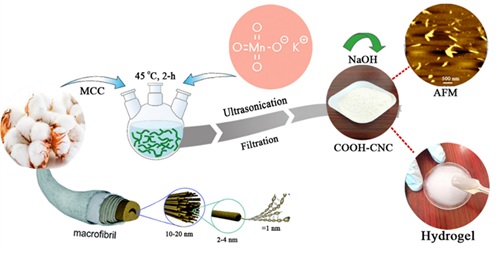
The development of environmentally friendly strategies for nanocellulose modification is crucial for advancing biomedical materials. Traditional oxidation methods often involve costly or toxic reagents, limiting large-scale use. This study addresses this by preparing oxidized nanocellulose (ONC) from microcrystalline cellulose using an eco-friendly acidic potassium permanganate (KMnO4) oxidation method to introduce surface carboxyl groups. Structural and morphological changes were characterized through FTIR, XRD, SEM, and DLS analyses, which confirmed successful oxidation, retained fibrillar morphology, and altered crystallinity and surface charge. Hydrogel formulations were developed from ONC suspensions, and their rheological properties were assessed through frequency and amplitude sweeps. FTIR spectra confirmed the introduction of carboxyl groups, while XRD revealed reduced crystallinity and lattice expansion with oxidation. DLS demonstrated narrower size distributions at intermediate oxidation times, indicating improved dispersion stability. SEM images confirmed retention of fibrous morphology with reduced fibril widths. Rheological tests showed that ONC hydrogels exhibited shear-thinning and gel-like behavior (G′ > G″), displaying the highest storage modulus and broadest linear viscoelastic region, consistent with a strong and stable gel network. ONC-based hydrogels show significant promise for biomedical applications, including mucoadhesive drug delivery, wound healing, and tissue engineering.
References
Seddiqi, H., Oliaei, E., Honarkar, H., Jin, J., Geonzon, L. C., Bacabac, R. G., & Klein-Nulend, J. (2021). Cellulose and its derivatives: towards biomedical applications. Cellulose, 28(4), 1893–1931. https://doi.org/10.1007/s10570-020-03674-w DOI: https://doi.org/10.1007/s10570-020-03674-w
Lupidi, G., Pastore, G., Marcantoni, E., & Gabrielli, S. (2023). Recent developments in chemical derivatization of microcrystalline cellulose (mcc): pre-treatments, functionalization, and applications. Molecules, 28(5), 2009. https://doi.org/10.3390/molecules28052009 DOI: https://doi.org/10.3390/molecules28052009
Shakhabutdinov, S.Sh., Yugay, S.M., Ashurov, N.Sh., Ergashev, D.J., Atakhanov, A.A., & Rashidova, S.Sh. (2024). Characterization electrospun nanofibers based on cellulose triacetate synthesized from licorice root cellulose. Eurasian Journal of Chemistry, 2(114), 21–31. https://doi.org/10.31489/2959-0663/2-24-2 DOI: https://doi.org/10.31489/2959-0663/2-24-2
Aziz, T., Farid, A., Haq, F., Kiran, M., Ullah, A., Zhang, K., Li, C., Ghazanfar, S., Sun, H., Ullah, R., Ali, A., Muzammal, M., Shah, M., Akhtar, N., Selim, S., Hagagy, N., Samy, M., & Al Jaouni, S. K. (2022). A review on the modification of cellulose and its applications. Polymers, 14(15), 3206. https://doi.org/10.3390/polym14153206 DOI: https://doi.org/10.3390/polym14153206
Goyibnazarov, I. S., Yuldoshov, S. A., Sarymsakov, A. A., Yunusov, K. E., Yarmatov, S. S., Shukurov, A. I. & Wan, Y. (2025). Obtaining dialdehyde carboxymethylcellulose through microwave treatment. Advances in Polymer Technology, 1, 9917563. https://doi.org/10.1155/adv/9917563 DOI: https://doi.org/10.1155/adv/9917563
Abraham, E., Deepa, B., Pothan, L. A., Jacob, M., Thomas, S., Cvelbar, U., & Anandjiwala, R. (2011). Extraction of nanocellulose fibrils from lignocellulosic fibres: A novel approach. Carbohydrate Polymers, 86(4), 1468–1475. https://doi.org/10.1016/j.carbpol.2011.06.034Get rights and content DOI: https://doi.org/10.1016/j.carbpol.2011.06.034
Choi, H. N., Yang, H. S., Chae, J. H., Choi, T. L., & Lee, I. H. (2020). Synthesis of conjugated rod–coil block copolymers by RuPhos Pd-catalyzed Suzuki–Miyaura catalyst-transfer polycondensation: initiation from coil-type polymers. Macromolecules, 53(13), 5497–5503. https://doi.org/10.1021/acs.macromol.0c00949 DOI: https://doi.org/10.1021/acs.macromol.0c00949
Kuzieva, M., Atakhanov, A.A., Shahobutdinav, S., Ashurov, N.S., Yunusov, K.E., & Guohua, J (2023). Preparation of oxidized nanocellulose by using potassium dichromate. Cellulose, 30:5657–5668. https://doi.org/10.1007/s10570-023-05222-8 DOI: https://doi.org/10.1007/s10570-023-05222-8
Saba, F., Mohammad, H.N., Navid, R. & Siavash, I (2023). ACS Biomaterials Science & Engineering, 9 (6), 2949–2969 https://doi.org/10.1021/acsbiomaterials.3c00300 DOI: https://doi.org/10.1021/acsbiomaterials.3c00300
Bayer, I.S. (2021). A review of sustained drug release studies from nanofiber hydrogels. Biomedicines, 9(11), 1612. https://doi.org/10.3390/biomedicines9111612 DOI: https://doi.org/10.3390/biomedicines9111612
Atakhanov, A.A., Ashurov, N.Sh., Kuzieva, M.M., Mamadiyorov, B.N., Ergashev, D.J., Rashidova, S.S. & Khutoryanskiy, V.V. (2024). Novel acryloylated and methacryloylated nanocellulose derivatives with improved mucoadhesive properties. Macromolecular Bioscience, 2400183 (1–10). https://doi.org/10.1002/mabi.202400183 DOI: https://doi.org/10.1002/mabi.202400183
Balcerak-Woźniak, A., Dzwonkowska-Zarzycka, M., & Kabatc-Borcz, J. (2024). A Comprehensive Review of Stimuli-Responsive Smart Polymer Materials — Recent Advances and Future Perspectives. Materials, 17(17), 4255. https://doi.org/10.3390/ma17174255 DOI: https://doi.org/10.3390/ma17174255
Tortorella, S., Vetri Buratti, V., Maturi, M., Sambri, L., Comes Franchini, M., & Locatelli, E. (2020). Surface-modified nanocellulose for application in biomedical engineering and nanomedicine: A review. International journal of nanomedicine, 9909–9937. https://doi.org/10.2147/IJN.S266103 DOI: https://doi.org/10.2147/IJN.S266103
Mehwish, H. M., Liu, G., Rajoka, M. S. R., Cai, H., Zhong, J., Song, X. & He, Z. (2021). Therapeutic potential of Moringa oleifera seed polysaccharide embedded silver nanoparticles in wound healing. International Journal of Biological Macromolecules, 184, 144–158. https://doi.org/10.1016/j.ijbiomac.2024.138116 DOI: https://doi.org/10.1016/j.ijbiomac.2021.05.202
Hassan, R. M., & Ibrahim, S. M. (2024). Review on synthesis of novel carbonyl derivatives of biological macromolecules by oxidation of polysaccharides with permanganate ion in alkaline media. Journal of Umm Al-Qura University for Applied Sciences, 10(2), 348–366. https://doi.org/10.1007/s43994-023-00098-7 DOI: https://doi.org/10.1007/s43994-023-00098-7
Guan, X., He, D., Ma, J., & Chen, G. (2010). Application of permanganate in the oxidation of micropollutants: a mini review. Frontiers of Environmental Science & Engineering in China, 4(4), 405–413. https://doi.org/10.1007/s11783-010-0252-8 DOI: https://doi.org/10.1007/s11783-010-0252-8
Zhou, S., Han, C., Ni, Z., Yang, C., Ni, Y., & Lv, Y. (2022). Gelatin-oxidized nanocellulose hydrogels suitable for extrusion-based 3D bioprinting. Processes, 10(11), 2216. https://www.mdpi.com/2227-9717/10/11/2216 DOI: https://doi.org/10.3390/pr10112216
Won, T., Goh, M., Lim, C., Moon, J., Lee, K., Park, J. & Gwon, K. (2025). Recent Progress in Cellulose Nanofibril Hydrogels for Biomedical Applications. Polymers, 17(17), 2272. https://doi.org/10.3390/polym17172272. DOI: https://doi.org/10.3390/polym17172272
Jaffar, S. S., Saallah, S., Misson, M., Siddiquee, S., Roslan, J., Saalah, S., & Lenggoro, W. (2022). Recent development and environmental applications of nanocellulose-based membranes. Membranes, 12(3), 287. https://doi.org/10.3390/membranes12030287 DOI: https://doi.org/10.3390/membranes12030287
Liu, S., Tian, Z. & Ji, X.X. (2024). Preparation and modification of nanocellulose using deep eutectic solvents and their applications. Cellulose, 31, 2175–2205. https://doi.org/10.1007/s10570-024-05738-7 DOI: https://doi.org/10.1007/s10570-024-05738-7
Rouhi, M., Garavand, F., Heydari, M., Mohammadi, R., Sarlak, Z., Cacciotti, I. & Parandi, E. (2024). Fabrication of novel antimicrobial nanocomposite films based on polyvinyl alcohol, bacterial cellulose nanocrystals, and boric acid for food packaging. Journal of Food Measurement and Characterization, 18(3), 2146–2161. https://doi.org/10.1007/s11694-023-02325-5 DOI: https://doi.org/10.1007/s11694-023-02325-5
Atakhanov, A. A., Kholmuminov, A. A., Mamadierov, B. N., Turdikulov, I. Kh. & Ashurov, N. Sh. (2020). Polym. Sci. Series A, 62(3), 213–217. https://doi.org/10.1134/S0965545X20030013 DOI: https://doi.org/10.1134/S0965545X20030013
Habibi, Y., Chanzy, H., & Vignon, M. R. (2006). TEMPO-mediated surface oxidation of cellulose whiskers. Cellulose, 13(6), 679–687. https://doi.org/10.1007/s10570-006-9075-y DOI: https://doi.org/10.1007/s10570-006-9075-y
Pan, R., Cheng, Y., Pei, Y., Liu, J., Tian, W., Jiang, Y. & Zheng, X. (2023). Cellulose materials with high light transmittance and high haze: a review. Cellulose, 30(8), 4813–4826. https://doi.org/10.21203/rs.3.rs-1310113/v1 DOI: https://doi.org/10.1007/s10570-023-05172-1
Yusuf, M. O. (2023). Bond characterization in cementitious material binders using Fourier-transform infrared spectroscopy. Applied Sciences, 13(5), 3353.25. https://doi.org/10.3390/app13053353 DOI: https://doi.org/10.3390/app13053353
Yang, B., Zhang, M., Lu, Z., Tan, J., Luo, J., Song, S. & Zhang, Q. (2019). Comparative study of aramid nanofiber (ANF) and cellulose nanofiber (CNF). Carbohydrate polymers, 208, 372–381. https://doi.org/10.3390/app13053353 DOI: https://doi.org/10.1016/j.carbpol.2018.12.086
Isogai, A., Saito, T., & Fukuzumi, H. (2011). TEMPO-oxidized cellulose nanofibers. Nanoscale, 3(1), 71–85. https://doi.org/10.1039/C0NR00583E DOI: https://doi.org/10.1039/C0NR00583E
Saito, T., Nishiyama, Y., Putaux, J. L., Vignon, M. & Isogai, A. (2006). Homogeneous suspensions of individualized microfibrils from TEMPO-catalyzed oxidation of native cellulose. Biomacromolecules, 7(6), 1687–1691. https://doi.org/10.1021/bm060154s DOI: https://doi.org/10.1021/bm060154s
Alexander, S. P., Mathie, A., Peters, J. A., Veale, E. L., Striessnig, J., Kelly, E. & Zhu, M. (2021). The concise guide to pharmacology 2021/22: Ion channels. British Journal of Pharmacology, 178, S157–S245. https://doi.org/10.1111/bph.15539 DOI: https://doi.org/10.1111/bph.15539
Filippov S.K., Khusnutdinov R., Murmiliuk A., Inam W., Zakharova L.Ya., Zhang H., & Khutoryanskiy V.V. (2023). Dynamic light scattering and transmission electron microscopy in drug delivery: a roadmap for correct characterization of nanoparticles and interpretation of results. Materials Horizons, 10, 5354–5370. https://doi.org/10.1039/D3MH00717K DOI: https://doi.org/10.1039/D3MH00717K
Huo, Y., Liu, Y., Xia, M., Du, H., Lin, Z., Li, B., & Liu, H. (2022). Nanocellulose-Based Composite Materials Used in Drug Delivery Systems. Polymers, 14(13), 2648. https://doi.org/10.3390/polym14132648 DOI: https://doi.org/10.3390/polym14132648
Zhang, H. (2018). Ice templating and freeze-drying for porous materials and their applications. John Wiley & Sons. https://doi.org/10.1002/9783527807390.ch10 DOI: https://doi.org/10.1002/9783527807390.ch10
Mezger, T. (2020). The rheology handbook: for users of rotational and oscillatory rheometers. European Coatings. https://doi.org/10.1515/arh-2002-0029 DOI: https://doi.org/10.1515/9783748603702
Downloads
Additional Files
Published
How to Cite
Issue
Section
License
Copyright (c) 2025 Makhliyo M. Kuzieva, Fayruza M. Urishova, Abdumutolib A. Atakhanov, Nurbek Sh. Ashurov, Sayyora Sh. Rashidova, Dmitriy I. Shiman, Sergey V. Kostjuk, Saewon Kang

This work is licensed under a Creative Commons Attribution-NonCommercial-NoDerivatives 4.0 International License.

This work is licensed under a Creative Commons Attribution-NonCommercial-NoDerivatives 4.0 International License.
Authors retain copyright and grant the journal right of first publication with the work simultaneously licensed under a Creative Commons Attribution License (CC BY-NC-ND 4.0) that allows others to share the work with an acknowledgement of the work's authorship and initial publication in this journal.
