

Design and Synthesis of Novel Molecular Switches Functionalized with a Viologen Unit Based on Copper(II) Bis(ethyl 4-chloroacetoacetate) Complex
DOI:
https://doi.org/10.31489/2959-0663/2-26-1Keywords:
molecular switches, viologen, dimerization, copper(II) complexes, 4,4′-bipyridine, ethyl 4-chloroacetoacetate , β-diketone , bidentate ligandAbstract
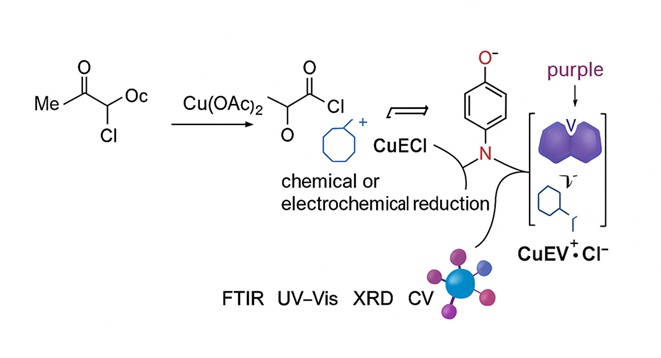
Viologen-based molecular switches have attracted significant attention due to their reversible redox properties and promising applications in electronic and sensing devices. This study focuses on the design and development of novel chemically and electrochemically responsive molecular switches constructed through non-covalent π–dimerization of viologen radicals within copper(II) β-diketone complexes in solution. Initially, the bidentate O2 donor ligand ethyl 4-chloroacetoacetate were coordinated to copper(II) to afford the base complexes CuECl, respectively. Subsequent axial coordination of CuECl with the neutral ligand 4,4′-bipyridine (bpy) led to the corresponding functionalized viologen system: CuEV+·Cl–. Moreover, SN2 nucleophilic substitution reactions of CuECl with bpy, afforded the additional complex CuEV+·Cl–. A total of eleven complexes were successfully synthesized and comprehensively characterized using FT-IR, LC-mass spectrometry, TGA, DTA, DSC, XRD, EDS, and UV–visible absorption spectroscopy, along with electrochemical and reduction studies. Finally, chemical and electrochemical reduction of the viologen unit in, CuEV+·Cl– produced intra and intermolecular π-dimers of the resulting viologen radicals. Additionally, interactions of CuECl with bpy was examined in DMF solution, and the absorption spectra of these mixtures were compared with those of the corresponding adduct complexes.
References
Lee, C.K., Gangadharappa, C., Fahrenbach, A.C., & Kim, D. J. (2024). Harnessing Radicals: Advances in Self‐Assembly and Molecular Machinery. Advanced Materials, 36(42), 2408271. https://doi.org/10.1002/adma.202408271 DOI: https://doi.org/10.1002/adma.202408271
Zhang, D.W., Tian, J., Chen, L., Zhang, L., & Li, Z.T. (2015). Dimerization of Conjugated Radical Cations: An Emerging Non‐Covalent Interaction for Self‐Assembly. Chemistry–An Asian Journal, 10(1), 56–68 https://doi.org/10.1002/asia.201402805 DOI: https://doi.org/10.1002/asia.201402805
Carrington, M.E., Sokołowski, K., Jónsson, E., Zhao, E.W., Graf, A.M., Temprano, I., & Scherman, O.A. (2023). Associative pyridinium electrolytes for air-tolerant redox flow batteries. Nature, 623(7989), 949–95. https://doi.org/10.1038/s41586-023-06664-7 DOI: https://doi.org/10.1038/s41586-023-06664-7
Liu, L., Yao, Y., Wang, Z., & Lu, Y.C. (2021). Viologen radical stabilization by molecular spectators for aqueous organic redox flow batteries. Nano Energy, 84, 105897. https://doi.org/10.1016/j.nanoen.2021.105897 DOI: https://doi.org/10.1016/j.nanoen.2021.105897
Zhou, C., Tian, J., Wang, J. L., Zhang, D. W., Zhao, X., Liu, Y., & Li, Z.T. (2014). A three-dimensional cross-linking supramolecular polymer stabilized by the cooperative dimerization of the viologen radical cation. Polymer Chemistry, 5(2), 341–345. https://doi.org/10.1039/C3PY01006F DOI: https://doi.org/10.1039/C3PY01006F
Dalvand, P., Nono, K.N., Shetty, D., Benyettou, F., Asfari, Z., Platas-Iglesias, C., & Elhabiri, M. (2021). Viologen–cucurbituril host/guest chemistry–redox control of dimerization versus inclusion. RSC advances, 11(47), 29543–29554. https://doi.org/10.1039/D1RA05488K DOI: https://doi.org/10.1039/D1RA05488K
Imabayashi, S.I., Kitamura, N., Tokuda, K., & Tazuke, S. (1987). Intramolecular Association of Viologen Dimer and Trimer Radical Cations. An Electrochemical and Spectroscopic Study. Chemistry Letters, 16(5), 915–918. https://doi.org/10.1246/cl.1987.915 DOI: https://doi.org/10.1246/cl.1987.915
Malik, M., Świtlicka, A., Bieńko, A., Komarnicka, U.K., Bieńko, D.C., Kozieł, S., ... & Machura, B. (2022). Copper (II) complexes with 2-ethylpyridine and related hydroxyl pyridine derivatives: structural, spectroscopic, magnetic and anticancer in vitro studies. RSC advances, 12(42), 27648–27665. https://doi.org/10.1039/D2RA05133H DOI: https://doi.org/10.1039/D2RA05133H
Rostas, A.M., Badea, M., Ruta, L.L., Farcasanu, I.C., Maxim, C., Chifiriuc, M. C., & Olar, R. (2020). Copper (II) complexes with mixed heterocycle ligands as promising antibacterial and antitumor species. Molecules, 25(17), 3777. https://doi.org/10.3390/molecules25173777 DOI: https://doi.org/10.3390/molecules25173777
El-Sayed, D.S., Tawfik, E.M., Elhusseiny, A.F., & El-Dissouky, A. (2023). A perception into binary and ternary copper (II) complexes: synthesis, characterization, DFT modeling, antimicrobial activity, protein binding screen, and amino acid interaction. BMC chemistry, 17(1), 55. https://doi.org/10.1186/s13065-023-00962-x DOI: https://doi.org/10.1186/s13065-023-00962-x
Sebastian, S., Sylvestre, S., Sundaraganesan, N., Karthikeyan, B., & Silvan, S. (2022). Conformational analysis, molecular structure, spectroscopic, NBO, reactivity descriptors, wavefunction and molecular docking investigations of 5,6-dimethoxy-1-indanone: A potential anti Alzheimer's agent. Heliyon, 8(1). https://doi.org/10.1016/j.heliyon.2022.e08821 DOI: https://doi.org/10.1016/j.heliyon.2022.e08821
Holtzclaw, H.F., Lintvedt, R.L., Baumgarten, H.E., Parker, R.G., Bursey, M.M., & Rogerson, P.F. (1969). Mass spectra of metal chelates. I. Substituent effects on ionization potentials and fragmentation patterns of some 1-methyl-3-alkyl-1, 3-dione-copper (II) chelates. Journal of the American Chemical Society, 91(14), 3774–3778. https://doi.org/10.1021/ja01042a014
Turgambaeva, A.E., Bykov, A.F., & Igumenov, I.K. (1995). Investigation of the thermal decomposition of bis(acetylacetonato)copper(II) vapour by a mass spectrometric method. Thermochimica acta, 256(2), 443–456. https://doi.org/10.1016/0040-6031(95)91302-Y
Jinan, A. Azouz, & Wathiq, S. Abdul-Hassan. (2025). Synthesis, characterization, and redox-responsive novel molecular switching behavior of copper(II)–Viologen adduct complexes. Applied Chemical Engineering. https://doi.org/10.59429/ace.v8i3.5751 DOI: https://doi.org/10.59429/ace.v8i3.5751
Neelakantan, P. (1964, June). Raman spectrum of ethyl chloroacetate. In Proceedings of the Indian Academy of Sciences-Section A (Vol. 59, No. 6, pp. 385–389). New Delhi: Springer India. https://doi.org/10.1007/BF03049210 DOI: https://doi.org/10.1007/BF03049210
Köse, D.A. (2007). Synthesis and characterization of bis(nicotinamide)-m-hydroxybenzoate complexes of Co (II), Ni (II), Cu (II), and Zn (II). Russian Journal of Inorganic Chemistry, 52(9), 1384–1390. https://doi.org/10.1134/S0036023607090124 DOI: https://doi.org/10.1134/S0036023607090124
Holtzclaw, H.F., Lintvedt, R.L., Baumgarten, H.E., Parker, R.G., Bursey, M.M., & Rogerson, P.F. (1969). Mass spectra of metal chelates. I. Substituent effects on ionization potentials and fragmentation patterns of some 1-methyl-3-alkyl-1, 3-dione-copper (II) chelates. Journal of the American Chemical Society, 91(14), 3774–3778. https://doi.org/10.1021/ja01042a014 DOI: https://doi.org/10.1021/ja01042a014
Turgambaeva, A.E., Bykov, A.F., & Igumenov, I.K. (1995). Investigation of the thermal decomposition of bis(acetylacetonato)copper(II) vapour by a mass spectrometric method. Thermochimica acta, 256(2), 443–456. https://doi.org/10.1016/0040-6031(95)91302-Y DOI: https://doi.org/10.1016/0040-6031(95)91302-Y
Azhar H. Gatea, Wathiq S. Abdul-Hassan. (2023). Ligand Adducts of Bis(acetylacetonato) Copper(II), Bis(3-chloroacetylacetonato) Copper(II) with 4,4'-bipyridine, and Propylene Spacered Bis-viologen. Journal of Medicinal and Chemical Sciences, 6(2), 280–303. http://doi:10.26655/JMCHEMSCI.2023.2.10 DOI: https://doi.org/10.26655/JMCHEMSCI.2023.2.10
Waseda, Y., Matsubara, E., & Shinoda, K. (2011). X-ray diffraction crystallography: introduction, examples and solved problems. Springer Science & Business Media. http://doi:10.1007/978-3-642-166355-8 DOI: https://doi.org/10.1007/978-3-642-16635-8
Prabhu, Y.T., Rao, K.V., Kumar, V.S.S., & Kumari, B.S. (2014). X-ray analysis by Williamson-Hall and size-strain plot methods of ZnO nanoparticles with fuel variation. World Journal of Nano Science and Engineering, 2014. http://dx.doi.org/10.4236/wjnse.2014.41004 DOI: https://doi.org/10.4236/wjnse.2014.41004
Lalancette, R.A., Syzdek, D., Grebowicz, J., Arslan, E., & Bernal, I. (2019). The thermal decomposition and analyses of metal tris-acetylacetonates: Free radical formation from Al, Cr, Mn, Fe and Co complexes. Journal of Thermal Analysis and Calorimetry, 135(6), 3463–3470. https://doi.org/10.1007/s10973-018-7598-8
Sheikh, J., Juneja, H., Ingle, V., Ali, P., & Hadda, T.B. (2013). Synthesis and in vitro biology of Co (II), Ni (II), Cu (II) and Zinc (II) complexes of functionalized beta-diketone bearing energy buried potential antibacterial and antiviral O,O pharmacophore sites. Journal of Saudi Chemical Society, 17(3), 269–276. https://doi.org/10.1016/j.jscs.2011.04.004 DOI: https://doi.org/10.1016/j.jscs.2011.04.004
Jassema, I.A., Abdul-Hassana, W.S., Flafela, I.A., & Jghebilb, H.O. (2023). Axial ligation for copper (II) complexes of bis(acetylacetonato)ethylenediimine and bis(3-chloroacetylacetonato)ethylenediimine. Journal of Medicinal and Pharmaceutical Chemical Research, 5, 173–203 https://doi.org/10.22034/ecc.2023.363684.1533
Lalancette, R.A., Syzdek, D., Grebowicz, J., Arslan, E., & Bernal, I. (2019). The thermal decomposition and analyses of metal tris-acetylacetonates: Free radical formation from Al, Cr, Mn, Fe and Co complexes. Journal of Thermal Analysis and Calorimetry, 135(6), 3463–3470. https://doi.org/10.1007/s10973-018-7598-8 DOI: https://doi.org/10.1007/s10973-018-7598-8
Chrissafis, K., Lalia-Kantouri, M., & Aslanidis, P. (2011). Kinetic analysis of the thermal decomposition of copper (I) complexes with heterocyclic thiones. Journal of thermal analysis and calorimetry, 104(3), 1045–1050. https://doi.org/10.1007/s10973-010-1164-3 DOI: https://doi.org/10.1007/s10973-010-1164-3
Farrukh, M. A., Butt, K.M., Chong, K.K., & Chang, W.S. (2019). Photoluminescence emission behavior on the reduced band gap of Fe doping in CeO2-SiO2 nanocomposite and photophysical properties. Journal of Saudi Chemical Society, 23(5), 561–575. https://doi.org/10.1016/j.jscs.2018.10.002 DOI: https://doi.org/10.1016/j.jscs.2018.10.002
Vigato, P.A., Peruzzo, V., & Tamburini, S. (2009). The evolution of β-diketone or β-diketophenol ligands and related complexes. Coordination Chemistry Reviews, 253(7-8), 1099–1201. https://doi.org/10.1016/j.ccr.2008.07.013 DOI: https://doi.org/10.1016/j.ccr.2008.07.013
Papatriantafyllopoulou, C., Efthymiou, C.G., Raptopoulou, C.P., Vicente, R., Manessi-Zoupa, E., Psycharis, V., ... & Perlepes, S.P. (2007). Initial use of the di-2-pyridyl ketone/sulfate “blend” in 3d-metal cluster chemistry: Preparation, X-ray structures and physical studies of zinc (II) and nickel (II) cubanes. Journal of molecular structure, 829(1–3), 176–188. https://doi.org/10.1016/j.molstruc.2006.06.022 DOI: https://doi.org/10.1016/j.molstruc.2006.06.022
Lindoy, L.F., Moody, W.E., & Taylor, D. (1977). Mass spectral and nuclear magnetic resonance (proton and carbon-13) study of metal complexes of quadridentate ligands derived from 1, 2-diaminoethane and substituted. beta-diketones; x-ray structure of N,N'-ethylenebis(5,5-dimethyl-4-oxohexan-2-iminato)nickel (II). Inorganic Chemistry, 16(8), 1962–1968. https://doi.org/10.1021/ic50174a027 DOI: https://doi.org/10.1021/ic50174a027
Martell, A.E., Belford, R.L., & Calvin, M. (1958). Influence of fluorine substitution on the properties of metal chelate compounds—II copper (II) chelates of tetradentate ligands. Journal of Inorganic and Nuclear Chemistry, 5(3), 170–181. https://doi.org/10.1016/0022-1902(58)80127-X DOI: https://doi.org/10.1016/0022-1902(58)80127-X
Raman, N., Ravichandran, S., & Thangaraja, C. (2004). Copper (II), cobalt (II), nickel (II) and zinc (II) complexes of Schiff base derived from benzil-2,4-dinitrophenylhydrazone with aniline. Journal of Chemical Sciences, 116(4), 215–219. https://doi.org/10.1007/BF02708270 DOI: https://doi.org/10.1007/BF02708270
Bünzli, J.C.G., & Piguet, C. (2005). Taking advantage of luminescent lanthanide ions. Chemical Society Reviews, 34(12), 1048–1077. https://doi.org/10.1039/B406082M DOI: https://doi.org/10.1039/b406082m
Hassan, W.M., Zayed, E.M., Elkholy, A.K., Moustafa, H., & Mohamed, G.G. (2013). Spectroscopic and density functional theory investigation of novel Schiff base complexes. Spectrochimica Acta Part A: Molecular and Biomolecular Spectroscopy, 103, 378–387. https://doi.org/10.1016/j.saa.2012.10.058 DOI: https://doi.org/10.1016/j.saa.2012.10.058
Vishwakarma, P.K., Mir, J.M., & Maurya, R.C. (2016). Pyrone-based Cu (II) complexes, their characterization, DFT based conformational drift from square planar to square pyramidal geometry and biological activities. Journal of Chemical Sciences, 128(4), 511–522. https://doi.org/10.1007/s12039-016-1048-6 DOI: https://doi.org/10.1007/s12039-016-1048-6
Faisal, A., & Maktoof, A. (2025). Analysis of Physical Properties and Evaluation of Heavy Element Concentrations in Euphrates River’s Fish in Nasiriyah City. University of Thi-Qar Journal of Science, 12(1), 233–237. https://doi.org/10.32792/utq/utjsci/v12i1.1380 DOI: https://doi.org/10.32792/utq/utjsci/v12i1.1380
Al-khafaji, N., Al-khafaji, B.Y., & Al-Omar, D.K. (2024). Assessment the Effects of Heavy Elements on Some Hematological Parameter in CKD Patients Undergoing Hemodialysis in Thi-Qar Province/Iraq. University of Thi-Qar Journal of Science, 11(2), 54-58. https://doi.org/10.32792/utq/utjsci/v11i2.1192 DOI: https://doi.org/10.32792/utq/utjsci/v11i2.1192
Ding, C.C., Wu, S.Y., Xu, Y.Q., Wu, L.N., & Zhang, LJ. (2018). DFT studies for three Cu (II) coordination polymers: geometrical and electronic structures, g factors and UV–visible spectra. Chemical Physics, 508, 20–25. https://doi.org/10.1016/j.chemphys.2018.04.016 DOI: https://doi.org/10.1016/j.chemphys.2018.04.016
Bamigboye, M., Mustapha, A., & Danjuma, F. (2024). Bioactivity Assessment of 8-Hydroxyquinoline and Monosodium Glutamate Mixed Ligand Copper Complex: Experimental and Computational. University of Thi-Qar Journal of Science, 11(2), 175–184. https://doi.org/10.32792/utq/utjsci/v11i2.1302 DOI: https://doi.org/10.32792/utq/utjsci/v11i2.1302
Wasielewski, M.R. (1992). Photoinduced electron transfer in supramolecular systems for artificial photosynthesis. Chemical reviews, 92(3), 435–461. https://doi.org/10.1021/cr00011a005 DOI: https://doi.org/10.1021/cr00011a005
Abruña, H.D., Denisevich, P., Umana, M., Meyer, T.J., & Murray, R.W. (1981). Rectifying interfaces using two-layer films of electrochemically polymerized vinylpyridine and vinylbipyridine complexes of ruthenium and iron on electrodes. Journal of the American Chemical Society, 103(1), 1–5. https://doi.org/10.1021/ja00391a001 DOI: https://doi.org/10.1021/ja00391a001
Markel, F., Ferris, N.S., Gould, I.R., & Myers, A.B. (1992). Mode-specific vibrational reorganization energies accompanying photoinduced electron transfer in the hexamethylbenzene/tetracyanoethylene charge-transfer complex. Journal of the American Chemical Society, 114(15), 6208–6219. https://doi.org/10.1021/ja00041a045 DOI: https://doi.org/10.1021/ja00041a045
Chambron, J.C., Harriman, A., Heitz, V., & Sauvage, J.P. (1993). Ultrafast photoinduced electron transfer between porphyrinic subunits within a bis (porphyrin)-stoppered rotaxane. Journal of the American Chemical Society, 115(14), 6109–6114. https://doi.org/10.1021/ja00067a028 DOI: https://doi.org/10.1021/ja00067a028
Koomson, D.A., Nicholson, J.H., Brogan, A.P., & Aldous, L. (2024). Re-assessing viologens for modern bio-electrocatalysis. Chemical Science, 15(24), 9325–9332. https://doi.org/10.1039/D4SC02431A DOI: https://doi.org/10.1039/D4SC02431A
Nucera, A., Rizzuto, C., Pipita, M. M., Barba Castagnaro, I., Termine, R., Barberi, R. C., & Castriota, M. (2024). The Effects of Polymerization on the Performance of Viologen-Based Electrochromic Devices. Gels, 10(11), 694. https://doi.org/10.3390/gels10110694 DOI: https://doi.org/10.3390/gels10110694
Monk, P.M., Turner, C., & Akhtar, S.P. (1999). Electrochemical behaviour of methyl viologen in a matrix of paper. Electrochimica acta, 44(26), 4817–4826. https://doi.org/10.1016/S0013-4686(99)00225-X DOI: https://doi.org/10.1016/S0013-4686(99)00225-X
Downloads
Additional Files
Published
How to Cite
Issue
Section
License
Copyright (c) 2026 Ahmed A. Alibrahimi, Wathiq S. Abdul-Hassan

This work is licensed under a Creative Commons Attribution-NonCommercial-NoDerivatives 4.0 International License.

This work is licensed under a Creative Commons Attribution-NonCommercial-NoDerivatives 4.0 International License.
Authors retain copyright and grant the journal right of first publication with the work simultaneously licensed under a Creative Commons Attribution License (CC BY-NC-ND 4.0) that allows others to share the work with an acknowledgement of the work's authorship and initial publication in this journal.
