

Functionalized C60 Fullerenes as Inorganic Redox Nanostructures: A Quantum Chemical Approach
DOI:
https://doi.org/10.31489/2959-0663/2-26-2Keywords:
density functional theory, computer simulation, fullerenes, electronic chemical potential, antioxidant activity, structure-property relationship, inorganic nanomaterials, C60Abstract
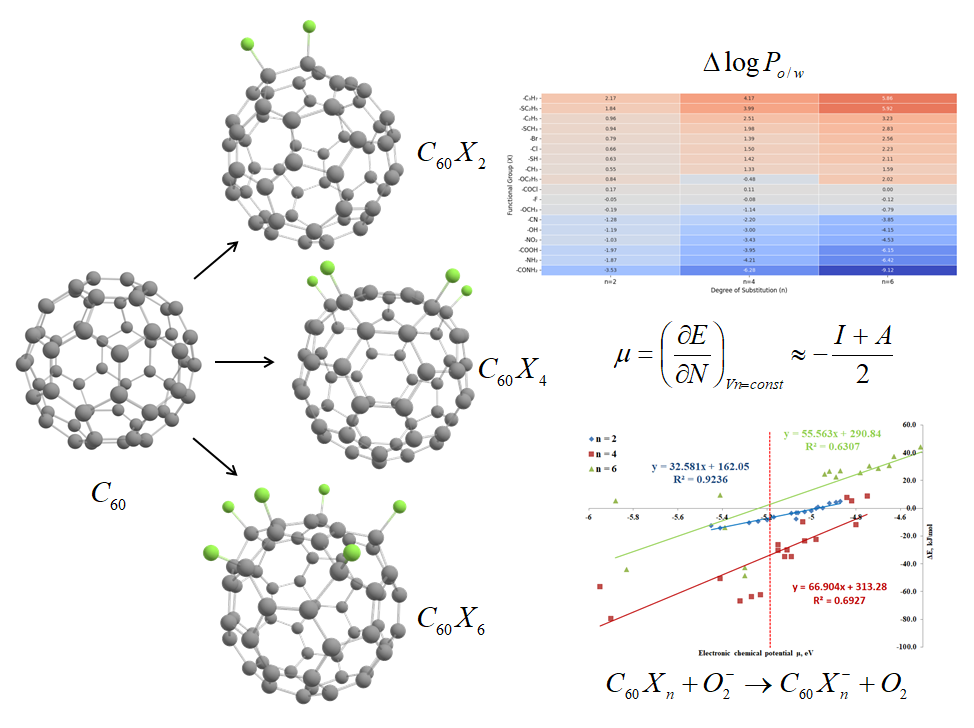
A comprehensive quantum-chemical study of functionally modified C60 fullerenes (C60Xn, n = 2, 4, 6) was performed using the hybrid PBE0 functional with dispersion correction (D4) and the SMD solvation model. Eighteen types of substituents with different electronic characteristics (X = –CH3, –C2H5, –C3H7, –F, –Cl,
–Br, –OH, –OCH3, –OC2H5, –SH, –SCH3, –SC2H5, –NH2, –NO2, –COOH, –COCl, –CONH2, –CN) were attached to the fullerene structure to explore how their nature and number influence hydrophilicity, electronic structure, and antioxidant reactivity. The lipophilicity (logP), electronic chemical potential (μ), and reaction energy (ΔE) of superoxide ion deactivation were systematically analyzed. A correlation between μ and ΔE was revealed, showing that a decrease in μ enhances electron-accepting ability and antioxidant activity, although the relationship is modulated by the degree of substitution. The optimal balance between π‑delocalization and electronic induction was found for tetra-substituted derivatives (n = 4). Electron-withdrawing groups (–NO2, –CN, –COCl, –F, –Cl, –Br) significantly increased antioxidant efficiency, while alkyl and thioalkyl groups exhibited the opposite effect. The established relationships provide a quantitative framework for understanding redox behavior in carbon-based nanostructures and open prospects for the rational design of fullerene-derived antioxidants as inorganic molecular systems with tunable electronic properties.
References
Sam, M., & Akbari, S. (2024). An overview of functionalized fullerenes and their applications in industry. Journal of NanoSci-ence Technology, 13, 1–11.
Bhakta, P., & Barthunia, B. (2020). Fullerene and its applications: A review. Journal of Indian academy of oral medicine and radiology, 32(2), 159–163. https://doi.org/10.4103/jiaomr.jiaomr_191_19 DOI: https://doi.org/10.4103/jiaomr.jiaomr_191_19
Jafvert, C.T., & Kulkarni, P.P. (2008). Buckminsterfullerene’s (C60) Octanol−Water Partition Coefficient (Kow) and Aqueous Solubility. Environ. Sci. Technol., 42, 5945–5950. https://doi.org/10.1021/es702809a.
Kop, T.J., Bjelaković, M.S., Živković, L., Žekić, A., & Milić, D.R. (2022). Stable colloidal dispersions of fullerene C60, curcu-min and C60-curcumin in water as potential antioxidants. Colloids and Surfaces A: Physicochemical and Engineering Aspects, 648, 129379. https://doi.org/10.1016/j.colsurfa.2022.129379 DOI: https://doi.org/10.1016/j.colsurfa.2022.129379
Zhen Hu, Wenchao Guan, Wei Wang, Lizhen Huang, Xiangying Tang, Hong Xu, Zhou Zhu, Xingzi Xie & Haiping Xing. (2008). Synthesis of amphiphilic amino acid C60 derivatives and their protective effect on hydrogen peroxide-induced apopto-sis in rat pheochromocytoma cells. Carbon, 46 (1), 99–109. https://doi.org/10.1016/j.carbon.2007.10.041 DOI: https://doi.org/10.1016/j.carbon.2007.10.041
Volkov, V.A., Yamskova, O.V., Shepel’, N.E., Romanova, V.S., Kurilov, D.V., Tregubov, A.V., ... & Kustov, L.M. (2019). An-tioxidant Properties of Amino Acid Derivatives of Fullerene C60. Russian Journal of Physical Chemistry A, 93(11), 2152–2157. https://doi.org/10.1134/S0036024419110335. DOI: https://doi.org/10.1134/S0036024419110335
Kulkarni, S., Chaudhari, S.B., Chikkamath, S.S., Kurale, R.S., Thopate, T.S., Praveenkumar, S., Ghotekar, S., Patil, P. & Kumar, D. (2025). Potential applications of fullerenes in drug delivery and medical advances. Inorganic Chemistry Communications, 173, 113829. https://doi.org/10.1016/j.inoche.2024.113829 DOI: https://doi.org/10.1016/j.inoche.2024.113829
Bogdanova, Yu.G., Tepanov, A.A., Ioutsi, V.A., Romanova, V.S., Bogdanov, G.N., Kotel’nikova, R.A., Mishchenko, D.V., Rybkin, A.Yu., & Kotel’nikov, A.I. (2012). Effect of lipophilicity of C60 fullerene derivatives on their ability to inhibit perox-ide oxidation of lipids in aqueous medium. Moscow University Chemistry Bulletin, 67(4), 154–158. https://doi.org/10.3103/s0027131412040025 DOI: https://doi.org/10.3103/S0027131412040025
Semenov, K.N., Charykov, N.A., & Keskinov, V.N. (2011). Fullerenol synthesis and identification. Properties of the fullerenol water solutions. Journal of Chemical & Engineering Data, 56(2), 230–239. https://doi.org/10.1021/je100755v DOI: https://doi.org/10.1021/je100755v
Sabirov, D.S., Garipova, R.R., & Bulgakov, R.G. (2013). Density functional theory study on the decay of fullerenyl radicals RC60•, ROC60•, and ROOC60• (R= tert-butyl and cumyl) and polarizability of the formed fullerene dimers. The Journal of Physi-cal Chemistry A, 117(49), 13176–13183. https://doi.org/10.1021/jp409845q DOI: https://doi.org/10.1021/jp409845q
Sabirov, D.S., Khursan, S.L., & Bulgakov, R.G. (2008). Ozone addition to C60 and C70 fullerenes: A DFT study. Journal of Molecular Graphics and Modelling, 27(2), 124–130. https://doi.org/10.1016/j.jmgm.2008.03.006 DOI: https://doi.org/10.1016/j.jmgm.2008.03.006
Zheng, G., Irle, S., & Morokuma, K. (2005). Performance of the DFTB method in comparison to DFT and semiempirical meth-ods for geometries and energies of C20–C86 fullerene isomers. Chemical Physics Letters, 412(1–3), 210–216. https://doi.org/10.1016/j.cplett.2005.06.105 DOI: https://doi.org/10.1016/j.cplett.2005.06.105
Shao, N., Gao, Y., & Zeng, X. C. (2007). Search for lowest-energy fullerenes 2: C38 to C80 and C112 to C120. The Journal of Physical Chemistry C, 111(48), 17671–17677. https://doi.org/10.1021/jp0701082 DOI: https://doi.org/10.1021/jp0701082
Charykov, N.A., Keskinov, V.A., & Petrov, A.V. (2021). Addukty legkikh fullerenov i aminokislot: sintez, identifikatsiya i kvantovo-mekhanicheskoye modelirovaniye ikh fiziko-khimicheskikh svoystv [Adducts of light fullerenes and amino acids: synthesis, identification, and quantum mechanical modeling of their physicochemical properties]. Zhurnal fizicheskoy khimii — Journal of Physical Chemistry, 95(12), 1787–1803. https://doi.org/10.31857/S0044453721120049 [in Russian] DOI: https://doi.org/10.1134/S0036024421120049
A de Leon, A, Jalbout, A.F. & Basiuk, V.A. (2008). Fullerene–amino acid interactions. A theoretical study. Chemical Physics Letters, 452 (4–6), 306–314. https://doi.org/10.1016/j.cplett.2007.12.065 DOI: https://doi.org/10.1016/j.cplett.2007.12.065
Clare, B. W., & Kepert, D. L. (2003). Early stages in the addition to C60 to form C60Xn, X = H, F, Cl, Br, CH3, C4H9. Journal of Molecular Structure: THEOCHEM, 621(3), 211–231. https://doi.org/10.1016/S0166-1280(02)00551-1 DOI: https://doi.org/10.1016/S0166-1280(02)00551-1
Neese, F. (2022). Software update: The ORCA program system—Version 5.0. Wiley Interdisciplinary Reviews: Computational Molecular Science, 12(5), e1606. https://doi.org/10.1002/wcms.1606 DOI: https://doi.org/10.1002/wcms.1606
Adamo, C., & Barone, V. (1999). Toward reliable density functional methods without adjustable parameters: The PBE0 model. The Journal of Chemical Physics, 110(13), 6158–6170. https://doi.org/10.1063/1.478522 DOI: https://doi.org/10.1063/1.478522
Caldeweyher, E., Ehlert, S., Hansen, A., Neugebauer, H., Spicher, S., Bannwarth, C., & Grimme, S. (2019). A generally appli-cable atomic-charge dependent London dispersion correction. The Journal of chemical physics, 150(15). https://doi.org/10.1063/1.5090222 DOI: https://doi.org/10.1063/1.5090222
Weigend, F., & Ahlrichs, R. (2005). Balanced basis sets of split valence, triple zeta valence and quadruple zeta valence quality for H to Rn: Design and assessment of accuracy. Physical Chemistry Chemical Physics, 7(18), 3297–3305. https://doi.org/10.1039/B508541A DOI: https://doi.org/10.1039/b508541a
Rappoport, D., & Furche, F. (2010). Property-optimized Gaussian basis sets for molecular response calculations. The Journal of chemical physics, 133(13). https://doi.org/10.1063/1.3484283 DOI: https://doi.org/10.1063/1.3484283
Ryabykh, A.V., Maslova, O.A., & Beznosyuk, S.A. (2023). Mechanisms of Docking of Superoxide Ions in the Catalytic Cycle of Manganese and Iron Superoxide Dismutases. Eurasian Journal of Chemistry, 111(3), 104–113. https://doi.org/10.31489/2959-0663/3-23-4 DOI: https://doi.org/10.31489/2959-0663/3-23-4
Marenich, A.V., Cramer, C.J., & Truhlar, D.G. (2009). Universal solvation model based on solute electron density and on a con-tinuum model of the solvent defined by the bulk dielectric constant and atomic surface tensions. The Journal of Physical Chem-istry B, 113(18), 6378–6396. https://doi.org/https://doi.org/10.1021/jp810292n DOI: https://doi.org/10.1021/jp810292n
Jafvert, C.T., & Kulkarni, P.P. (2008). Buckminsterfullerene’s (C60) octanol-water partition coefficient (Kow) and aqueous solu-bility. Environmental science & technology, 42(16), 5945–5950. https://doi.org/10.1021/es702809a DOI: https://doi.org/10.1021/es702809a
Kongsted, J., Söderhjelm, P., & Ryde, U. (2009). How accurate are continuum solvation models for drug-like molecules? Jour-nal of Computer-Aided Molecular Design, 23(7), 395–409. https://doi.org/10.1007/s10822-009-9271-6 DOI: https://doi.org/10.1007/s10822-009-9271-6
Chakraborty, D., & Chattaraj, P.K. (2021). Conceptual density functional theory based electronic structure principles. Chemical Science, 12(18), 6264–6279. https://doi.org/10.1039/D0SC07017C DOI: https://doi.org/10.1039/D0SC07017C
Downloads
Additional Files
Published
How to Cite
Issue
Section
License
Copyright (c) 2026 Andrey V. Ryabykh, Olga A. Maslova, Sergey A. Beznosyuk, Roman I. Kravchuk, Artem S. Polyntsev, Dmitriy S. Spodarev, Svetlana V. Spodareva

This work is licensed under a Creative Commons Attribution-NonCommercial-NoDerivatives 4.0 International License.

This work is licensed under a Creative Commons Attribution-NonCommercial-NoDerivatives 4.0 International License.
Authors retain copyright and grant the journal right of first publication with the work simultaneously licensed under a Creative Commons Attribution License (CC BY-NC-ND 4.0) that allows others to share the work with an acknowledgement of the work's authorship and initial publication in this journal.
