

Biopolymer-Based Pectin/PVP/CNC Nanocomposites as Sustainable Matrices for Solid Polymer Electrolyte Systems
DOI:
https://doi.org/10.31489/2959-0663/2-26-4Keywords:
biopolymers, nanocomposite, pectin, poly(vinyl pyrrolidone), cellulose nanocrystals, solid polymer electrolyte, polyblend, sustainable polymer matricesAbstract
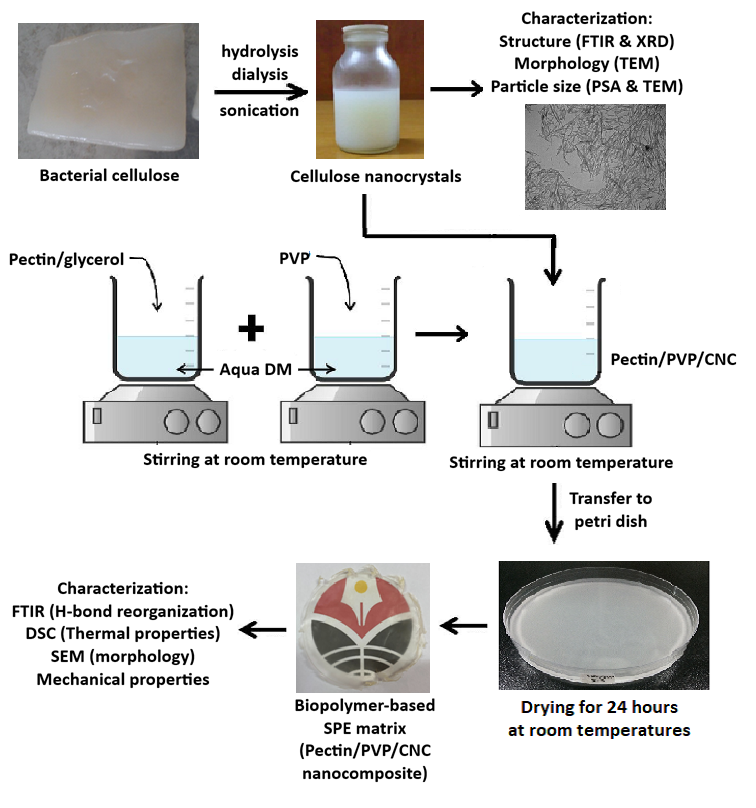
Biopolymer-based solid polymer electrolytes (SPEs) are attractive as sustainable alternatives to petroleum-derived systems; however, balancing mechanical integrity and chain mobility remains challenging. In this study, cellulose nanocrystals (CNCs) were incorporated into an optimized pectin/poly(vinyl pyrrolidone) (PVP) polyblend to elucidate their role as functional nanofillers in biopolymer-based SPE matrix design. CNCs were introduced into the pectin/PVP (7:1, w/w) matrix at loadings of 2, 4, and 6 wt% via solution casting. FTIR and SEM analyses confirm good compatibility and homogeneous dispersion of CNCs through hydrogen-bond-mediated interactions. Mechanical testing shows that CNC incorporation does not act as conventional reinforcement; instead, low to intermediate CNC contents reduce stiffness and strength while enhancing ductility, indicating increased segmental mobility. DSC analysis reveals CNC-induced modulation of Tg-related enthalpy relaxation without inducing crystallinity. SEM observations further confirm a continuous polymer matrix with CNC-induced interfacial heterogeneity and no macroscopic phase separation. These findings demonstrate that CNCs function as mobility-regulating nanofillers, enabling controlled tuning of thermal–mechanical behavior, and highlight pectin/PVP/CNC nanocomposites as promising sustainable matrices for future solid polymer electrolyte systems.
References
Ma, C., Cui, W., Liu, X., Ding, Y., & Wang, Y. (2022). In situ preparation of gel polymer electrolyte for lithium batteries: Progress and perspectives. InfoMat, 4(2), e12232. https://doi.org/10.1002/inf2.12232 DOI: https://doi.org/10.1002/inf2.12232
Song, Y., Su, M., Xiang, H., Kang, J., Yu, W., Peng, Z., Wang H., Cheng B., Deng, N., & Kang, W. (2025). PEO-based solid-state polymer electrolytes for wide-temperature solid-state lithium metal batteries. Nano-Micro Small, 21(3), 2408045. https://doi.org/10.1002/smll.202408045 DOI: https://doi.org/10.1002/smll.202408045
Khan, K.H., Haleem, A., Arwish, S., Shah, A., & Hussain, H. (2025) PVDF-based solid polymer electrolytes for lithium-ion batteries: strategies in composites, blends, dielectric engineering, and machine learning approaches. RSC Advanced, 15, 20629-20656. https://doi.org/10.1039/d5ra02951a DOI: https://doi.org/10.1039/D5RA02951A
Chen, T., Zhao, F., Wang, L., Ma, S., Shi, G., Liu, Q., Liu, Y., & Han, G. (2025). High-performance PMMA based solvent-free solid transparent polymer electrolyte modified by succinonitrile for electrochromic devices. Solar Energy Materials and Solar Cells, 285, 113538. https://doi.org/10.1016/j.solmat.2025.113538 DOI: https://doi.org/10.1016/j.solmat.2025.113538
Dennis, J.O., Shukur, M.F., Aldaghri, O.A., Ibnaouf, K.H., Adam, A.A., Usman, F., Hassan, Y.M., Alsadig, A., Danbature, W.L., & Abdulkadir, B.A. (2023). A Review of current trends on poly(vinyl alcohol) (PVA)-based solid polymer electrolytes. Molecules, 28(4), 1781. https://doi.org/10.3390/molecules28041781 DOI: https://doi.org/10.3390/molecules28041781
Kumar, L.S., Selvin, P.C., & Selvasekarapandian, S. (2021). Impact of lithium triflate (LiCF3SO3) salt on tamarind seed polysaccharide-based natural solid polymer electrolyte for application in electrochemical device. Polymer Bulletin, 78, 1797–1819. https://doi.org/10.1007/s00289-020-03185-5 DOI: https://doi.org/10.1007/s00289-020-03185-5
Rani, M.S., Rudhziah, S., Ahmad, A., & Mohamed, N.S. (2014). Biopolymer electrolyte based on derivatives of cellulose from kenaf bast fiber. Polymers 6(9), 23712385. https://doi.org/10.3390/polym6092371 DOI: https://doi.org/10.3390/polym6092371
Adlin, H.P., Ajith, K., Infanta, D.M., Lakshmi, D., & Christopher, S.P. (2022). Chitosan-based biopolymer electrolyte reinforced with V2O5 filler for magnesium batteries: an inclusive investigation. Journal of Materials Science: Materials in Electronics 33(7), 3925–3937. https://doi.org/10.1007/s10854-021-07587-7 DOI: https://doi.org/10.1007/s10854-021-07587-7
Nešić, A., Ružić, J., Gordić, M., Ostojić, S., Micić, D., & Onjia, A. (2017). Pectin-polyvinylpyrrolidone films: A sustainable approach to the development of biobased packaging materials. Composites Part B: Engineering 110, 56-61. https://doi.org/10.1016/j.compositesb.2016.11.016 DOI: https://doi.org/10.1016/j.compositesb.2016.11.016
Ilyas, R.A., Sapuan, S.M., Sanyang, M.L., Ishak, M.R., & Zainudin, E.S. (2018). Nanocrystalline cellulose as reinforcement for polymeric matrix nanocomposites and its potential applications: A review. Current Analytical Chemistry, 14(3), 203–225. https://doi.org/10.2174/1573411013666171003155624 DOI: https://doi.org/10.2174/1573411013666171003155624
Xu, X., Liu, F., Jiang, L., Zhu, J.Y., Haagenson, D., & Wiesenborn, D.P. (2013). Cellulose nanocrystals vs. cellulose nanofibrils: A comparative study on their microstructures and effects as polymer reinforcing agents. ACS Applied Materials & Interfaces, 5(8), 2999–3009. https://doi.org/10.1021/am302624t DOI: https://doi.org/10.1021/am302624t
Anwar, B., Bundjali, B., Arcana, I.M. (2015). Isolation of cellulose nanocrystals from bacterial cellulose produced from pineapple peel waste juice as culture medium. Procedia Chemistry, 16, 279–284. https://doi.org/10.1016/j.proche.2015.12.051 DOI: https://doi.org/10.1016/j.proche.2015.12.051
Anwar, B., Bundjali, B., Sunarya, Y., Arcana, I.M. (2021). Properties of bacterial cellulose and its nanocrystalline obtained from pineapple peel waste juice. Fibers and Polymers, 22, 1228–1236. https://doi.org/10.1007/s12221-021-0765-8 DOI: https://doi.org/10.1007/s12221-021-0765-8
Segal, L., Creely, J.J., Martin, Jr. A.E., & Conrad, C.M. (1959). An empirical method for estimating the degree of crystallinity of native cellulose using the X-ray diffractometer. Textile Research Journal, 29, 786–794. https://doi.org/10.1177/004051755902901003 DOI: https://doi.org/10.1177/004051755902901003
Nelson, M.L. & O'Connor, R.T. (1964). Relation of certain infrared bands to cellulose crystallinity and crystal lattice type. Part II. A new infrared ratio for estimation of crystallinity in celluloses I and II. Journal of Applied Polymer Science, 8(3), 1325–1341. https://doi.org/10.1002/app.1964.070080323 DOI: https://doi.org/10.1002/app.1964.070080323
Thakur, M., Sharma, A., Ahlawat, V., Bhattacharya, M., & Goswami, S. (2020). Process optimization for the production of cellulose nanocrystals from rice straw derived α-cellulose. Materials Science for Energy Technologies, 3, 328–34. https://doi.org/10.1016/j.mset.2019.12.005 DOI: https://doi.org/10.1016/j.mset.2019.12.005
Newman, R.H. (1999). Estimation of the lateral dimensions of cellulose crystallites using 13C NMR signal strengths. Solid State Nuclear Magnetic Resonance, 15(1), 21–29. https://doi.org/10.1016/S0926-2040(99)00043-0 DOI: https://doi.org/10.1016/S0926-2040(99)00043-0
French, A.D. & Cintron, M.S. (2013). Cellulose polymorphy, crystallite size, and the Segal Crystallinity Index. Cellulose, 20, 583–588. https://doi.org/10.1007/s10570-012-9833-y DOI: https://doi.org/10.1007/s10570-012-9833-y
Lewandowska, K. & Szulc, M. (2021). Characterisation of hyaluronic acid blends modified by poly(N-vinylpyrrolidone). Molecules, 26(17), 5233 https://doi.org/10.3390/molecules26175233 DOI: https://doi.org/10.3390/molecules26175233
Hazrati, K.Z., Sapuan, S.M., Zuhri, M.Y.M., & Jumaidin, R. (2021). Effect of plasticizers on physical, thermal, and tensile properties of thermoplastic films based on Dioscorea hispida starch. International Journal of Biological Macromolecules, 185, 219–228. https://doi.org/10.1016/j.ijbiomac.2021.06.099 DOI: https://doi.org/10.1016/j.ijbiomac.2021.06.099
Sanyang, M.L., Sapuan, S.M., Jawaid, M., Ishak, M.R., & Sahari, J. (2015). Effect of plasticizer type and concentration on tensile, thermal and barrier properties of biodegradable films based on sugar palm (Arenga pinnata) starch. Polymers, 7(6), 1106–1124; https://doi.org/10.3390/polym7061106 DOI: https://doi.org/10.3390/polym7061106
Garavito, J., Castellanos-González, S., Peña-Venegas, C.P., & Castellanos, D.A. (2026). Development and characterization of reinforced flexible packaging based on amazonian cassava starch through flat sheet extrusion. Polymer, 18(6), 675, 1–24. https://doi.org/10.3390/polym18060675 DOI: https://doi.org/10.3390/polym18060675
Shi, S., Wang, Y., Zhang, Y. et al. (2023). Plasticizer role of cellulose nanocrystals in the biodegradable polymer blend with ductile polymer as continuous phase. Cellulose, 30, 10139–10156. https://doi.org/10.1007/s10570-023-05501-4 DOI: https://doi.org/10.1007/s10570-023-05501-4
Ding, C., Zhang, M., & Li, G. (2015). Preparation and characterization of collagen/hydroxypropyl methylcellulose (HPMC) blend film. Carbohydrate Polymers, 119, 194. http://dx.doi.org/10.1016/j.carbpol.2014.11.057 DOI: https://doi.org/10.1016/j.carbpol.2014.11.057
Voronova, M., Rubleva, N., Kochkina, N., Afineevskii, A., Zakharov, A., & Surov, O. (2018). Preparation and characterization of polyvinylpyrrolidone/cellulose nanocrystals composites. Nanomaterials, 8(12), 1011. https://doi.org/10.3390/nano8121011 DOI: https://doi.org/10.3390/nano8121011
Yu, Y., Tyrikos-Ergas, T., Zhu, Y., et al. (2019). Systematic hydrogen-bond manipulations to establish polysaccharide structure–property correlations. Angewandte Chemie, 58(37), 13127–13132. https://doi.org/10.1002/anie.201906577 DOI: https://doi.org/10.1002/anie.201906577
Kawai, K., Sogabe, T., Nakagawa, H., Yamada, T., & Koseki, S. (2024). Effect of water activity on the mechanical glass transition and dynamical transition of bacteria-solute systems. Journal of Food Engineering 375, 112066. https://doi.org/10.1016/j.jfoodeng.2024.112066 DOI: https://doi.org/10.1016/j.jfoodeng.2024.112066
Anwar, B., Nurhashiva, C., Arwa, R., Yuliani, G. (2023). Physicochemical properties of bioplastic based on hydroxyethylcellulose and polyvinylpyrrolidone blend. Journal of the Serbian Chemical Society, 89, 215–30. https://doi.org/10.2298/jsc231023103a DOI: https://doi.org/10.2298/JSC231023103A
Sydykov, B., Oldenhof, H., Sieme, H., & Wolkers, W.F. (2017). Hydrogen bonding interactions and enthalpy relaxation in sugar/protein glasses. Journal of Pharmaceutical Sciences, 106(3), 761–769. https://doi.org/10.1016/j.xphs.2016.11.003 DOI: https://doi.org/10.1016/j.xphs.2016.11.003
Downloads
Published
How to Cite
Issue
Section
License
Copyright (c) 2026 Budiman Anwar, Lidya I. Febriani, Fitri Dara, Galuh Yuliani

This work is licensed under a Creative Commons Attribution-NonCommercial-NoDerivatives 4.0 International License.

This work is licensed under a Creative Commons Attribution-NonCommercial-NoDerivatives 4.0 International License.
Authors retain copyright and grant the journal right of first publication with the work simultaneously licensed under a Creative Commons Attribution License (CC BY-NC-ND 4.0) that allows others to share the work with an acknowledgement of the work's authorship and initial publication in this journal.
