

Microwave Aquathermolysis of Oil Shales: Enhancement of Light Hydrocarbon Yield and Modification of Gaseous Product Composition
DOI:
https://doi.org/10.31489/2959-0663/2-26-5Keywords:
oil shale, microwave aquathermolysis, heat–mass transfer, enhanced light fraction yield, energy–efficient processing, microwave irradiation, kerogen conversion, steam activation, gaseous product modificationAbstract
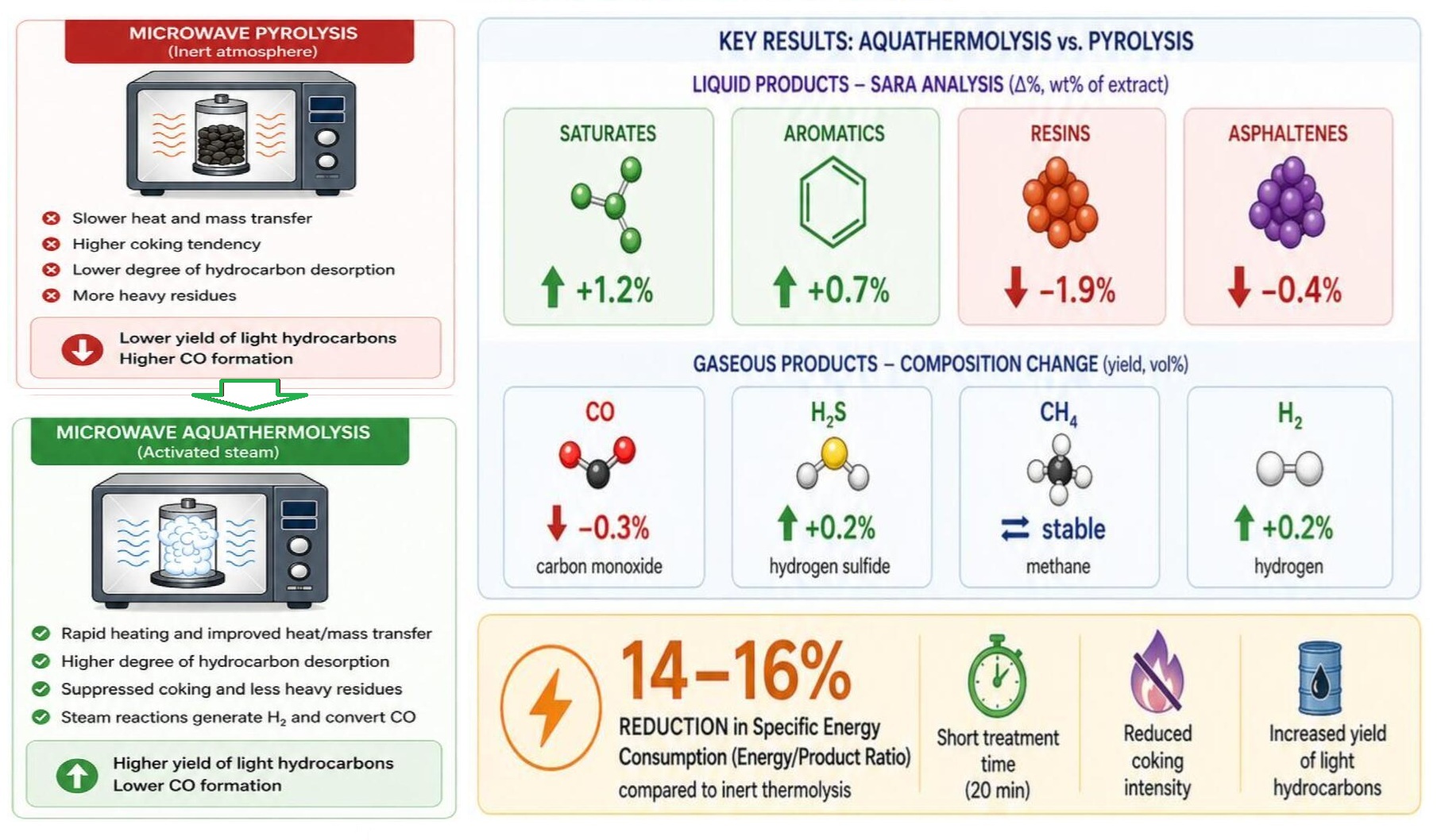
The growing global demand for energy and the depletion of conventional light hydrocarbon resources necessitate the development of alternative and hard-to-recover feedstocks, among which oil shales represent a strategically important resource due to their vast reserves. In this study, the efficiency of conventional microwave thermolysis in an inert atmosphere is compared with an innovative microwave aquathermolysis approach employing activated steam for oil shale samples from three Azerbaijani deposits (Diyally, Guba, and Jangichay). The experiments were conducted under microwave irradiation (2.45 GHz, 600–800 W) at 300–400 °C with a treatment duration of 20 minutes, ensuring rapid and uniform heating. Microwave aquathermolysis was shown to enhance heat and mass transfer, promoting deeper degassing and partial kerogen conversion. Steam activation led to an increased yield of light hydrocarbons, a marked reduction of heavy resins and asphaltenes, and significant changes in gaseous product composition. Gas chromatographic and SARA analyses confirmed accelerated thermochemical reactions, suppression of secondary coking, steam-assisted conversion of carbon oxides, and partial hydrogenation of unsaturated compounds. Overall, the results indicate that microwave aquathermolysis is more efficient and energy-saving than conventional microwave thermolysis, demonstrating strong potential for processing Azerbaijani oil shales and other kerogen-rich unconventional resources.
References
Abbasov, O.R., Aliyev, A.A., & Baloglanov, E.E. (2024, April 14–19). A comparative mineralogical and geochemical studies of Eocene and Maikop oil shales in Eastern Azerbaijan: Stratigraphic controls on formation of oil and gas hydrocarbons in the South Caspian basin [Conference presentation abstract]. EGU General Assembly 2024, Vienna, Austria. https://doi.org/10.5194/egusphere-egu24-925 DOI: https://doi.org/10.5194/egusphere-egu24-925
Abbasov, O.R. (2022). Eocene–Miocene oil shales in Azerbaijan: Stratigraphic controls on formation, distribution and hydrocarbon generation. Stratigraphy and Sedimentology of Oil-Gas Basins, 1, 39–55. https://doi.org/10.35714/ggistrat20220100004 DOI: https://doi.org/10.35714/ggistrat20220100004
Nurlybayeva, A., Yermekova, A., Taubayeva, R., Sarova, N., Sapiyeva, A., Mateeva, S., Matniyazova, G., Bulekbayeva, K., Jetpisbayeva, G., & Tamabekova, M. (2025). Modern methods of obtaining synthetic oil from unconventional hydrocarbon raw materials: Technologies, catalysts, and development prospects. Polymers, 17(6), Article 776. https://doi.org/10.3390/polym17060776 DOI: https://doi.org/10.3390/polym17060776
Jafarova, R.A., Yolchuyeva, U.J., Abbasov, O.R., Aliyeva, A.F., Baloglanov, E.E., Mehdiyeva, N.A., & Gasimova, F.I. (2025). Phototransformation processes of oil sands bitumen under the influence of ultraviolet radiation. Coke and Chemistry, 68, 45–51. https://doi.org/10.3103/S1068364X25600022 DOI: https://doi.org/10.3103/S1068364X25600022
Dutta, S. (2023). Sustainable synthesis of drop-in chemicals from biomass via chemical catalysis: Scopes, challenges, and the way forward. Energy & Fuels, 37(4), 2648–2666. https://doi.org/10.1021/acs.energyfuels.2c03891 DOI: https://doi.org/10.1021/acs.energyfuels.2c03891
Prischepa, O.M., Xu, R., Martynov, A., Ibatullin, A., Krykova, T., & Sinitsa, N. (2024). Potential of high-carbon Domanik (Upper Devonian) shale deposits: Timan–Pechora oil and gas province assessment. International Journal of Engineering, 37(8), 1639–1657. https://doi.org/10.5829/ije.2024.37.08b.16 DOI: https://doi.org/10.5829/IJE.2024.37.08B.16
Prischepa, O.M., & Xu, R. (2025). Criteria for oil and gas bearing potential of Jurassic continental sediments of the central part of the Junggarian sedimentary basin. International Journal of Engineering, 38(1), 223–235. https://doi.org/10.5829/ije.2025.38.01a.20 DOI: https://doi.org/10.5829/ije.2025.38.01a.20
Nefedov, Y.V., Gao, H., Gribanov, M.A., Vostrikov, N.N., Yashmolkin, A.M., Yandulov, P.V., Loginov, A.V., Gribanov, D.A., & Karimov, V.M. (2024). Analysis of oil and gas controlling factors of Lower Silurian and Upper Ordovician sediments of the Wufeng–Longmaxi Formation in the Sichuan Basin. International Journal of Engineering, 37(10), 2066–2079. https://doi.org/10.5829/ije.2024.37.10a.17 DOI: https://doi.org/10.5829/IJE.2024.37.10A.17
Khuduzade, A.I., Abbasov, O.R., Guliyev, I.S., Yolchuyeva, U.J., Baloglanov, E.E., Jafarova, R.A., Akhundov, R.R., Aliyeva, N.M. & Bashirov, O.K. (2026). Geochemical-paleontological study of Mesozoic source rocks, Eurasian‒Gondwana junction, Azerbaijan. Episodes. https://doi.org/10.18814/epiiugs/2026/026002 DOI: https://doi.org/10.18814/epiiugs/2026/026002
Abbasov, O.R., Khuduzade, A.I., Guliyev, I.S., Yolchuyeva, U.J., Baloglanov, E.E., Jafarova, R.A., Akhundov, R.R., Samadov, E.S., & Bashirov, O.K. (2026, May 3–8). Mesozoic source rock systems at the junction between Eurasia and Gondwana: Tethyan vs Boreal controls in the Southeastern Caucasus, Northeastern Azerbaijan [Conference presentation abstract]. EGU General Assembly 2026, Vienna, Austria. https://doi.org/10.5194/egusphere-egu26-14353 DOI: https://doi.org/10.5194/egusphere-egu26-14353
Sabanov, S., Qureshi, A.R., Dauitbay, Z., & Kurmangazy, G. (2023). A method for the modified estimation of oil shale mineable reserves for shale oil projects: A case study. Energies, 16(16), Article 5853. https://doi.org/10.3390/en16165853 DOI: https://doi.org/10.3390/en16165853
Zhao, D., Zhang, Q., Ren, C., Zhang, Z., Zhang, J., Hu, F., Zhou, X., Tan, X., & Guo, Y. (2023). A bibliometric comparative study on global oil shale research: Hotspots, trends and regional focus. Oil Shale, 40(1), 1–24. https://doi.org/10.3176/oil.2023.1.01 DOI: https://doi.org/10.3176/oil.2023.1.01
Liu, X., Yi, R., Zhao, D., Luo, W., Huang, L., Su, J., & Zhu, J. (2025). Research progress on the pyrolysis characteristics of oil shale in laboratory experiments. Processes, 13(9), Article 2787. https://doi.org/10.3390/pr13092787 DOI: https://doi.org/10.3390/pr13092787
Yolchuyeva, U.J., Abbasov, O.R., Jafarova, R.A., Hajiyeva, G.A., Rahimov, R.A., Mehdiyeva, N.A., & Baloglanov, E.E. (2025). A study of asphaltene solubility and aggregation due to sulfur heteroatoms: Molecular dynamics simulation. Journal of Molecular Modeling, 31, Article 133. https://doi.org/10.1007/s00894-025-06358-z DOI: https://doi.org/10.1007/s00894-025-06358-z
Yolchuyeva, U.J., Abbasov, V.M., Abbasov, O.R., Abdullayev, Y., Jafarova, R.A., Mammadov, A.M., Rahimov, R.A., Hajiyeva, G.A., & Autschbach, J. (2026). N-Octylaminopropan-2-ol surfactant for crude-oil asphaltene dispersion: Integrated experimental and modeling insights. Fuel, 404(Part B), Article 136286. https://doi.org/10.1016/j.fuel.2025.136286 DOI: https://doi.org/10.1016/j.fuel.2025.136286
Aliyev, A.A., & Abbasov, O.R. (2020). Distribution patterns, organic geochemistry and mineralogy of oil shales in Azerbaijan. Gornyi Zhurnal, 8, 13–18. https://doi.org/10.17580/gzh.2020.08.02 DOI: https://doi.org/10.17580/gzh.2020.08.02
Aliyev, A.A., Abbasov, O.R., Ibadzade, A.J., & Mammadova, A.N. (2018). Genesis and organic geochemical characteristics of oil shale in Eastern Azerbaijan. SOCAR Proceedings, 3, 4–15. https://doi.org/10.5510/OGP20180300356 DOI: https://doi.org/10.5510/OGP20180300356
Abbasov, O., Baloglanov, E.E., Yolchuyeva, U.J., Khuduzade, A.I., & Akhundov, R.V. (2025). Factors controlling the formation and oil-generating potential of the Middle Eocene shales of Eastern Azerbaijan. Boletín de la Sociedad Geológica Mexicana, 77(1), Article A020724. https://doi.org/10.18268/BSGM2023v77n1a020724 DOI: https://doi.org/10.18268/BSGM2025v77n1a020724
Aliyev, A.A., Abbasov, O.R., Aghayev, A.M., Khuduzade, A.I., & Hasanov, E.H. (2022). Mineralogy, geochemistry and paleoweathering characteristics of Paleogene–Miocene oil shales in Azerbaijan. SOCAR Proceedings, 1, 24–36. https://doi.org/10.5510/OGP20220100625 DOI: https://doi.org/10.5510/OGP20220100625
Aliyev, A., Huseynov, D., Abbasov, O., Rashidov, T., & Kangarli, I. (2024). Mud volcanoes of Azerbaijan: The unique natural objects of the geoheritage. Geoheritage, 16, Article 20. https://doi.org/10.1007/s12371-024-00931-3 DOI: https://doi.org/10.1007/s12371-024-00931-3
Baldermann, A., Abbasov, O.R., Bayramova, A., Abdullayev, E., & Dietzel, M. (2020). New insights into fluid–rock interaction mechanisms at mud volcanoes. Chemical Geology, 537, Article 119479. https://doi.org/10.1016/j.chemgeo.2020.119479 DOI: https://doi.org/10.1016/j.chemgeo.2020.119479
Baloglanov, E., Yolchuyeva, U., Akhundov, R., Samedov, E., & Mustafayev, K. (2025). Mineralogical and geochemical proxies of Miocene sediments of Eastern Azerbaijan. Visnyk of V.N. Karazin Kharkiv National University. Series Geology, Geography, Ecology, 62, 11–24. https://doi.org/10.26565/2410-7360-2025-62-01 DOI: https://doi.org/10.26565/2410-7360-2025-62-01
Baloglanov, E. (2023). Geochemical proxies of the gryphon breccia of mud volcanoes in East Azerbaijan. Visnyk of V.N. Karazin Kharkiv National University. Series Geology, Geography, Ecology, 59, 8–17. https://doi.org/10.26565/2410-7360-2023-59-01 DOI: https://doi.org/10.26565/2410-7360-2023-59-01
Bayramova, A., Abbasov, O.R., Aliyev, A.A., Baloglanov, E.E., Stamm, F.M., Dietzel, M., & Baldermann, A. (2023). Tracing water–rock–gas reactions in shallow productive mud chambers of active mud volcanoes in the Caspian Sea region (Azerbaijan). Minerals, 13(5), Article 696. https://doi.org/10.3390/min13050696 DOI: https://doi.org/10.3390/min13050696
Liu, J., Treude, T., Abbasov, O.R., Baloglanov, E.E., Aliyev, A.A., Harris, C.M., Leavitt, W.D., & Young, E.D. (2024). Clumped isotope evidence for microbial alteration of thermogenic methane in terrestrial mud volcanoes. Geology, 52(1), 22–26. https://doi.org/10.1130/G51667.1 DOI: https://doi.org/10.1130/G51667.1
Odonne, F., Imbert, P., Dupuis, M., Aliyev, A.A., Abbasov, O.R., Baloglanov, E.E., Vendeville, B.C., Gabalda, G., Remy, D., Bichaud, V., Juste, R., Pain, M., Blouin, A., Dofal, A., & Gertauda, M. (2020). Mud volcano growth by radial expansion: Examples from onshore Azerbaijan. Marine and Petroleum Geology, 112, Article 104051. https://doi.org/10.1016/j.marpetgeo.2019.104051 DOI: https://doi.org/10.1016/j.marpetgeo.2019.104051
Odonne, F., Imbert, P., Remy, D., Gabalda, G., Aliyev, A.A., Abbasov, O.R., Baloglanov, E.E., Bichaud, V., Juste, R., Dupuis, M., & Bonvalot, S. (2021). Surface structure, activity and microgravimetry modeling delineate contrasted mud chamber types below flat and conical mud volcanoes from Azerbaijan. Marine and Petroleum Geology, 134, Article 105315. https://doi.org/10.1016/j.marpetgeo.2021.105315 DOI: https://doi.org/10.1016/j.marpetgeo.2021.105315
Jerzak, W., Acha, E., & Li, B. (2024). Comprehensive review of biomass pyrolysis: Conventional and advanced technologies, reactor designs, product compositions and yields, and techno-economic analysis. Energies, 17(20), Article 5082. https://doi.org/10.3390/en17205082 DOI: https://doi.org/10.3390/en17205082
Yang, C., Shang, H., Li, J., Fan, X., Sun, J., & Duan, A. (2023). A review on the microwave-assisted pyrolysis of waste plastics. Processes, 11(5), Article 1487. https://doi.org/10.3390/pr11051487 DOI: https://doi.org/10.3390/pr11051487
Karkach, B., Tahiri, M., Haibi, A., Bouya, M., & Kifani-Sahban, F. (2023). Review on fast pyrolysis of biomass for biofuel production from date palm. Applied Sciences, 13(18), Article 10463. https://doi.org/10.3390/app131810463 DOI: https://doi.org/10.3390/app131810463
Krylov, K.A., Bazhin, V.Y., Sharikov, F.Y., Matylsky, B.E., & Dydin, V.M. (2026). Thermophysical Treatment of Petroleum Coke-Based Electrode Paste as a New Promising Approach to Integrating the Oil Refining and Metallurgical Industries for Carbon-Graphite Electrode Production. International Journal of Engineering, 39(2), 341–350. https://doi.org/10.5829/ije.2026.39.02b.0535 DOI: https://doi.org/10.5829/ije.2026.39.02b.05
Muradova, P. A., Zulfugarova, S. M., Graser, E., Strekov, A. S., & Litvishkov, Y. N. (2018). Microwaves-induced thermolysis of petroleum under contact with heterogenous catalysts. Chemie Ingenieur Technik, 90(3), 393–397. https://doi.org/10.1002/cite.201700010 DOI: https://doi.org/10.1002/cite.201700010
Al-Harahsheh, A., Al-Ayed, O., Al-Harahsheh, M., & Abu-El-Halawah, R. (2010). Heating rate effect on fractional yield and composition of oil retorted from El-Lajjun oil shale. Journal of Analytical and Applied Pyrolysis, 89(2), 239–243. https://doi.org/10.1016/j.jaap.2010.08.009 DOI: https://doi.org/10.1016/j.jaap.2010.08.009
Ben Chanaa, M., Lalleman, M. & Mohlisse, A. (1994). Pyrolysis of Timahdit oil shales under microwave field influence. Fuel, 73(10), 1643–1649. https://doi.org/10.1016/0016-2361(94)90145-7 DOI: https://doi.org/10.1016/0016-2361(94)90145-7
Taheri-Shakib, J., & Kantzas, A. (2021). A comprehensive review of microwave application on oil shale: Prospects for shale oil production. Fuel, 305, Article 121519. https://doi.org/10.1016/j.fuel.2021.121519 DOI: https://doi.org/10.1016/j.fuel.2021.121519
Zhu, J., Yi, L., Yang, Z., & Duan, M. (2021). Three-dimensional numerical simulation on the thermal response of oil shale subjected to microwave heating. Chemical Engineering Journal, 407, Article 127197. https://doi.org/10.1016/j.cej.2020.127197 DOI: https://doi.org/10.1016/j.cej.2020.127197
Muradova, P.A., Litvishkov, Y.N., & Abbasov, O.R. (2024). Thermogravimetric study of oil shales of some deposits in Eastern Azerbaijan by the method of microwave impact. ANAS Transactions, Earth Sciences, 2, 160–167. https://doi.org/10.33677/ggianas20240200134 DOI: https://doi.org/10.33677/ggianas20240200134
Wang, L., Yang, D., & Kang, Z. (2021). Evolution of permeability and mesostructure of oil shale exposed to high-temperature water vapor. Fuel, 290, Article 119786. https://doi.org/10.1016/j.fuel.2020.119786 DOI: https://doi.org/10.1016/j.fuel.2020.119786
Huang, X., Kang, Z., Zhao, J., Wang, G., Zhang, H., & Yang, D. (2023). Experimental investigation on micro-fracture evolution and fracture permeability of oil shale heated by water vapor. Energy, 277, Article 127677. https://doi.org/10.1016/j.energy.2023.127677 DOI: https://doi.org/10.1016/j.energy.2023.127677
Aliyev, A., Abbasov, O., & Agayev, A. (2019). Mineralogy and geochemistry of oil shale in Azerbaijan: Classification, palaeoweathering and maturity features. Visnyk of V.N. Karazin Kharkiv National University. Series Geology, Geography, Ecology, 50, 11–26. https://doi.org/10.26565/2410-7360-2019-50-01 DOI: https://doi.org/10.26565/2410-7360-2019-50-01
Aliyev, A.A., & Abbasov, O.R. (2019). Nature of the provenance and tectonic setting of oil shale (Middle Eocene) in the Greater Caucasus southeastern plunge. Geodynamics, 1(26), 43–59. https://doi.org/10.23939/jgd2019.01.043 DOI: https://doi.org/10.23939/jgd2019.01.043
Srinivasan, P., Endara Arguello, E. M., & Atwah, I. (2024). Evaluating the reliability of solid phase extraction techniques for hydrocarbon analysis by GC–MS. Journal of Chromatography A, 1737, Article 465435. https://doi.org/10.1016/j.chroma.2024.465435 DOI: https://doi.org/10.1016/j.chroma.2024.465435
Pan, Y., Lou, X., Wang, Y., Yang, S., Li, Z., Zhang, X., Yan, Y., & Xin, H. (2023). A review on the application of microwave absorbents in oil shale. Industrial & Engineering Chemistry Research, 62(46), 19402–19426. https://doi.org/10.1021/acs.iecr.3c01683 DOI: https://doi.org/10.1021/acs.iecr.3c01683
Nottenburg, R., Rajeshwar, K., Freeman, M., & Dubow, J. (1979). Effect of pore water and adsorbed moisture on the dielectric properties of Green River oil shale. Thermochimica Acta, 31(1), 39–46. https://doi.org/10.1016/0040-6031(79)80005-2 DOI: https://doi.org/10.1016/0040-6031(79)80005-2
Fedyaeva, O.N., Antipenko, V.R., & Vostrikov, A.A. (2017). Peculiarities of composition of hydrocarbon and heteroatomic substances obtained during conversion of Kashpir oil shale in supercritical water. Russian Journal of Physical Chemistry B, 11, 1246–1254. https://doi.org/10.1134/S1990793117080036 DOI: https://doi.org/10.1134/S1990793117080036
Kutuzov, I., Xiao, Q., Cai, C., & Amrani, A. (2023). Formation of volatile organic sulfur compounds by low thermal maturation of source rocks: A geochemical proxy for natural gas. Marine and Petroleum Geology, 158, Article 106531. https://doi.org/10.1016/j.marpetgeo.2023.106531 DOI: https://doi.org/10.1016/j.marpetgeo.2023.106531
Qiu, M., Xiang, C., Wen, Y., Hong, W., Liu, R., Chen, D., & Chen, D. (2025). H2 production from pyrolysis-steam reforming of municipal solid waste and biomass: A comparative study when using the self-derived char-based catalysts. Catalysts, 15(6), Article 531. https://doi.org/10.3390/catal15060531 DOI: https://doi.org/10.3390/catal15060531
Meng, W., Wang, H., Yu, C., Liu, Y., & Wang, W. (2026). Mechanistic analysis of in situ hydrogen production during heavy oil gasification based on numerical simulations. Processes, 14(6), Article 1026. https://doi.org/10.3390/pr14061026 DOI: https://doi.org/10.3390/pr14061026
Downloads
Published
How to Cite
Issue
Section
License
Copyright (c) 2026 Peri A. Muradova, Yuriy N. Litvishkov, Elnur E. Baloglanov, Ulviyya J. Yolchuyeva, Ruslan V. Akhundov, Elmar S. Samedov

This work is licensed under a Creative Commons Attribution-NonCommercial-NoDerivatives 4.0 International License.

This work is licensed under a Creative Commons Attribution-NonCommercial-NoDerivatives 4.0 International License.
Authors retain copyright and grant the journal right of first publication with the work simultaneously licensed under a Creative Commons Attribution License (CC BY-NC-ND 4.0) that allows others to share the work with an acknowledgement of the work's authorship and initial publication in this journal.
