
Classification Analysis of Bituminous Coals Using a Combination of GC-MS and Chemometric Methods
DOI:
https://doi.org/10.31489/2959-0663/2-26-6Keywords:
chemometrics, gas chromatography, PCA, hierarchical cluster analysis, k-means, coal classification, PDDoE, Kazakhstani depositsAbstract
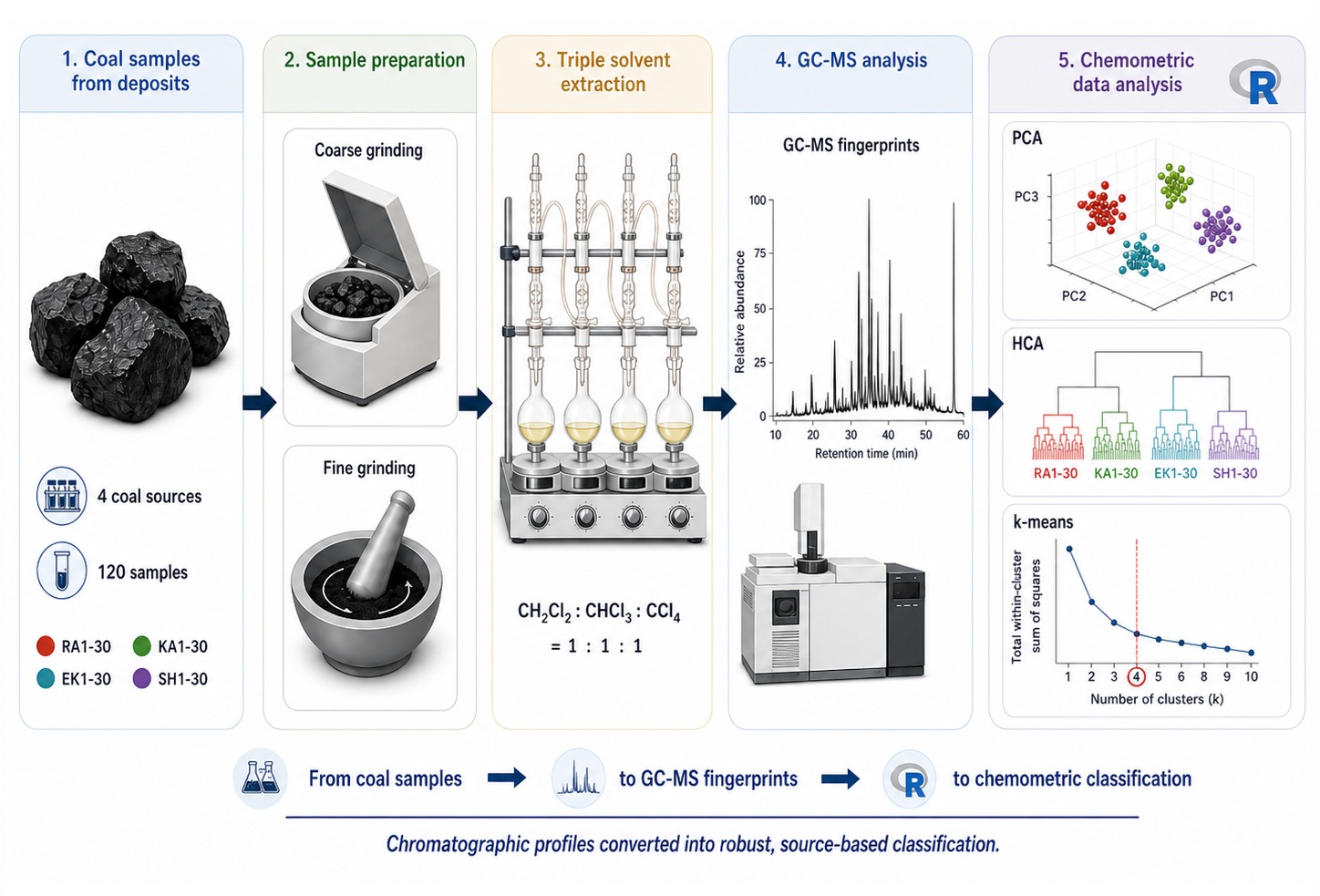
A comprehensive approach to the analysis of organic matter in bituminous coals from Kazakhstani deposits was developed, based on a combination of liquid extraction, gas chromatography with mass spectrometric detection (GC-MS), and chemometric data processing. A triple extraction system of dichloromethane–chloroform–tetrachloromethane (1:1:1) was proposed for sample preparation, providing representative extraction of aliphatic, aromatic and heteroatomic components without additional extract concentration. Chromatographic profiles of 120 coal extracts from four sources in Central and Northern Kazakhstan were analyzed. Optimization of the chromatographic separation conditions was carried out using probabilistic-deterministic design of experiment, which made it possible to establish robust relationships between the instrument parameters (column heating rate, carrier gas pressure) and the chromatogram characteristics. Chemometric data processing using principal component analysis (PCA), hierarchical cluster analysis (HCA), and k-means method revealed reproducible grouping of samples based on chromatographic profile similarity. Compact clusters corresponding to conventionally designated coal sources were formed in the principal component space, which is confirmed by the clustering results. The obtained results demonstrate the applicability of GC-MS and the chemometric approach for coal classification analysis and provide the foundation for the creation of a database of chromatographic fingerprints of the organic phase of coals.
References
Alexander, G., & Hazai, I. (1981). Chromatographic fingerprinting of coal extracts. Journal of Chromatography, 217, 19–38. https://doi.org/10.1016/S0021-9673(00)88059-0 DOI: https://doi.org/10.1016/S0021-9673(00)88059-0
Bartle, K.D., Mills, D.G., Mulligan, M.J., Amaechina, I.O., & Taylor, N. (1984). Molecular mass calibration in size-exclusion chromatography of coal derivatives. Fuel, 63(11), 1556–1560. https://doi.org/10.1016/0016-2361(84)90226-6 DOI: https://doi.org/10.1016/0016-2361(84)90226-6
Blanco, C., Prado, J.G., Guillén, M.D., Borrego, A.G., & Iglesias, M.J. (1991). Capillary gas-chromatographic and combined gas-chromatography mass-spectrometric study of the volatile fraction of a coal-tar pitch using OV-1701 stationary phase. Journal of Chromatography, 539(1), 157–167. https://doi.org/10.1016/S0021-9673(01)95369-5 DOI: https://doi.org/10.1016/S0021-9673(01)95369-5
Assis, L., & Lanças, F. (1999). High-resolution gas chromatography and high-resolution gas chromatography/mass spectrometry study of the volatile fraction obtained from high-inertinite Brazilian coal by supercritical fluid extraction. Journal of Microcolumn Separations, 11(7), 501–512. https://doi.org/10.1002/(SICI)1520-667X(1999)11:7<501::AID-MCS2>3.0.CO;2-V DOI: https://doi.org/10.1002/(SICI)1520-667X(1999)11:7<501::AID-MCS2>3.0.CO;2-V
Takanohashi, T., Yoshida, T., Iino, M., Katoh, K., & Nishioka, M. (2000). An inverse liquid chromatography study of the interaction of organic compounds with Argonne premium coals. Energy & Fuels, 14(3), 720–726. https://doi.org/10.1021/ef990261y DOI: https://doi.org/10.1021/ef990261y
Platonov, V.V., Proskuryakov, V.A., Korotaeva, K.V., & Yur'ev, E.M. (2002). Development and optimization of the procedure of gas-chromatographic elemental analysis of high-carbon solid fossil fuels. Russian Journal of Applied Chemistry, 75(5), 834–839. https://doi.org/10.1023/A:1020387318686 DOI: https://doi.org/10.1023/A:1020387318686
Rathsack, P., & Otto, M. (2014). Classification of chemical compound classes in slow pyrolysis liquids from brown coal using comprehensive gas-chromatography mass-spectrometry. Fuel, 116, 841–849. https://doi.org/10.1016/j.fuel.2013.05.100 DOI: https://doi.org/10.1016/j.fuel.2013.05.100
Zubkova, V., & Witkiewicz, Z. (2016). Chromatographic analysis of chemical compositions of coals and changes in them during technological processing. Critical Reviews in Environmental Science and Technology, 46(7), 701–755. https://doi.org/10.1080/10643389.2016.1154779 DOI: https://doi.org/10.1080/10643389.2016.1154779
Zuber, J., Ecker, D., Otto, M., & Wüst, E. (2016). Gas chromatography/atmospheric pressure chemical ionization-Fourier transform ion cyclotron resonance mass spectrometry of pyrolysis oil from German brown coal. International Journal of Analytical Chemistry, 2016, Article 5960916. https://doi.org/10.1155/2016/5960916 DOI: https://doi.org/10.1155/2016/5960916
Li, G., Li, Z., Ma, C., Zhang, L., Cheng, J., & Hou, Y. (2019). Molecular characteristics of the soluble components from three low-rank coals based on the analyses using GC/MS and GC/Q-TOF MS. Fuel, 254, Article 115671. https://doi.org/10.1016/j.fuel.2019.06.010 DOI: https://doi.org/10.1016/j.fuel.2019.06.010
Li, W., Zhang, D., Hou, Y., Qiao, E., & Cui, S. (2019). Analysis of light weight fractions of coal-based crude oil by gas chromatography combined with mass spectroscopy and flame ionization detection. Fuel, 241, 392–401. https://doi.org/10.1016/j.fuel.2019.04.108 DOI: https://doi.org/10.1016/j.fuel.2018.12.045
Wang, X., Zhu, Z., & Li, X. (2024). Analysis of the Organic Chemical Fractions of Three Coal Extracts. Applied Sciences, 14(19), 8933. https://doi.org/10.3390/app14198933 DOI: https://doi.org/10.3390/app14198933
Wang, X., & He, X. (2022). Cluster Analysis of Soluble Organic Fractions in Two Low-Rank Coals. Applied Sciences, 12(22), 11562. https://doi.org/10.3390/app122211562 DOI: https://doi.org/10.3390/app122211562
McGregor, L., Gauchotte, E., Habets, F., & Goovaerts, P. (2012). Multivariate statistical methods for the environmental forensic classification of coal tars from former manufactured gas plants. Environmental Science & Technology, 46(7), 3744–3752. https://doi.org/10.1021/es203708w DOI: https://doi.org/10.1021/es203708w
Zhang, X., Wei, X., Li, G., Wang, Y., Zhang, L., & Zong, Z. (2020). Structural characteristics of soluble organic matter in four low-rank coals. Fuel, 267, Article 117230. https://doi.org/10.1016/j.fuel.2020.117230 DOI: https://doi.org/10.1016/j.fuel.2020.117230
Fan, X., Yu, H., Liu, Z., Yu, J., Zhou, Q., & Wei, X. (2018). Molecular characteristics of Shenfu coal characterized by mass spectrometers with three ion sources. ChemistrySelect, 3(37), 10383–10387. https://doi.org/10.1002/slct.201802238 DOI: https://doi.org/10.1002/slct.201802238
Xu, H., Zhang, L., Wei, X., Fan, X., & Zong, Z. (2024). Exploring the molecular characteristics of organic matter in low-rank coals using GCxGC/TOF-MS plus data mining. Journal of Analytical and Applied Pyrolysis, 181, Article 106605. https://doi.org/10.1016/j.jaap.2024.106605 DOI: https://doi.org/10.1016/j.jaap.2024.106605
Hamilton, J.F., Webb, P.J., Lewis, A.C., & Reviejo, M.M. (2007). Comprehensive two-dimensional gas chromatography coupled to time-of-flight mass spectrometry of coal liquids produced during a coal liquefaction process. Energy & Fuels, 21(1), 286–294. https://doi.org/10.1021/ef060366i DOI: https://doi.org/10.1021/ef060366i
Zhang, X., Li, G., Wei, X., Zhang, L., & Zong, Z. (2019). Cluster analysis of molecular characteristics for soluble organic matter in coals. Chinese Journal of Analytical Chemistry, 47(1), 99–105. https://doi.org/10.19756/j.issn.0253-3820.181585
Zeng, Z., Hugel, H.M., Marriott, P.J., & Schoenmakers, P.J. (2014). Interpretation of comprehensive two-dimensional gas chromatography data using advanced chemometrics. TrAC Trends in Analytical Chemistry, 53, 150–166. https://doi.org/10.1016/j.trac.2013.08.009 DOI: https://doi.org/10.1016/j.trac.2013.08.009
Li, G., Li, Z., Jiang, H., Mo, W., Hu, H., & Zhang, L. (2019). Insight into molecular information of Huolinguole lignite obtained by Fourier transform ion cyclotron resonance mass spectrometry and statistical methods. Rapid Communications in Mass Spectrometry, 33(13), 1107–1113. https://doi.org/10.1002/rcm.8448
Huang, J., Li, G., Xu, H., Li, Z., Qin, Z., Fan, X., & Wei, X. (2024). Molecular characteristics of eight lignites based on the big data obtained from Orbitrap mass spectrometry. Journal of the Energy Institute, 114, Article 101569. https://doi.org/10.1016/j.joei.2024.101569 DOI: https://doi.org/10.1016/j.joei.2024.101579
Li, G., Qin, Z., Li, Z., Xu, H., & Wei, X. (2024). Combination of chemometrics and mass spectrometric methods for the data mining of molecular structure information of coal and biomass. Fuel, 361, Article 130714. https://doi.org/10.1016/j.fuel.2023.130714 DOI: https://doi.org/10.1016/j.fuel.2023.130714
Roy, A., Varma, A. K., Sar, T. K., Biswas, S., & Gupta, S. (2021). Insights from principal component analysis applied to Py-GCMS study of Indian coals and their solvent extracted clean coal products. International Journal of Coal Science & Technology, 8(6), 1504–1514. https://doi.org/10.21203/rs.3.rs-127356/v1 DOI: https://doi.org/10.1007/s40789-021-00457-x
Li, Y., Li, G., Xu, H., Li, Z., Fan, X., Qin, Z., & Wei, X. (2024). Accurate classification of the molecular characteristics of soluble portions from various lignites: Joint analysis of thermal dissolution experiments and data mining methods. Journal of Analytical and Applied Pyrolysis, 180, Article 106536. https://doi.org/10.1016/j.jaap.2024.106536 DOI: https://doi.org/10.1016/j.jaap.2024.106536
Fan, H.-H., Li, J., Song, L., & Cui, Y. (2025). Comprehensive quantitative analysis of coal-based liquids by Mask R-CNN-assisted two-dimensional gas chromatography. Separations, 12(2), Article 22. https://doi.org/10.3390/separations12020022
Li, B., Li, G., Jiang, H., Mo, W., Hu, H., & Zhang, L. (2019). Insight into molecular information of Huolinguole lignite obtained by Fourier transform ion cyclotron resonance mass spectrometry and statistical methods. Rapid Communications in Mass Spectrometry, 33(13), 1107–1113. https://doi.org/10.1002/rcm.8448 DOI: https://doi.org/10.1002/rcm.8448
Khare, P., Baruah, B.P., & Rao, P.G. (2011). Application of chemometrics to study the kinetics of coal pyrolysis: A novel approach. Fuel, 90(11), 3299–3305. https://doi.org/10.1016/j.fuel.2011.05.017 DOI: https://doi.org/10.1016/j.fuel.2011.05.017
Roy, A., Varma, A.K., Rao, K.S., Prasad, M., & Reddy, B.S. (2019). Py-GCMS studies of Indian coals and their solvent extracted products. Fuel, 256, Article 115981. https://doi.org/10.1016/j.fuel.2019.115981 DOI: https://doi.org/10.1016/j.fuel.2019.115981
Yin, H., Yang, Y., Liu, X., Li, J., & Zhang, X. (2021). Application of chemometrics for coal pyrolysis products by online py-GCxGC-MS. ACS Omega, 6(5), 3763–3770. https://doi.org/10.1021/acsomega.0c05359 DOI: https://doi.org/10.1021/acsomega.0c05359
Lu, W., Li, H., Wang, X., Zhang, Y., & Chen, J. (2024). Discrimination of coal geographical origins through HS-GC-IMS assisted with machine learning algorithms in larceny case. Journal of Chromatography A, 1735, Article 465330. https://doi.org/10.1016/j.chroma.2024.465330 DOI: https://doi.org/10.1016/j.chroma.2024.465330
Zhang, L., Li, G., Wei, X., Fan, X., & Zong, Z. (2022). Characterization of nitrogen-containing compounds in coal tar and its subfractions by comprehensive two-dimensional GC x GC-TOF and ESI FT-ICR mass spectrometry based on new separation method. Fuel Processing Technology, 227, Article 107213. https://doi.org/10.1016/j.fuproc.2022.107213 DOI: https://doi.org/10.1016/j.fuproc.2021.107125
Fan, H.-H., Li, J., Song, L., & Cui, Y. (2025). Comprehensive quantitative analysis of coal-based liquids by Mask R-CNN-assisted two-dimensional gas chromatography. Separations, 12(2), Article 22. https://doi.org/10.3390/separations12020022 DOI: https://doi.org/10.3390/separations12020022
Wu, Z., Rodgers, R.P., & Marshall, A.G. (2003). Resolution of 10,000 compositionally distinct components in polar coal extracts by negative-ion electrospray ionization Fourier transform ion cyclotron resonance mass spectrometry. Energy & Fuels, 17(4), 946–953. https://doi.org/10.1021/ef030026m DOI: https://doi.org/10.1021/ef030026m
Li, Z., Li, G., Xu, H., Qin, Z., Fan, X., & Wei, X. (2025). Classification of soluble proportions derived from coals and their correlation with coal type: Conjoint analyses of extraction, thermal dissolution and machine learning. Journal of the Energy Institute, 119, Article 102010. https://doi.org/10.1016/j.joei.2025.102010 DOI: https://doi.org/10.1016/j.joei.2025.102010
Fomin, V.N., Aynabaev, A.A., Kaykenov, D.A., Sadyrbekov, D.T., Bakhytkyzy, I., & Aldabergenova, S.K. (2021). Optimization of coal tar gas chromatography conditions using probabilistic-deterministic design of experiment. Bulletin of the Karaganda University. Chemistry Series, 4(104), 39–46. https://doi.org/10.31489/2021Ch4/39-46 DOI: https://doi.org/10.31489/2021Ch4/39-46
Turovets, M.A., Fomin, V.N., Kelesbek, N.K., Ainabayev, A.A., & Sadyrbekov, D.T. (2024). Chemometric approach for the determination of vanadium by the LIBS method. Eurasian Journal of Chemistry, 29(4), 61–70. https://doi.org/10.31489/2959-0663/4-24-10 DOI: https://doi.org/10.31489/2959-0663/4-24-10
Fomin, V.N., Aldabergenova, S.K., Kelesbek, N.K., Ainabayev, A.A., Sadyrbekov, D.T., Kaykenov, D.A., Borsynbayev, A.S., Azhibay, N.T., & Turovets, M.A. (2024). Method of classification and quantitative analysis of vein quartz using LIBS and chemometric techniques. Bulletin of the L.N. Gumilyov Eurasian National University. Chemistry. Geography. Ecology Series, 2(147), 48–60. https://doi.org/10.32523/2616-6771-2024-147-2-48-60 DOI: https://doi.org/10.32523/2616-6771-2024-147-2-48-60
Fomin, V.N., Aldabergenova, S.K., Rustembekov, K.T., Omarov, K.B., Rozhkovoy, I.E., Dik, A.V., & Saulebekov, D.M. (2021). Optimization of the parameters of a laser induced breakdown spectrometer (LIBS) using probabilistic-deterministic design of experiment. Industrial Laboratory. Diagnostics of Materials, 87(5), 14–19. https://doi.org/10.26896/1028-6861-2021-87-5-14-19 DOI: https://doi.org/10.26896/1028-6861-2021-87-5-14-19
Fomin, V., Turovets, M., Kelesbek, N., Ainabayev, A., Sadyrbekov, D., Kaykenov, D., Borsynbayev, A., Azhibay, N., & Aldabergenova, S. (2025). LIBS of low-alloyed lead systems: Chemometric data processing and quantitative analysis. Analytica, 6(4), Article 55. https://doi.org/10.3390/analytica6040055 DOI: https://doi.org/10.3390/analytica6040055
Fomin, V.N. (2018). Veroyatnostno-determinirovannoe planirovanie eksperimenta (VDPE) [Probabilistically-deterministic design of experiments (PDDE)] (Certificate of Authorship of the Republic of Kazakhstan No. 26 dated 01.10.2018) [Computer software]. Kazpatent. https://copyright.kazpatent.kz/?!.iD=kux
Fomin, V. (2025). Software implementation of probabilistic-deterministic design of a chemical experiment on R. Bulletin of the L.N. Gumilyov Eurasian National University. Chemistry. Geography. Ecology Series, 2(151), 130–142. https://doi.org/10.32523/2616-6771-2025-151-2-130-142 DOI: https://doi.org/10.32523/2616-6771-2025-151-2-130-142
Buldakov, Y.M., Egizekov, M.G., Kulenova, N.A., Reymer, Y.A., & Skorikov, S.P. (2018). Tovarnyy ugol' i produkty yego szhiganiya — perspektivy razvitiya novykh proizvodstv [Commercial coal and its combustion products: prospects for new industry development]. Novosti nauki Kazahstana — News of Kazakhstan Science, 1(135), 99–116. https://vestnik.nauka.kz/storage/docs/2018/03/9-%D0 %91 %D1 %83 %D0 %BB%D0 %B4 %D0 %B0 %D0 %BA%D0 %BE%D0 %B2.pdf [in Russian]
Ermagambet, B.T., Kasenov, B.K., Nurgaliyev, N.U., Kazankapova, M.K., Kasenova, Zh.M., & Kuanyshbekov, E.E. (2020). Chemical Composition and Electrophysical Characteristics of the Ash of Bogatyr Coal. Solid Fuel Chemistry, 54(2), 99–104. https://doi.org/10.3103/s0361521920020020 DOI: https://doi.org/10.3103/S0361521920020020
Downloads
Published
How to Cite
Issue
Section
License
Copyright (c) 2026 Vitaliy N. Fomin, Assanali A. Aynabayev, Saule K. Aldabergenova, Dauletkhan A. Kaykenov, Milana A. Turovets

This work is licensed under a Creative Commons Attribution-NonCommercial-NoDerivatives 4.0 International License.

This work is licensed under a Creative Commons Attribution-NonCommercial-NoDerivatives 4.0 International License.
Authors retain copyright and grant the journal right of first publication with the work simultaneously licensed under a Creative Commons Attribution License (CC BY-NC-ND 4.0) that allows others to share the work with an acknowledgement of the work's authorship and initial publication in this journal.
