

Design of Floating Tablets Based on Hydroxypropyl Cellulose and Weakly Cross-Linked Poly(acrylic acid) for Gastroretentive Drug Delivery
DOI:
https://doi.org/10.31489/2959-0663/1-26-7Keywords:
floating tablet, gastroretentive system, sustained release, interpolymer complexes, cellulose derivatives, hydroxypropyl cellulose, Carbopol®Abstract
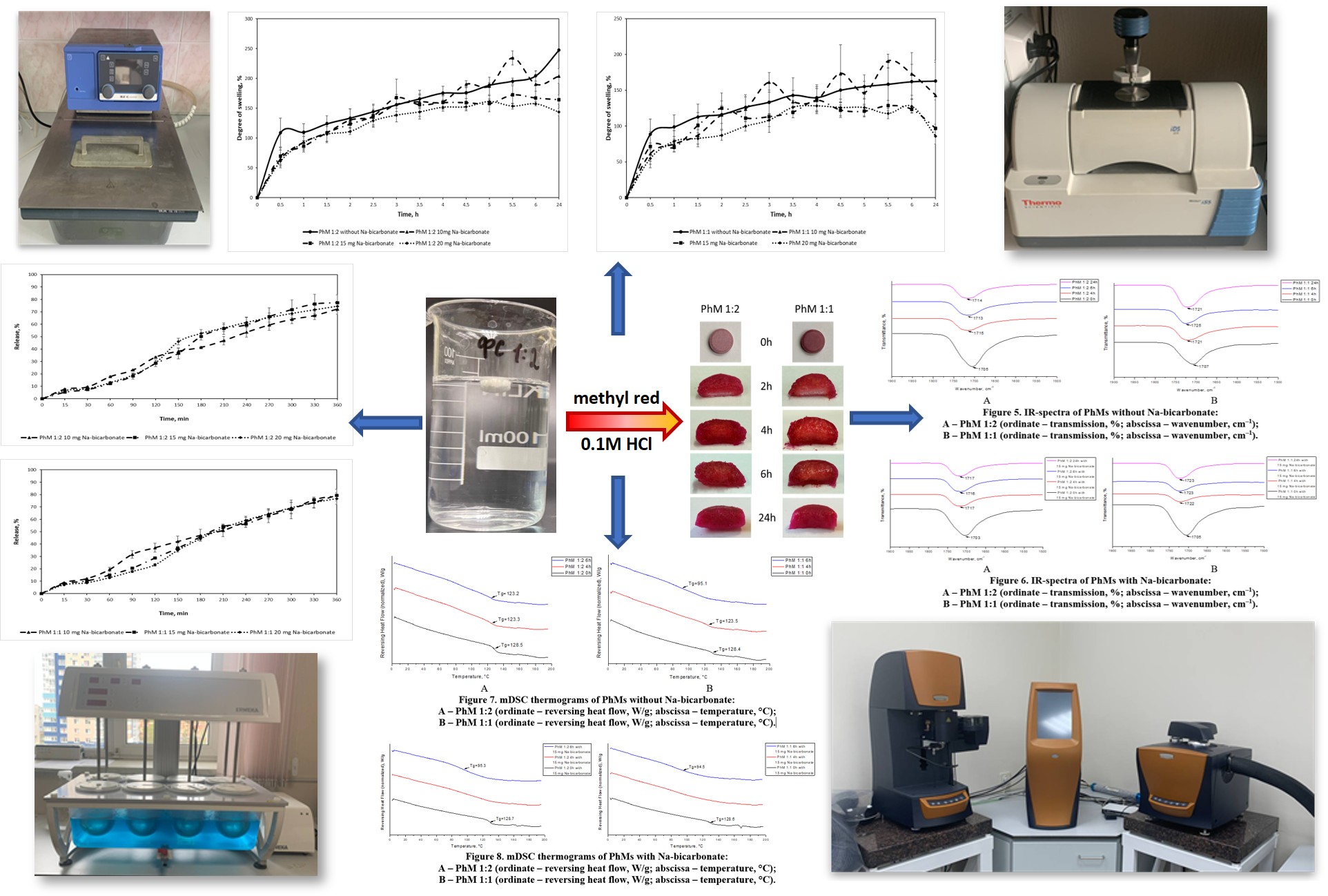
Floating or buoyant dosage forms are kind of gastroretentive delivery system specifically designed to achieve localized drug release in the upper gastrointestinal tract (GI). The aim of this study is to select a composition for creating a floating matrix system based on hydroxypropyl cellulose (HPC) and Carbopol® 71G (C71G) with an evaluating of the effect of sodium bicarbonate (Na-bicarbonate) on the complexation process, and to design a gastroretentive system for acyclovir delivering. The tablets are based on physical mixtures (PhMs) HPC/C71G 1:2; 1:1. All matrices containing sodium bicarbonate showed a flotation time of less than 3 minutes, with the exception of a 2:1 PhM with 10 mg of sodium bicarbonate. PhM HPC/C71G (1:1) was observed greater matrix erosion compared to a 1:2 ratio due to the lower C71G content. During the swelling process of the matrices, interaction of polymers occurs, which is confirmed by a spectral shift in the ATR-FTIR spectra and Tg by mDSC. The addition of sodium bicarbonate did not increase the release rate due to the effervescent effect. A slightly higher release rate was observed for matrices with a 1:1 polymer ratio, due to erosion of the soluble HPC polymer.
References
Vo, A. Q., Zhang, J., Nyavanandi, D., Bandari, S., & Repka, M. A. (2020). Hot melt extrusion paired fused deposition modeling 3D printing to develop hydroxypropyl cellulose based floating tablets of cinnarizine. Carbohydrate Polymers, 246, 116519. https://doi.org/10.1016/J.CARBPOL.2020.116519 DOI: https://doi.org/10.1016/j.carbpol.2020.116519
Alekseyev, K. V., Blynskaya, E. V., Karbusheva, E. Yu., Sedova, M. K., Tikhonova, N. V., & Uvarov, N. A. (2012). Production of Floating Medicinal Forms. Pharmacy, (6), 35–38 [in Russian].
Lin, X., Fu, H., Hou, Z., Si, Y., Shan, W., & Yang, Y. (2021). Three-dimensional printing of gastro-floating tablets using polyethylene glycol diacrylate-based photocurable printing material. International Journal of Pharmaceutics, 603, 120674. https://doi.org/10.1016/j.ijpharm.2021.120674 DOI: https://doi.org/10.1016/j.ijpharm.2021.120674
Lopes, C. M., Bettencourt, C., Rossi, A., Buttini, F., & Barata, P. (2016). Overview on gastroretentive drug delivery systems for improving drug bioavailability. International journal of pharmaceutics, 510(1), 144–158. https://doi.org/10.1016/j.ijpharm.2016.05.016 DOI: https://doi.org/10.1016/j.ijpharm.2016.05.016
Omidian, H. (2025). Gastroretentive drug delivery systems: A holy grail in oral delivery. Drug Discovery Today, 104340. https://doi.org/10.1016/j.drudis.2025.104340 DOI: https://doi.org/10.1016/j.drudis.2025.104340
Yuan, K. C., Chiang, Y. C., Li, P. H., & Chiang, P. Y. (2024). Physicochemical and release properties of anthocyanin gastric floating tablets colloidized with κ-carrageenan/metal ions. Food Hydrocolloids, 150, 109674. https://doi.org/10.1016/j.foodhyd.2023.109674 DOI: https://doi.org/10.1016/j.foodhyd.2023.109674
Pinto, J. F. (2010). Site-specific drug delivery systems within the gastro-intestinal tract: from the mouth to the colon. International journal of pharmaceutics, 395(1-2), 44–52. https://doi.org/10.1016/j.ijpharm.2010.05.003 DOI: https://doi.org/10.1016/j.ijpharm.2010.05.003
Shah, K., Singh, D., Agrawal, R., & Garg, A. (2025). Current developments in the delivery of gastro-retentive drugs. American Association of Pharmaceutical Scientists PharmSciTech, 26(2), 57. https://doi.org/10.1208/s12249-025-03052-4 DOI: https://doi.org/10.1208/s12249-025-03052-4
Issarachot, O., Bunlung, S., Kaewkroek, K., & Wiwattanapatapee, R. (2023). Superporous hydrogels based on blends of chitosan and polyvinyl alcohol as a carrier for enhanced gastric delivery of resveratrol. Saudi Pharmaceutical Journal, 31(3), 335–347. https://doi.org/10.1016/j.jsps.2023.01.001 DOI: https://doi.org/10.1016/j.jsps.2023.01.001
Charoenying, T., Opanasopit, P., Ngawhirunpat, T., Rojanarata, T., Akkaramongkolporn, P., & Patrojanasophon, P. (2023). Development of a novel tablet-shaped floating 3D-printed device with adjustable floating time as floating drug delivery systems provided zero-order release kinetics. Journal of Drug Delivery Science and Technology, 84, 104506. https://doi.org/10.1016/j.jddst.2023.104506 DOI: https://doi.org/10.1016/j.jddst.2023.104506
Mustafin R. I., Protasova A. A., Bukhovets A. V., & Semina I. I. (2014). Issledovanie interpolymernykh sochetaniy na osnove (met)akrilatov v kachestve perspektivnykh nositeley v polikompleksnykh sistemakh dlya gastroretentivnoy dostavki [Investigation of interpolymers based on (meth)acrylates as promising carriers in multiplex gastroretentive drug delivery systems]. Farmatsiya — Farmatsiya, 5, 3–5 [in Russian].
Blynskaya, E. V., Vinogradov, V. P., Tishkov, S. V., Suslina, S. N., & Alekseev, K. V. (2022). Modern Approaches to Obtaining Floating Drug Dosage Forms (A Review). Pharmaceutical Chemistry Journal, 56(9), 1277–1284. https://doi.org/10.1007/s11094-022-02786-w DOI: https://doi.org/10.1007/s11094-022-02786-w
Raza, A., Hayat, U., Wang, H. J., & Wang, J. Y. (2020). Preparation and evaluation of captopril loaded gastro-retentive zein based porous floating tablets. International Journal of Pharmaceutics, 579, 119185. https://doi.org/10.1016/j.ijpharm.2020.119185 DOI: https://doi.org/10.1016/j.ijpharm.2020.119185
Tort, S., Han, D., & Steckl, A. J. (2020). Self-inflating floating nanofiber membranes for controlled drug delivery. International Journal of Pharmaceutics, 579, 119164. https://doi.org/10.1016/j.ijpharm.2020.119164 DOI: https://doi.org/10.1016/j.ijpharm.2020.119164
Rahim, S. A., Carter, P., & Elkordy, A. A. (2017). Influence of calcium carbonate and sodium carbonate gassing agents on pentoxifylline floating tablets properties. Powder Technology, 322, 65–74. https://doi.org/10.1016/j.powtec.2017.09.001 DOI: https://doi.org/10.1016/j.powtec.2017.09.001
Yin, L., Qin, C., Chen, K., Zhu, C., Cao, H., Zhou, J., He, W., & Zhang, Q. (2013). Gastro-floating tablets of cephalexin: preparation and in vitro/in vivo evaluation. International journal of pharmaceutics, 452(1-2), 241–248. https://doi.org/10.1016/j.ijpharm.2013.05.011 DOI: https://doi.org/10.1016/j.ijpharm.2013.05.011
Chaudhary, S., Chandrika, A. M., Chaudhary, Y., Shahi, A., Sigdel, A., & Thapa, R. (2025). Formulation and Invitro Evaluation of Effervescent Floating Tablets of Hydrophilic Polymers Using Propranolol Hydrochloride as a Model Drug. World Journal of Current Medical and Pharmaceutical Research, 7(1), 29–34. https://doi.org/10.37022/wjcmpr.v7i1.354 DOI: https://doi.org/10.37022/wjcmpr.v7i1.354
Tufail, M., Shah, K. U., Khan, I. U., Khan, K. A., Shah, S. U., Rashid, F., Khan, J., Alshammari, A., Alasmari, A. F., & Riaz, M. S. (2024). Controlled release bilayer floating effervescent and noneffervescent tablets containing levofloxacin and famotidine. International Journal of Polymer Science, 2024(1), 1243321. https://doi.org/10.1155/2024/1243321 DOI: https://doi.org/10.1155/2024/1243321
Siripruekpong, W., Wiwattanapatapee, R., Chambin, O., & Assifaoui, A. (2025). Structural and mechanistic exploration in the development of floating drug delivery systems using calcium-pectinate gels with sodium bicarbonate as CO2 gas-forming agent. Journal of Drug Delivery Science and Technology, 107, 106729. https://doi.org/10.1016/j.jddst.2025.106729 DOI: https://doi.org/10.1016/j.jddst.2025.106729
Ahmad, S., Khan, J. A., Kausar, T. N., Mahnashi, M. H., Alasiri, A., Alqahtani, A. A., Alqahtani, T. S., Walbi, I. A., Alshehri, O. M., Elnoubi, O. A., Mahmood, F., & Sadiq, A. (2023). Preparation, characterization and evaluation of flavonolignan silymarin effervescent floating matrix tablets for enhanced oral bioavailability. Molecules, 28(6), 2606. https://doi.org/10.3390/molecules28062606 DOI: https://doi.org/10.3390/molecules28062606
Zhang, R., Shi, H., Li, S., Zhang, H., Zhang, D., Wu, A., Zhang, C., Li, C., Fu, X., Chen, S., Shi, J., Tian, Y., Wang, Y., & Liu, H. (2023). A double-layered gastric floating tablet for zero-order controlled release of dihydromyricetin: Design, development, and in vitro/in vivo evaluation. International Journal of Pharmaceutics, 638, 122929. https://doi.org/10.1016/j.ijpharm.2023.122929 DOI: https://doi.org/10.1016/j.ijpharm.2023.122929
Saady, M., Shoman, N. A., Teaima, M., Abdelmonem, R., El-Nabarawi, M. A., & Elhabal, S. F. (2024). Fabrication of gastro-floating sustained-release etoricoxib and famotidine tablets: design, optimization, in-vitro, and in-vivo evaluation. Pharmaceutical Development and Technology, 29(5), 429–444. https://doi.org/10.1080/10837450.2024.2343320 DOI: https://doi.org/10.1080/10837450.2024.2343320
Bellad, K., Nanjwade, B., Sarkar, A., Srichana, T., & Shetake, R. (2020). Development and evaluation of curcumin floating tablets. Pharmaceutica Analytica Acta, 12, 622. https://doi.org/10.35248/2153-2435.20.11.622
Bote, S., & Kolageri, S. (2022). Formulation and Evaluation of Floating Tablets of Pantoprazole. Journal of Drug Delivery and Therapeutics, 12(5), 34–45. https://doi.org/10.22270/jddt.v12i5.5577 DOI: https://doi.org/10.22270/jddt.v12i5.5577
Liu, H., Wang, S., Shi, H., Zhang, R., Qu, K., Hu, Y., Qu, X., Gan, C., Chen, J., Shi, X., Zhang, M., & Zeng, W. (2021). Gastric floating tablet improves the bioavailability and reduces the hypokalemia effect of gossypol in vivo. Saudi Pharmaceutical Journal, 29(4), 305–314. https://doi.org/10.1016/j.jsps.2021.03.001 DOI: https://doi.org/10.1016/j.jsps.2021.03.001
Wavhule, P., & Devarajan, P. V. (2021). Development and optimization of microballoons assisted floating tablets of Baclofen. American Association of Pharmaceutical Scientists PharmSciTech, 22(8), 272. https://doi.org/10.1208/s12249-021-02139-y DOI: https://doi.org/10.1208/s12249-021-02139-y
Huh, H. W., Na, Y. G., Kang, H., Kim, M., Han, M., Pham, T. M. A., Lee, H., Baek, J. S., Lee, H. K., & Cho, C. W. (2021). Novel self-floating tablet for enhanced oral bioavailability of metformin based on cellulose. International Journal of Pharmaceutics, 592, 120113. https://doi.org/10.1016/j.ijpharm.2020.120113 DOI: https://doi.org/10.1016/j.ijpharm.2020.120113
Moustafine R. I., Bukhovets A. V., Protasova A. A., Shaykhramova R. N., Sitenkov A. Y., & Semina I. I. (2015). Sravnitel’noe issledovanie polikompleksnykh sistem dlya gastroretentivnoy dostavki metformina [Comparative investigation of polycomplex systems for gastroretentive metformin delivery]. Razrabotka i registratsiya lekarstvennykh sredstv — Drug development & registration, 1(10), 48–50 [in Russian].
Khutoryanskiy, V. V., Dubolazov, A. V., & Mun, G. A. (2009). pH-and ionic strength effects on interpolymer complexation via hydrogen-bonding. In Hydrogen-bonded interpolymer complexes: Formation, structure and applications, 1-21. https://doi.org/10.1142/9789812709776_0001 DOI: https://doi.org/10.1142/9789812709776_0001
Smyslov, R. Y., Gorshkova, Y. E., Nekrasova, T. N., Makhayeva, D. N., Mun, G. A., Irmukhametova, G. S., & Khutoryanskiy, V. V. (2025). Dynamic and structural insights into hydrogen-bonded interpolymer complexes of poly(2-alkyl-2-oxazolines) with poly(carboxylic acids). Journal of Colloid and Interface Science, 699(1), 138185. https://doi.org/10.1016/j.jcis.2025.138185 DOI: https://doi.org/10.1016/j.jcis.2025.138185
Khutoryanskiy, V. V. (2007). Hydrogen-bonded interpolymer complexes as materials for pharmaceutical applications. International Journal of Pharmaceutics, 334(1-2), 15–26. https://doi.org/10.1016/j.ijpharm.2007.01.037 DOI: https://doi.org/10.1016/j.ijpharm.2007.01.037
Bani-Jaber, A. K., Alkawareek, M. Y., Al-Gousous, J. J., & Helwa, A. Y. A. (2011). Floating and sustained-release characteristics of effervescent tablets prepared with a mixed matrix of Eudragit L-100-55 and Eudragit EPO. Chemical and Pharmaceutical Bulletin, 59(2), 155–160. https://doi.org/10.1248/cpb.59.155 DOI: https://doi.org/10.1248/cpb.59.155
Zabolotnaya U.N., Timergalieva V.R., Nasibullin S.F., & Moustafine R.I. (2025). Development of polycomplex carriers based on hydroxypropyl cellulose and Carbopol® for gastroretentive drug delivery. Drug development & registration, 14(4), 108–124 [in Russian]. https://doi.org/10.33380/2305-2066-2025-14-4-2148 DOI: https://doi.org/10.33380/2305-2066-2025-14-4-2148
Nurkeeva, Z. S., Mun, G. A., & Khutoryanskiy, V. V. (2003). Interpolymer complexes of water‐soluble nonionic polysaccharides with polycarboxylic acids and their applications. Macromolecular Bioscience, 3(6), 283–295. https://doi.org/10.1002/chin.200408305 DOI: https://doi.org/10.1002/mabi.200390037
Satoh, K., Takayama, K., Machida, Y., Suzuki, Y., Nakagaki, M., & Nagai, T. (1989). Factors affecting the bioadhesive property of tablets consisting of hydroxypropyl cellulose and carboxyvinyl polymer. Chemical and pharmaceutical bulletin, 37(5), 1366-1368. https://doi.org/10.1248/cpb.37.1366 DOI: https://doi.org/10.1248/cpb.37.1366
Mangazbaeva, R. A., Mun, G. A., Nurkeeva, Z. S., & Khutoryanskiy, V. V. (2006). Interpolymer complexes of hydroxypropylmethylcellulose with polycarboxylic acids in aqueous solutions. Polymer international, 55(6), 668–674. https://doi.org/10.1002/pi.2012 DOI: https://doi.org/10.1002/pi.2012
Mun, G. A., Nurkeeva, Z. S., Khutoryanskiy, V., & Dubolazov, A. V. (2003). Effect of pH and ionic strength on the complex formation of poly(acrylic acid) with hydroxyethylcellulose in aqueous solutions. Polymer Science, 45(12), 2091–2095.
Şakar‐Deliormanli, A. (2012). Flow behavior of hydroxypropyl methyl cellulose/polyacrylic acid interpolymer complexes in aqueous media. Polymer international, 61(12), 1751–1757. https://doi.org/10.1002/pi.4266 DOI: https://doi.org/10.1002/pi.4266
Negim, E. S. M., Nurpeissova, Z. A., Mangazbayeva, R. A., Khatib, J. M., Williams, C., & Mun, G. A. (2014). Effect of pH on the physico-mechanical properties and miscibility of methyl cellulose/poly(acrylic acid) blends. Carbohydrate Polymers, 101, 415–422. https://doi.org/10.1016/j.carbpol.2013.09.047 DOI: https://doi.org/10.1016/j.carbpol.2013.09.047
Fedorova, O. V., Ovchinnikova, I. G., Rusinov, G. L., Avdeeva, V. V., Zhdanov, A. P., Zhizhin, K. Yu., Kuznetsov, N. T., Zakharova, L. Ya., Kuznetsova, D. A., Razuvaeva, Yu. S., Zhiltsova, E. P., Sinyashin, O. G., Alekseeva, A. S., Vodovozova, E. L., Abdrakhmanova, I. I., Ibrahim, A., Solovyeva, V. V., Maltsev, A. V., Fisenko, V. P., Bachurin, S. O., Mikhailov, Yu. M., Aleksandrova, Yu. I., Shurpik, D. N., Stoikov, I. I., Ziganshina, A. Y., Solovieva, S. E., Antipin, I. S., Agafonov, M. A., Terekhova, I. V., Ilicheva, P. M., Pidenko, P. S., Burmistrova, N. A, Moustafine, R. I., Timergalieva, V. R., Zabolotnaya, Y. N., Khutoryanskiy, V. V., Demin, A. M., Levit, G. L., Charushin, V. N., Krasnov, V. P., Goryacheva, O. A., Mayorova, O. A., Mesheryakova, S. M., Goryacheva, I. Yu., Ayupova, A. I., Fattakhova, А. А., Rizvanov, А. А., Inozemtseva, O. A., Gusliakova, O. I., Gorin, D. A., Gerasimov, A. V., Zubaidullina, L. S., Ziganshin, M. A., Valiulin, S. V., Onischuk, A. A., Bezrukov, A. N., Galyametdinov, Yu. G., Padnya, P. L., Nazarova, A. A., Sultanova, E. D. & Burilov, V. A. (2025). Modern Strategies of Drug Therapy: Multi-Target Drug Delivery, Bioimaging, Diagnostics. Russian Journal of General Chemistry, 95 (Suppl 1), S1-S448. https://doi.org/10.1134/S1070363225606726 DOI: https://doi.org/10.1134/S1070363225606726
Gordeeva D. S., Sitenkova (Bukhovets) A. V., Moustafine R. I. (2020). Interpolyelectrolyte Complexes Based On Eudragit® Copolymers As Carriers For Bioadhesive Gastroretentive Metronidazole Delivery System. Drug development & registration, 9(2), 72–76 [in Russian]. https://doi.org/10.33380/2305-2066-2020-9-2-72-76 DOI: https://doi.org/10.33380/2305-2066-2020-9-2-72-76
Viktorova A. S., Elizarova E. S., Romanova R. S., Timergalieva V. R., Khutoryanskiy V. V., Moustafine R. I. (2021). Interpolymer complexes based on Carbopol® and poly(2-ethyl-2-oxazoline) as carriers for buccal delivery of metformin. Drug development & registration, 10(1), 48–55 [in Russian]. https://doi.org/10.33380/2305-2066-2021-10-1-48-55 DOI: https://doi.org/10.33380/2305-2066-2021-10-1-48-55
Streubel, A., Siepmann, J., Dashevsky, A., & Bodmeier, R. (2000). pH-independent release of a weakly basic drug from water-insoluble and-soluble matrix tablets. Journal of controlled release, 67(1), 101–110. https://doi.org/10.1016/S0168-3659(00)00200-5 DOI: https://doi.org/10.1016/S0168-3659(00)00200-5
Zhang X., Lin F., Yuan Q., Zhu L., Wang C., Yang S. (2019). Hydrogen-bonded thin films of cellulose ethers and poly(acrylic acid). Carbohydrate Polymers, 215, 58-62. https://doi.org/10.1016/j.carbpol.2019.03.066 DOI: https://doi.org/10.1016/j.carbpol.2019.03.066
Rao, G. K., Mandapalli, P. K., Manthri, R., & Reddy, V. P. (2013). Development and in vivo evaluation of gastroretentive delivery systems for cefuroxime axetil. Saudi Pharmaceutical Journal, 21(1), 53–59. https://doi.org/10.1016/j.jsps.2012.01.003 DOI: https://doi.org/10.1016/j.jsps.2012.01.003
Prajapati, P. H., Nakum, V. V., & Patel, C. N. (2012). Formulation and evaluation of floating matrix tablet of stavudine. International Journal of pharmaceutical investigation, 2(2), 83. https://doi.org/10.4103/2230-973X.100047 DOI: https://doi.org/10.4103/2230-973X.100047
Yusif R. M., Hashim I. I. A., Mohamed E. A., El Rakhawy M. M. (2016). Investigation and evaluation of an in situ interpolymer complex of carbopol with polyvinylpyrrolidone as a matrix for gastroretentive tablets of ranitidine hydrochloride. Chemical and Pharmaceutical Bulletin, 64(1), 42–51. https://doi.org/10.1248/cpb.c15-00620 DOI: https://doi.org/10.1248/cpb.c15-00620
Priyanka, R., & Prabhu, R. (2020). Carbopol 71G-NF polymer–the next pillar of oral solid dosage form. Magna Scientia Adv Res Rev, 1, 010–017. https://doi.org/10.30574/msarr.2020.1.1.0018 DOI: https://doi.org/10.30574/msarr.2020.1.1.0018
Ozeki, T., Yuasa, H., & Kanaya, Y. (2000). Controlled release from solid dispersion composed of poly(ethylene oxide)–Carbopol® interpolymer complex with various cross-linking degrees of Carbopol®. Journal of controlled release, 63(3), 287–295. https://doi.org/10.1016/S0168-3659(99)00202-3 DOI: https://doi.org/10.1016/S0168-3659(99)00202-3
Barman, S., Sarkar, A., Das, U., & Mandal, S. (2025). Double Target Strategy of Novel Floating Raft System Containing Metronidazole. Journal of Pharmaceutical Innovation, 20(6), 1–25. https://doi.org/10.1007/s12247-025-10187-1 DOI: https://doi.org/10.1007/s12247-025-10187-1
Thapa, P., & Jeong, S. H. (2018). Effects of formulation and process variables on gastroretentive floating tablets with a high-dose soluble drug and experimental design approach. Pharmaceutics, 10(3), 161. https://doi.org/10.3390/pharmaceutics10030161 DOI: https://doi.org/10.3390/pharmaceutics10030161
Jindal, S., Jindal, K., Gupta, G., Garg, R., & Awasthi, R. (2016). Gastroretentive floating tablets: An investigation of excipients effect on tablet properties. Marmara Pharmaceutical Journal, 20(2), 100–110. https://doi.org/10.12991/mpj.20162018166 DOI: https://doi.org/10.12991/mpj.20162018166
Moustafine, R. I., Viktorova, A. S., & Khutoryanskiy, V. V. (2019). Interpolymer complexes of carbopol® 971 and poly(2-ethyl-2-oxazoline): Physicochemical studies of complexation and formulations for oral drug delivery. International journal of pharmaceutics, 558, 53–62. https://doi.org/10.1016/j.ijpharm.2019.01.002 DOI: https://doi.org/10.1016/j.ijpharm.2019.01.002
Gómez-Carracedo, A., Alvarez-Lorenzo, C., Gomez-Amoza, J. L., & Concheiro, A. (2004). Glass transitions and viscoelastic properties of Carbopol® and Noveon® compacts. International journal of pharmaceutics, 274(1-2), 233–243. https://doi.org/10.1016/j.ijpharm.2004.01.023 DOI: https://doi.org/10.1016/j.ijpharm.2004.01.023
Khutoryanskiy, V. V., Cascone, M. G., Lazzeri, L., Barbani, N., Nurkeeva, Z. S., Mun, G. A., & Dubolazov, A. V. (2004). Morphological and thermal characterization of interpolymer complexes and blends based on poly(acrylic acid) and hydroxypropylcellulose. Polymer International, 53(3), 307–311. https://doi.org/10.1002/pi.1408 DOI: https://doi.org/10.1002/pi.1408
Heda, P. K., Dollimore, D., Alexander, K. S., Chen, D., Law, E., & Bicknell, P. (1995). A method of assessing solid state reactivity illustrated by thermal decomposition experiments on sodium bicarbonate. Thermochimica acta, 255, 255–272. https://doi.org/10.1016/0040-6031(94)02154-G DOI: https://doi.org/10.1016/0040-6031(94)02154-G
Sadik, T., Pillon, C., Carrot, C., & Ruiz, J. A. R. (2018). Dsc studies on the decomposition of chemical blowing agents based on citric acid and sodium bicarbonate. Thermochimica Acta, 659, 74–81. https://doi.org/10.1016/j.tca.2017.11.007 DOI: https://doi.org/10.1016/j.tca.2017.11.007
Downloads
Published
How to Cite
Issue
Section
License
Copyright (c) 2026 Ulyana N. Zabolotnaya, Venera R. Timergalieva, Shamil F. Nasibullin, Rouslan I. Moustafine

This work is licensed under a Creative Commons Attribution-NonCommercial-NoDerivatives 4.0 International License.

This work is licensed under a Creative Commons Attribution-NonCommercial-NoDerivatives 4.0 International License.
Authors retain copyright and grant the journal right of first publication with the work simultaneously licensed under a Creative Commons Attribution License (CC BY-NC-ND 4.0) that allows others to share the work with an acknowledgement of the work's authorship and initial publication in this journal.
