

Effect of HF Concentration on the Structural, Morphological, and Electrical Properties of Ti3C2Tx MXene Prepared by Microwave-Assisted Etching
DOI:
https://doi.org/10.31489/2959-0663/2-26-9Keywords:
Ti3C2Tx MXene, MAX phase, gradient HF etching, etching concentration, surface terminations, exfoliation, morphology, structural integrityAbstract
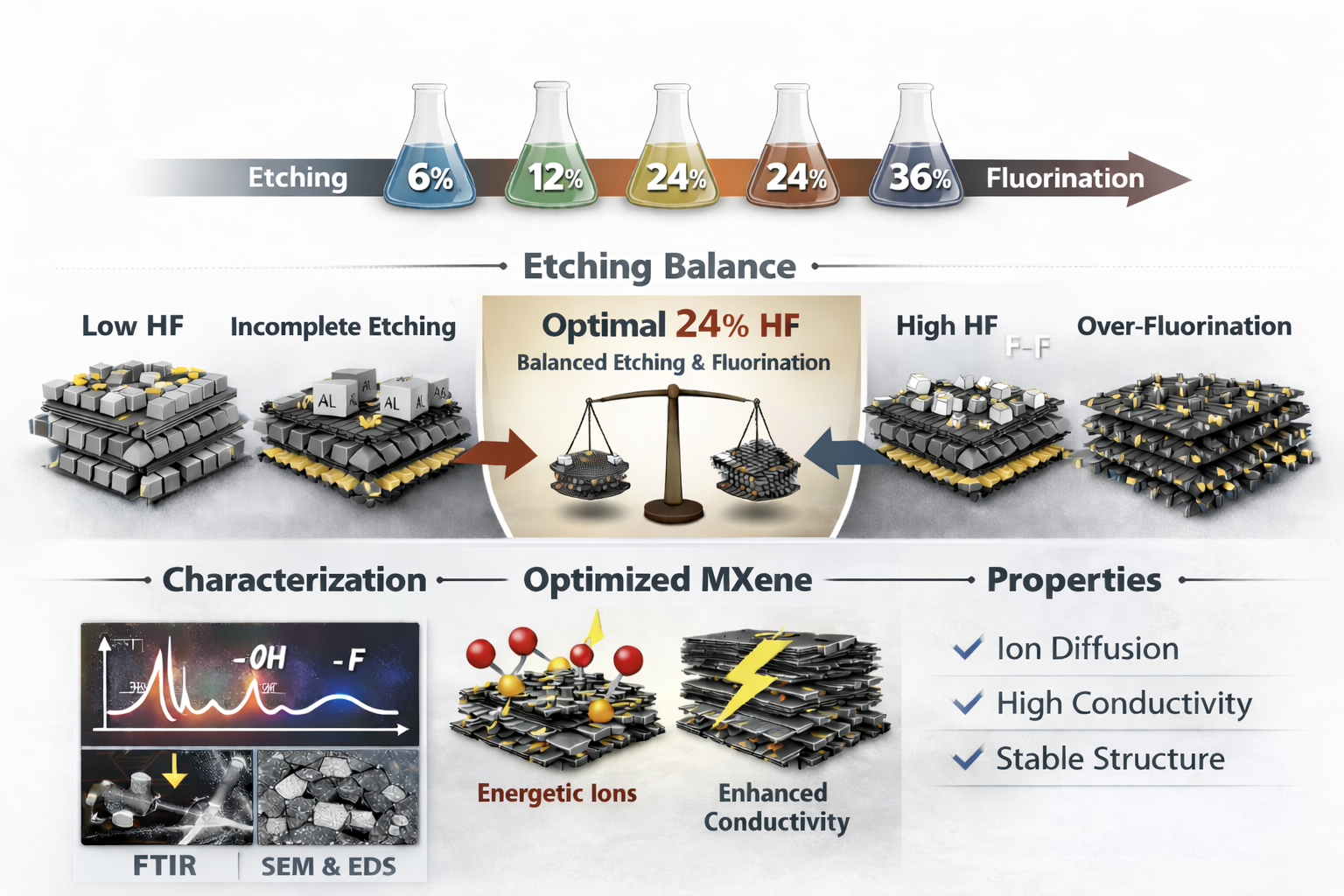
Two-dimensional MXenes have emerged as a versatile class of materials for energy storage, electronics, and catalysis owing to their high electrical conductivity, tunable surface chemistry, and layered structure; however, the controlled synthesis of Ti3C2Tx MXene with well-defined morphology and stable surface chemistry remains a major challenge, as etching conditions strongly influence structural integrity, degree of exfoliation, and functional performance. In this study, the morphological, structural, and functional evolution of Ti3C2Tx MXene materials was systematically investigated by applying hydrofluoric acid (HF) etching at varying concentrations (6 %, 12 %, 24 %, 36 %, and 48 %) using microwave-assisted method. The impact of etching intensity on Al removal, layer delamination, and surface functionalization was examined through a multi-technique characterization approach including scanning electron microscopy (SEM), X-ray diffraction (XRD), Fourier transform infrared spectroscopy (FTIR), and energy-dispersive X-ray spectroscopy (EDS). The results reveal that an HF concentration of 24 % achieves efficient Al extraction while preserving the Ti–C framework, yielding well-exfoliated and structurally stable MXene sheets. Lower HF concentrations (6 % and 12 %) lead to incomplete etching and limited exfoliation, whereas higher concentrations (36 % and 48 %) cause over-etching and pronounced structural degradation. These findings underscore the critical role of etching conditions in tuning MXene morphology and functional properties. The ability to balance surface termination control and structural integrity via gradient etching is particularly relevant for the use of Ti3C2Tx MXenes as conductive electrodes and interfacial layers in photovoltaic and other energy-conversion devices.
References
Naguib, M., Kurtoglu, M., Presser, V., Lu, J., Niu, J., Heon, M., Hultman, L., Gogotsi, Y., & Barsoum, M. (2011). Two-dimensional nanocrystals produced by exfoliation of Ti3C2Tx. Advanced Materials, 23, 4207. https://doi.org/10.1002/adma.201190147 DOI: https://doi.org/10.1002/adma.201190147
Anasori, B., Lukatskaya, M.R., & Gogotsi, Y. (2017). 2D metal carbides and nitrides (MXenes) for energy storage. Nature Reviews Materials, 2, 16098. https://doi.org/10.1038/natrevmats.2016.98 DOI: https://doi.org/10.1038/natrevmats.2016.98
Vahid Mohammadi, A., Rosen, J., & Gogotsi, Y. (2021). The world of two-dimensional carbides and nitrides (MXenes). Science, 372(6547). https://doi.org/10.1126/science.abf1581 DOI: https://doi.org/10.1126/science.abf1581
Lei, J.C., Zhang, X., & Zhou, Z. (2015). Recent advances in MXene: preparation, properties, and applications. Frontiers of Physics, 10, 276–286. https://doi.org/10.1007/s11467-015-0493-x DOI: https://doi.org/10.1007/s11467-015-0493-x
Alhabeb, M., Maleski, K., Anasori, B., Lelyukh, P., Clark, L., Sin, S., & Gogotsi, Y. (2017). Guidelines for synthesis and processing of 2D titanium carbide (Ti3C2Tx) MXene. Chemistry of Materials, 29, 7633–7644. https://doi.org/10.1021/acs.chemmater.7b02847
Krishnaiah, P., Awan, H., Walvekar, R., & Manickam, S. (2022). MXene-based composites and their applications. In: MXene Materials. Springer, 4, 1–?. https://doi.org/10.1007/978-3-031-05006-0_4 DOI: https://doi.org/10.1007/978-3-031-05006-0_4
Mashtalir, O., Naguib, M., Mochalin, V.N., Dall’Agnese, Y., Heon, M., Barsoum, M.W., & Gogotsi, Y. (2013). Intercalation and delamination of layered carbides and carbonitrides. Nature Communications, 4, 1716. https://doi.org/10.1038/ncomms2664
Nouseen, S., & Pumera, M. (2025). Electrochemical etching of MXenes: mechanism, challenges and future outlooks. Journal of Materials Chemistry A, 13, 34055–34084. https://doi.org/10.1039/D5TA04176G DOI: https://doi.org/10.1039/D5TA04176G
Rahman, U.U., Humayun, M., Ghani, U., Usman, M., Ullah, H., Khan, A., El-Metwaly, N., & Khan, A. (2022). MXenes as emerging materials: synthesis, properties, and applications. Molecules, 27, 4909. https://doi.org/10.3390/molecules27154909 DOI: https://doi.org/10.3390/molecules27154909
Peng, Y.Y., Akuzum, B., Kurra, N., Zhao, M., Alhabeb, M., Anasori, B., & Gogotsi, Y. (2016). All-MXene solid-state microsupercapacitors for on-chip energy storage. Energy & Environmental Science, 9, 2847–2854. https://doi.org/10.1039/C6EE01717G DOI: https://doi.org/10.1039/C6EE01717G
Khazaei, M., Arai, M., Sasaki, T., Chung, C.Y., Estili, M., Sakka, Y., & Kawazoe, Y. (2013). Novel electronic and magnetic properties of two-dimensional transition metal carbides and nitrides. Advanced Functional Materials, 23, 2185–2192. https://doi.org/10.1002/adfm.201202502 DOI: https://doi.org/10.1002/adfm.201202502
Khanal, R., & Irle, S. (2023). Effect of surface functional groups on MXene conductivity. Journal of Chemical Physics, 158, 124703. https://doi.org/10.1063/5.0141589 DOI: https://doi.org/10.1063/5.0141589
Rafique, M., Tahir, M., & Anwar, S. (2024). MXenes for energy storage applications. In: MXene Materials. CRC Press. https://doi.org/10.1201/9781003465768 DOI: https://doi.org/10.1201/9781003465768
Mozafari, M., & Soroush, M. (2021). Surface functionalization of MXenes. Materials Advances, 2, 7277–7291. https://doi.org/10.1039/D1MA00625H DOI: https://doi.org/10.1039/D1MA00625H
Yang, G., Yao, X., Li, Y., Hu, Y., Chen, X., Li, J., Chen, J., & Jiang, J. (2023). Ti3C2Tx MXene Nanosheet-Based Hybrid Films for Enhanced Wave Absorption-Dominated Electromagnetic Interference Shielding. ACS Applied Nano Materials, 6(20), 19378–19391. https://doi.org/10.1021/acsanm.3c03932 DOI: https://doi.org/10.1021/acsanm.3c03932
Berdiyorov, G. (2015). Effect of lithium and sodium ion adsorption on electronic transport properties of Ti3C2 MXene. Applied Surface Science, 359, 153–158. https://doi.org/10.1016/j.apsusc.2015.10.050 DOI: https://doi.org/10.1016/j.apsusc.2015.10.050
Berdiyorov, G., & Mahmoud, K. (2017). Effect of surface termination on ion intercalation selectivity of bilayer Ti3C2Tx MXene. Applied Surface Science, 416, 980–986. https://doi.org/10.1016/j.apsusc.2017.04.195 DOI: https://doi.org/10.1016/j.apsusc.2017.04.195
Berdiyorov, G. R. (2016). Optical properties of functionalized Ti3C2T2 (T = F, O, OH) MXene: First-principles calculations. AIP Advances, 6(5). https://doi.org/10.1063/1.4948799 DOI: https://doi.org/10.1063/1.4948799
Rasool, K., Pandey, R., Rasheed, P.A., Berdiyorov, G., & Mahmoud, K. (2019). MXenes for environmental and water treatment applications. In: MXenes. Springer. https://doi.org/10.1007/978-3-030-19026-2_22 DOI: https://doi.org/10.1007/978-3-030-19026-2_22
Rasool, K., Mahmoud, K., Johnson, D.J., Helal, M.I., Berdiyorov, G., & Gogotsi, Y. (2017). Efficient antibacterial membrane based on Ti3C2Tx MXene nanosheets. Scientific Reports. 7:1598. https://doi.org/10.1038/s41598-017-01714-3 DOI: https://doi.org/10.1038/s41598-017-01714-3
Liu, L., Zschiesche, H., Antonietti, M., Daffos, B., Tarakina, N., Gibilaro, M., Chamelot, P., Massot, L., Duployer, B., Taberna, P.L., & Simon, P. (2023). Tuning the surface chemistry of MXene to improve energy storage: example of nitrification by salt melt. Advanced Energy Materials, 13, 2202709. https://doi.org/10.1002/aenm.202202709 DOI: https://doi.org/10.1002/aenm.202202709
Fagerli, F., Wang, Z., Grande, T., Kaland, H., Selbach, S.M., Wagner, N., & Wiik, K. (2022). Removing fluoride terminations from multilayered V2CTx MXene by gas hydrolyzation. ACS Omega, 7, 24656–24665. https://doi.org/10.1021/acsomega.2c02441 DOI: https://doi.org/10.1021/acsomega.2c02441
Lei, J., Yu, F., Xie, H., & Ma, J. (2023). Ti3C2Tx MXene/carbon nanofiber multifunction electrode for electrodeionization with antifouling activity. Chemical Science, 14(13), 3610–3621. https://doi.org/10.1039/d2sc06946f DOI: https://doi.org/10.1039/D2SC06946F
Huang, L., Ding, L., & Wang, H. (2021). MXene-based membranes for separation applications. Small Science, 1, 2100013. https://doi.org/10.1002/smsc.202100013 DOI: https://doi.org/10.1002/smsc.202100013
Carey, M., & Barsoum, M.W. (2021). MXene polymer nanocomposites: a review. Materials Today Advances, 9, 100120. https://doi.org/10.1016/j.mtadv.2020.100120 DOI: https://doi.org/10.1016/j.mtadv.2020.100120
Abbasi, F., Hajilary, N., & Rezakazemi, M. (2022). Antibacterial properties of MXene-based nanomaterials: a review. Materials Express, 12,34–48. https://doi.org/10.1166/mex.2022.2138 DOI: https://doi.org/10.1166/mex.2022.2138
Naguib, M., Unocic, R.R., Armstrong, B.L., & Nanda, J. (2015). Large-scale delamination of multilayer transition metal carbides and carbonitrides (MXenes). Dalton Transactions, 44, 9353–9358. https://doi.org/10.1039/C5DT01247C DOI: https://doi.org/10.1039/C5DT01247C
Gentile, A., Marchionna, S., Balordi, M., Pagot, G., Ferrara, C., Noto, V., & Ruffo, R. (2022). Critical analysis of MXene production with in situ HF forming agents for sustainable manufacturing. ChemElectroChem, 9, e202200891. https://doi.org/10.1002/celc.202200891
Wang, Y., Xu, Y., Hu, M., Ling, H., & Zhu, X. (2020). MXenes: focus on optical and electronic properties and corresponding applications. Nanophotonics, 9, 1–24. https://doi.org/10.1515/nanoph-2019-0556 DOI: https://doi.org/10.1515/nanoph-2019-0556
Ahmed, Z., Rehman, F.U., Ali, U., Ali, A., Iqbal, M., & Thebo, K.H. (2021). Recent advances in MXene-based separation membranes. ChemBioEng Reviews, 8, 1–12. https://doi.org/10.1002/cben.202000026 DOI: https://doi.org/10.1002/cben.202000026
Thangavelu, H., Huang, C., Chabanais, F., Palisaitis, J., & Persson, P. (2025). A review on MXene terminations. Advanced Functional Materials, 36, 25015604. https://doi.org/10.1002/adfm.202515604 DOI: https://doi.org/10.1002/adfm.202515604
Kumar, S., Park, H., Kumar, M., & Seo, Y. (2023). Long-term stability studies and applications of Ti3C2Tx MXene. International Journal of Energy Research, 2023, 5275439. https://doi.org/10.1155/2023/5275439 DOI: https://doi.org/10.1155/2023/5275439
Lee, A., Shekhirev, M., Anayee, M., & Gogotsi, Y. (2024). Multi-year study of environmental stability of Ti3C2Tx MXene films. Graphene and 2D Materials, 9, 1–9. https://doi.org/10.1007/s41127-024-00076-8
Jun, B.M., Kim, S., Heo, J., Park, C.M., Her, N.G., Jang, M., Huang, H., Han, J., & Yoon, Y. (2019). Review of MXenes as new nanomaterials for energy storage/delivery and selected environmental applications. Nano Research, 12, 471–487. https://doi.org/10.1007/s12274-018-2225-3 DOI: https://doi.org/10.1007/s12274-018-2225-3
Kouao, D.S., & Siuzdak, K. (2025). Electrochemical synthesis of MXenes: a promising leap beyond hydrothermal MAX phase etching. 2D Materials, 13, 012001. https://doi.org/10.1088/2053-1583/ae2a4d DOI: https://doi.org/10.1088/2053-1583/ae2a4d
Kruger, D., Garcia, H., & Primo, A. (2024). Molten salt derived MXenes: synthesis and applications. Advanced Science, 11, 2307106. https://doi.org/10.1002/advs.202307106 DOI: https://doi.org/10.1002/advs.202307106
Berdiyorov, G., Madjet, M., & Mahmoud, K. (2021). First-principles density functional theory calculations of bilayer Ti3C2Tx MXene/graphene and AgNP heterostructure membranes. Membranes, 11, 543. https://doi.org/10.3390/membranes11070543 DOI: https://doi.org/10.3390/membranes11070543
Mahabari, K., Mohili, R.D., Patel, M., Jadhav, A.H., Lee, K., & Chaudhari, N.K. (2024). HF-free microwave-assisted synthesis of MXene as an electrocatalyst for hydrogen evolution in alkaline media. Nanoscale Advances, 6, 5388–5397. https://doi.org/10.1039/D4NA00250D DOI: https://doi.org/10.1039/D4NA00250D
Feng, Y., Zhang, M., Yan, H., Zhang, Y., Guo, R., & Wang, H. (2022). Microwave-assisted efficient exfoliation of MXene and its composite for high-performance supercapacitors. Ceramics International, 48, 9518–9526. https://doi.org/10.1016/j.ceramint.2021.12.149 DOI: https://doi.org/10.1016/j.ceramint.2021.12.149
Mashangva, T.T., Vishwakarma, N., Singh, P.P., Prasher, S., Dhiman, R., Kumar, M., & Sharma, A. (2026). Synergistic enhancement of electrochemical properties in domestic microwave-assisted Ti3C2Tx MXene composite with V2O5 nanoparticles for supercapacitor applications. Journal of Energy Storage, 150, 120387. https://doi.org/10.1016/j.est.2026.120387 DOI: https://doi.org/10.1016/j.est.2026.120387
Bagri, U., Jan, S., Sharma, A., & Singh, P.P. (2025). Enhanced photocatalytic degradation of ciprofloxacin from pharmaceutical wastewater using microwave-synthesized lanthanum/MXene nanocomposites. Topics in Catalysis. https://doi.org/10.1007/s11244-025-02214-9 DOI: https://doi.org/10.1007/s11244-025-02214-9
Numan, A., Rafique, S., Khalid, M., Zaharin, H., Radwan, A., Mokri, N., Oh, P.C., & Rashmi, W. (2022). Microwave-assisted rapid MAX phase etching and delamination: A paradigm shift in MXene synthesis. Materials Chemistry and Physics, 288, 126429. https://doi.org/10.1016/j.matchemphys.2022.126429 DOI: https://doi.org/10.1016/j.matchemphys.2022.126429
Saha, A., Shpigel, N., Leifer, N., Taragin, S., Sharabani, T., Aviv, H., Perelshtein, I., Nessim, G., Noked, M., & Gogotsi, Y. (2021). Enhancing the energy storage capabilities of Ti3C2Tx MXene electrodes by atomic surface reduction. Advanced Functional Materials, 31, 2106294. https://doi.org/10.1002/adfm.202106294 DOI: https://doi.org/10.1002/adfm.202106294
Liu, S., Zhou, Y., Zhou, J., Tang, H., Gao, F., Zhao, D., Ren, J., Wu, Y., Wang, Z., Luo, Y., Liu, X., & Zhang, Y. (2022). Ti3C2Tx MXene-based flexible materials for electrochemical energy storage and solar energy conversion. Nanophotonics, 11, 3139–3164. https://doi.org/10.1515/nanoph-2022-0228 DOI: https://doi.org/10.1515/nanoph-2022-0228
Liu, Y., Wang, Y., Wu, N., Han, M., Liu, W., Liu, J., & Zeng, Z. (2023). Diverse structural design strategies of MXene-based macrostructures for high-performance electromagnetic interference shielding. Nano-Micro Letters, 15, 203. https://doi.org/10.1007/s40820-023-01203-5 DOI: https://doi.org/10.1007/s40820-023-01203-5
Hwang, H., Yang, S., Yuk, S., Lee, K.S., Byun, S., & Lee, D. (2023). Ti3C2Tx MXene as a growth template for amorphous RuOₓ in carbon nanofiber-based flexible electrodes for enhanced pseudocapacitive energy storage. NPG Asia Materials, 15, 76. https://doi.org/10.1038/s41427-023-00476-x DOI: https://doi.org/10.1038/s41427-023-00476-x
Jose, S., Price, J., Lopez, J., Perez-Perez, E., & Menezes, P. (2025). Advances in MXene materials: fabrication, properties, and applications. Materials, 18, 4894. https://doi.org/10.3390/ma18214894 DOI: https://doi.org/10.3390/ma18214894
Cai, Z., & Kim, H. (2025). Recent advances in MXene gas sensors: synthesis, composites, and mechanisms. npj 2D Materials and Applications, 9, 58. https://doi.org/10.1038/s41699-025-00586-w DOI: https://doi.org/10.1038/s41699-025-00586-w
Said, Z., Sohail, M., Tabassum, H., Sajid, I., Ali, H., Jamil, F., Mishra, Y.K., & Pandey, A. (2025). MXenes at the forefront: advances in energy storage and nanofluidic applications. Advanced Composites and Hybrid Materials, 8, 1404. https://doi.org/10.1007/s42114-025-01404-z DOI: https://doi.org/10.1007/s42114-025-01404-z
Silva, L., Fileti, E.E., & Colherinhas, G. (2025). Exploring MXene materials in energy storage devices: a review of supercapacitor applications. ACS Materials Au, 5, 1–18. https://doi.org/10.1021/acsmaterialsau.5c00102 DOI: https://doi.org/10.1021/acsmaterialsau.5c00102
Jawad, N., Darwesh, T., Abbas, A., Yahya, A.A., Hilal, A., Rashid, K., Abood, T., Al-Juboori, R., Meskher, H., & Al-Saadi, S. (2025). MXene synthesis, surface functionalization, and membrane integration for photocatalytic removal of heavy metals from wastewater. Materials Today Sustainability, 32, 101208. https://doi.org/10.1016/j.mtsust.2025.101208 DOI: https://doi.org/10.1016/j.mtsust.2025.101208
Han, Y., Hu, J., Liu, X., & Liu, F. (2025). Progress in Surface and Interface Modification Strategies of MXene Materials for Energy Storage Applications. Materials, 18(15), 3576. https://doi.org/10.3390/ma18153576 DOI: https://doi.org/10.3390/ma18153576
Li, H., Liu, L., Yuan, T., Zhang, J., Wang, T., Hou, J., & Chen, J. (2024). Advances in MXene surface functionalization strategies for CO2 reduction. Nanoscale, 16(24), 11480–11495. https://doi.org/10.1039/d4nr01517g DOI: https://doi.org/10.1039/D4NR01517G
Koh, S.W., Rekhi, L., Arramel, A., Birowosuto, M.D., Trinh, T., Ge, J., Yu, W., Wee, A.T.S., & Li, C.H. (2024). Tuning the work function of MXene via surface functionalization. ACS Applied Materials & Interfaces, 16, 11234–11244. https://doi.org/10.1021/acsami.3c11857 DOI: https://doi.org/10.1021/acsami.3c11857
Ganesan, S., Ethiraj, K., Kumar, K., & Palaniappan, A. (2022). Biomedical applications of MXenes. In: MXene Materials. Springer. https://doi.org/10.1007/978-3-031-05006-0_11 DOI: https://doi.org/10.1007/978-3-031-05006-0_11
Bhattacharjee, Y., Mielke, L., Al-Hussein, M., Singh, S., Schaefer, K., Rodriguez-Barea, B., Li, Q., Ghosh, A.K., Erbe, A., Herrmann, C., Vaynzof, Y., Fery, A., & Schlicke, H. (2025). Molecular cross-linking of MXenes: tunable interfaces and chemiresistive sensing. Advanced Functional Materials, 35, 2501884. https://doi.org/10.1002/adfm.202518884 DOI: https://doi.org/10.1002/adfm.202518884
Shuck, C.E., Sarycheva, A., Anayee, M., Levitt, A., Zhu, Y., Uzun, S., Balitskiy, V., Zahorodna, V., & Gogotsi, Y. (2020). Scalable synthesis of Ti3C2Tx MXene. Advanced Engineering Materials, 22, 1901241. https://doi.org/10.1002/adem.201901241 DOI: https://doi.org/10.1002/adem.201901241
Gentile, A., Marchionna, S., Balordi, M., Pagot, G., Ferrara, Ch., Di Noto, V., & Ruffo, R. (2022). Critical Analysis of MXene Production with In-Situ HF Forming Agents for Sustainable Manufacturing. ChemElectroChem, 9(23). https://doi.org/10.1002/celc.202200891 DOI: https://doi.org/10.1002/celc.202201063
Lee, A., Shekhirev, M., Anayee, M. & Gogotsi, Y. (2024). Multi year study of environmental stability of Ti3C2Tx MXene films. Graphene and 2D Materials, 9, 77–85. https://doi.org/10.1007/s41127-024-00076-8 DOI: https://doi.org/10.1007/s41127-024-00076-8
Kiran, N.U., Deore, A., More, M., Raye, D., Rout, C.S., Mane, P., Chakraborty, B., Besra, L., & Chatterjee, S. (2022). Comparative study of cold electron emission from 2D Ti3C2Tx MXene nanosheets with respect to its precursor Ti3SiC2 MAX phase. ACS Applied Electronic Materials, 4(6), 2656–2666. https://doi.org/10.1021/acsaelm.2c00128 DOI: https://doi.org/10.1021/acsaelm.2c00128
Solangi, M.Y., Hanan, A., Aftab, U., Soomro, I.A., & Ibupoto, Z.H. (2025). Novel titanium carbide (Ti3C2Tx) MXene electrocatalyst for HER application. NUST Journal of Engineering Sciences, 18(1). https://journals.nust.edu.pk/index.php/ njes/issue/view/35
Fu, S., Zhou, Q., Jin, C., Gao, Z., Niu, M., Wan, D., & Bao, Y. (2025). Interface protection mechanism of Ti3AlC2 ceramics under CMAS corrosion condition. International Journal of Applied Ceramic Technology, 22, e15134. https://doi.org/10.1111/ijac.15134 DOI: https://doi.org/10.1111/ijac.15134
Bagheri, S., Lipatov, A., Vorobeva, N.S., & Sinitskii, A. (2023). Interlayer Incorporation of A-Elements into MXenes Via Selective Etching of A′ from Mn+1A′1–xA″xCn MAX Phases. ACS Nano, 17, 18747–18757. https://doi.org/10.1021/acsnano.3c02198 DOI: https://doi.org/10.1021/acsnano.3c02198
Ahmed, E.M., Ali, A.S., Hieba, E.M., Shaban, Z.S., Fathy, M.S., Amer, A.M., Ishmael, A.M., Bakr, A., Rashdan, H.R.M., & Elzwawy, A. (2025). Exploring the potential of MXenes in advanced energy, environmental, and biomedical applications. RSC Advances, 15, 44812–44863. https://doi.org/10.1039/D5RA04498G DOI: https://doi.org/10.1039/D5RA04498G
Mashtalir, O., Naguib, M., Mochalin, V.N., Dall’Agnese, Y., Heon, M., Barsoum, M.W., & Gogotsi, Y. (2013). Intercalation and Delamination of Layered Carbides (MXenes). Nature Communication, 4, 1716. https://doi.org/10.1038/ncomms2715 DOI: https://doi.org/10.1038/ncomms2664
Lipatov, A., Goad, A., Loes, M.J., Vorobeva, N.S., Abourahma, J., Gogotsi, Y., & Sinitski, A. (2021). High electrical conductivity and breakdown current density of individual monolayer Ti3C2Tx·MXene flakes. Matter, 4(4), 1413–1427. https://doi.org/10.1016/j.matt.2021.01.021 DOI: https://doi.org/10.1016/j.matt.2021.01.021
Magnuson, M. & Mattesini, M. (2017). Chemical bonding and electronic-structure in MAX phases as viewed by X-ray spectroscopy and density functional theory. Thin Solid Films, 621, 108–130. https://doi.org/10.1016/j.tsf.2016.11.005 DOI: https://doi.org/10.1016/j.tsf.2016.11.005
Long, Y., Tao, Y., Shang, T., Yang, H., Sun, Z., Chen, W. & Yang, Q. (2022). Roles of Metal Ions in MXene Synthesis, Processing and Applications: A Perspective. Advanced Science, 9, 2200296. https://doi.org/10.1002/advs.202200296 DOI: https://doi.org/10.1002/advs.202200296
Alhabeb, M., Maleski, K., Anasori, B., Lelyukh, P., Clark, L., Sin, S., & and Gogotsi, Y. (2017). Guidelines for Synthesis and Processing of Two-Dimensional Titanium Carbide (Ti3C2Tx·MXene). Chemistry of Materials, 29, 7633−7644. https://doi.org/10.1021/acs.chemmater.7b02847 DOI: https://doi.org/10.1021/acs.chemmater.7b02847
Downloads
Published
How to Cite
Issue
Section
License
Copyright (c) 2026 Khumoyunmirzo A. Gulomjonov, Nurbek Sh. Ashurov, Abdumutolib A. Atakhanov , Golibjon Berdiyorov

This work is licensed under a Creative Commons Attribution-NonCommercial-NoDerivatives 4.0 International License.

This work is licensed under a Creative Commons Attribution-NonCommercial-NoDerivatives 4.0 International License.
Authors retain copyright and grant the journal right of first publication with the work simultaneously licensed under a Creative Commons Attribution License (CC BY-NC-ND 4.0) that allows others to share the work with an acknowledgement of the work's authorship and initial publication in this journal.
