

Synthesis and Study of the Properties of a Composite Material Based on Sulfohumic Acid and Multi-Walled Carbon Nanotubes
DOI:
https://doi.org/10.31489/2959-0663/2-26-8Keywords:
natural polymer, composite, sulfohumic acid, multi-walled carbon nanotubes, modification, ultrasound, sorbent, sorptionAbstract
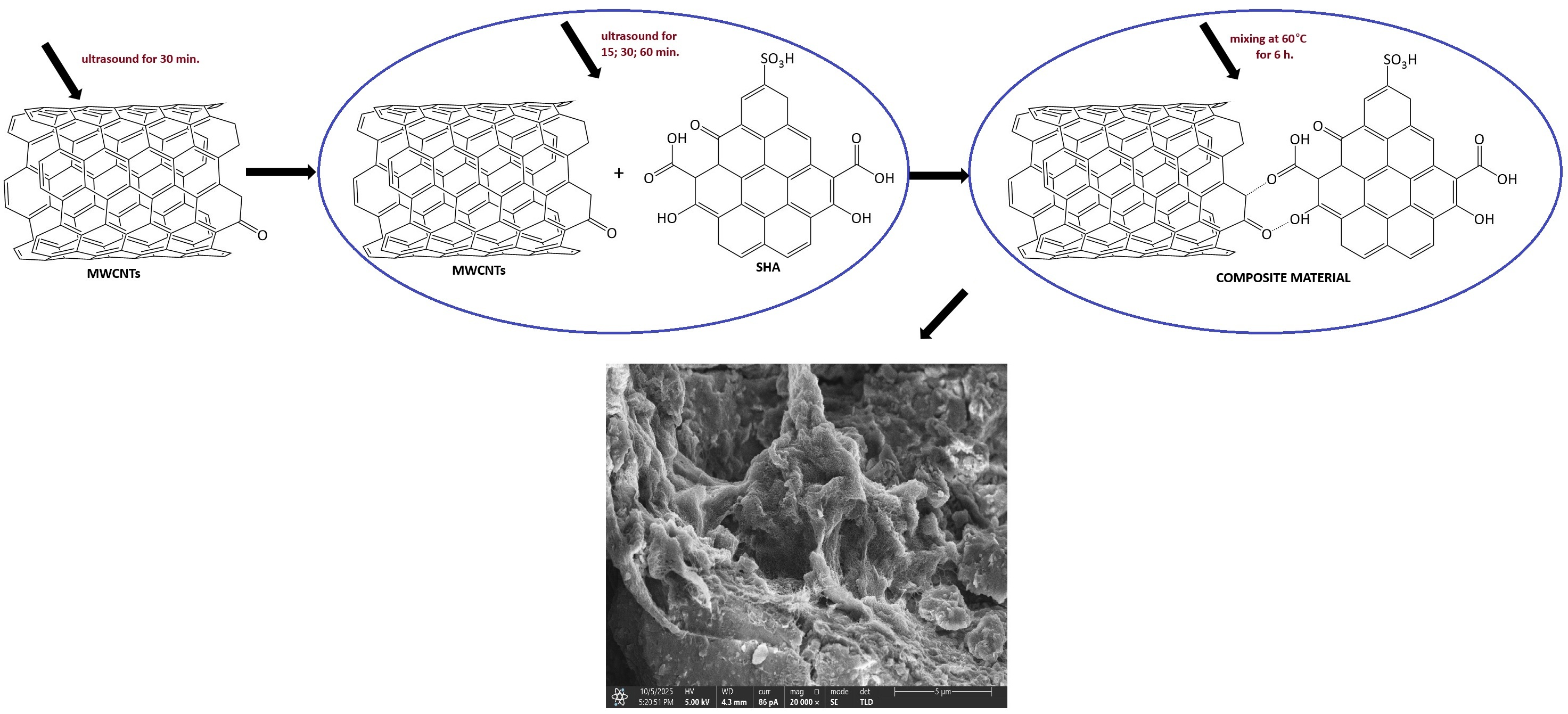
A composite sorption material based on sulfohumic acid (SHA) and multi-walled carbon nanotubes (MWCNTs) was synthesized. The composite was obtained via ultrasonic-enhanced coprecipitation, which ensures the efficient incorporation of nanotubes into the sulfohumic matrix. The structural and physicochemical properties of the initial SHA and the SHA:MWCNTs composite were studied using elemental analysis, conductometric titration, infrared spectroscopy, thermogravimetric analysis, and electron microscopy. The introduction of MWCNTs was shown to alter the surface morphology, increase roughness, and form a more developed porous structure. Thermogravimetric analysis indicates increased thermal stability of the composite material. The sorption properties of the synthesized composite with respect to Cu2+ ions from aqueous solutions were also studied. It was established that the SHA:MWCNTs composite possesses higher sorption capacity compared to the original SHA. Analysis of sorption isotherms revealed that the process is predominantly described by the Langmuir model, while satisfactory agreement with the Freundlich model indicates the energetic heterogeneity of the sorbent surface. These results demonstrate the potential of the SHA:MWCNTs composite as an effective sorption material for removing heavy metal ions from aqueous solutions.
References
Ciobanu, R., Bucatariu, F., Mihai, M., & Teodosiu, C. (2024). Silica-Based Composite Sorbents for Heavy Metal Ions Removal from Aqueous Solutions. Polymers, 16(21), 3048. https://doi.org/10.3390/polym16213048 DOI: https://doi.org/10.3390/polym16213048
Islam, R., Smith, N., Jang, B., & Guo, L. (2026). The Comparison of Fresh and Dry Duckweed (Lemna minor L.) on Metal (Cr6+, Cd2+, and Zn2+) Removal from Wastewater. Plants, 15(5), 848. https://doi.org/10.3390/plants15050848 DOI: https://doi.org/10.3390/plants15050848
Stanković, K., Telečki, I., Smiljanić, D., Bajuk-Bogdanović, D., Potočnik, J., Veselinović, L., & Kumrić, K. (2026). Chitosan/Cellulose Functional Composite Hydrogel as Adsorbent for the Removal of Cu(II) from Aqueous Solutions in Dynamic Adsorption System. Polysaccharides, 7(1), 30. https://doi.org/10.3390/polysaccharides7010030 DOI: https://doi.org/10.3390/polysaccharides7010030
Morozova, A.G., Lonzinger, T.M., Skotnikov, V.A., Mikhailov, G.G., Kapelyushin, Y., Khandaker, M.U., Alqahtani, A., Bradley, D.A., Sayyed, M.I., Tishkevich, D.I., Vinnik, D.A., & Trukhanov, A.V. (2022). Insights into Sorption–Mineralization Mechanism for Sustainable Granular Composite of MgO-CaO-Al2O3-SiO2-CO2 Based on Nanosized Adsorption Centers and Its Effect on Aqueous Cu(II) Removal. Nanomaterials, 12(1), 116. https://doi.org/10.3390/nano12010116 DOI: https://doi.org/10.3390/nano12010116
Baby, R., Saifullah, B. & Hussein, M.Z. (2019). Carbon Nanomaterials for the Treatment of Heavy Metal-Contaminated Water and Environmental Remediation. Nanoscale Res Lett, 14, 341. https://doi.org/10.1186/s11671-019-3167-8 DOI: https://doi.org/10.1186/s11671-019-3167-8
Sakthivel, U., Gopi Kumar, S. (2025). A Review on Heavy Metal Adsorption Using Nanocomposites for Wastewater Treatment. In S.B. Singh, M. Gopalarathnam, N. Roy. (Eds), Proceedings of the 3rd International Conference on Advances in Concrete, Structural, and Geotechnical Engineering-Volume 3. ACSGE 2024. (pp 317-325). Springer Proceedings in Materials, Springer, Singapore. https://doi.org/10.1007/978-981-96-0755-6_26 DOI: https://doi.org/10.1007/978-981-96-0755-6_26
Kumari, S., Kaur, M., Dhania, G. (2023). Carbon Nanomaterials for Wastewater Treatment. In: Malik, J.A., Sadiq Mohamed, M.J. (eds) Modern Nanotechnology. Springer, Cham., 255-277. https://doi.org/10.1007/978-3-031-31111-6_11 DOI: https://doi.org/10.1007/978-3-031-31111-6_11
Wang, H., Sun, X., Wang, Y., Hong Wang, Xu Sun, Yizhuo Wang, Li K., Wang, J., Dai, X., Chen, B., Chong, D., Zhang, L. & Yan J. (2023). Acid enhanced zipping effect to densify MWCNT packing for multifunctional MWCNT films with ultra-high electrical conductivity. Nat Commun, 14, 380. https://doi.org/10.1038/s41467-023-36082-2 DOI: https://doi.org/10.1038/s41467-023-36082-2
Sabzehmeidani, M. M., Mahnaee, S., Ghaedi, M., Heidari, H., Roy, V.A.L. (2021). Carbon based materials: a review of adsorbents for inorganic and organic compounds. Mater. Adv., 2, 598. https://doi.org/10.1039/D0MA00087F DOI: https://doi.org/10.1039/D0MA00087F
Adegoke, K.A., Okon-Akan, O.A., Adebusuyi, T.A., Adewuyi, O.I., Oluwatosin Adu, P., Bamisaye, A., Adegoke, O.R., Opeyemi Babarinde, C., Bello, O.S. (2025). Adsorptive removal of gaseous contaminants using biomass-based adsorbents. RSC Adv., 15, 13960. https://doi.org/10.1039/D4RA08572H DOI: https://doi.org/10.1039/D4RA08572H
Oladipo, M., Ogunsola, S., Oladoye, P. (2025). Covalent and non-covalent carbon nanotube functionalization: A review for the case of assessment criteria, and practical implementation in wastewater treatment. Chemosphere, 385, 144549. https://doi.org/10.1016/j.chemosphere.2025.144549 DOI: https://doi.org/10.1016/j.chemosphere.2025.144549
Suthar, V., Sharma, P., Murthy, C.N. (2024). Advances in Functionalized Polymer Nanocomposites: From Synthesis to Applications (Woodhead Publishing Series in Composites Science and Engineering). 339–378. https://doi.org/10.1016/B978-0-443-18860-2.00021-9 DOI: https://doi.org/10.1016/B978-0-443-18860-2.00021-9
Temirgaliyeva, T.S., Nazhipkyzy, M., Nurgain, A., Turganbay, Dinistanova, B. & Mansurov, Z.A. (2020). Synthesis of Multiwall Carbon Nanotubes by the Cvd Method and their Functionalization. J Eng Phys Thermophy, 93, 91–94 https://doi.org/10.1007/s10891-020-02094-8 DOI: https://doi.org/10.1007/s10891-020-02094-8
Brito, C.L., Ferreira, E.I. & La-Scalea, M.A. (2020). Multi-walled carbon nanotube functionalization and the dispersing agents study applied for the glassy carbon electrode modification and voltammetric reduction of nitrofurazone. J Solid State Electrochem, 24, 1969–1980 https://doi.org/10.1007/s10008-020-04621-2 DOI: https://doi.org/10.1007/s10008-020-04621-2
Parameshwarappa, S., Chinnagiri, K.T., Chinnagiri, R.T. & Thippandegowdru, R.M. (2026). Sulfathiazole-Azo-Aniline Dye as Electrode Modifier for Carbon Paste Electrode: Synthesis and Electrochemical Evaluation for the Simultaneous Determination of Dopamine, Uric Acid, and Tyrosine. Top Catal. https://doi.org/10.1007/s11244-026-02271-8 DOI: https://doi.org/10.1007/s11244-026-02271-8
Gao, L., Zhang, J., Liu, Q., Xu, H., Wan, M. & Guan, X. (2026). Study on the synergistic modification of Chinese fir wood cell walls by carbon dots and polyethylene glycol. Wood Sci Technol, 60, 40 https://doi.org/10.1007/s00226-026-01753-y DOI: https://doi.org/10.1007/s00226-026-01753-y
Zhakina, A.K., Vassilets, Y.P., Arnt, O.V., Kudryavtseva Ye.V., Zhivotova T.S., Gazaliev A.M., Muldakhmetov Z.M. (2020). Synthesis and Properties of a Nanocomposite Material Based on a Product of Coal Waste Processing. Solid Fuel Chem., 54, 274–279. https://doi.org/10.3103/S0361521920050109 DOI: https://doi.org/10.3103/S0361521920050109
Tian, X., Yang, K., Xu, Y., Lu, H., Lin, D. (2013). Effect of Humic Acids on the Physicochemical Property and Cd(II) Sorption of Multiwalled Carbon Nanotubes. In J. Xu, J. Wu, Y. He (Eds.), Functions of Natural Organic Matter in Changing Environment (pp. 751–755). Springer, Dordrecht. https://doi.org/10.1007/978-94-007-5634-2_136 DOI: https://doi.org/10.1007/978-94-007-5634-2_136
Gvozdeva, Y., Peneva, P., & Katsarov, P. (2025). Biomedical Applications of Humic Substances: From Natural Biopolymers to Therapeutic Agents. Antioxidants, 14(9), 1139. https://doi.org/10.3390/antiox14091139 DOI: https://doi.org/10.3390/antiox14091139
Ioannidis, I., Vakarou, G., Sarrou, I., & Pashalidis, I. (2026). Uranium Adsorption at Increased and Ultra-Trace Levels by Humic Acid-Coated Alumina: Thermodynamic and Kinetic Studies. Applied Sciences, 16(4), 1829. https://doi.org/10.3390/app16041829 DOI: https://doi.org/10.3390/app16041829
Beza, P., Anastopoulos, I., Arkas, M., Bompotis, T., Giannakopoulos, K., Ioannidis, I., & Pashalidis, I. (2025). The Impact of Humic Acid Coating on the Adsorption of Radionuclides (U-232) by Fe3O4 Particles. Coatings, 15(12), 1399. https://doi.org/10.3390/coatings15121399 DOI: https://doi.org/10.3390/coatings15121399
Helal, A.A., Ahmed, I.M., Gamal, R., Abo-El-Enein, S.A., Helal, A.A. (2022). Sorption of uranium(VI) from aqueous solution using nanomagnetite particles; with and without humic acid coating. J. Radioanal. Nucl. Chem., 331, 3005–3014. https://doi.org/10.1007/s10967-022-08352-8 DOI: https://doi.org/10.1007/s10967-022-08352-8
He, Z., Wang, D., Shi, L., Xie, H., Xiong, Y., & Zhang, D. (2025). Effects of Humic Acids, Freeze–Thaw and Oxidative Aging on the Adsorption of Cd(II) by the Derived Cuttlebones: Performance and Mechanism. Sustainability, 17(21), 9628. https://doi.org/10.3390/su17219628 DOI: https://doi.org/10.3390/su17219628
Bolin, L., Zhongwu, L., Jia, C., Changsheng, J., Weicheng, C., Bo, P. (2025). Humic-like components in dissolved organic matter inhibit cadmium sequestration by sediment. Journal of Environmental Sciences, 150, 645–656. https://doi.org/10.1016/j.jes.2024.03.055 DOI: https://doi.org/10.1016/j.jes.2024.03.055
Yang, Y., Wang, B., Guo, X., Zou, C., Tan, X. (2019). Investigating adsorption performance of heavy metals onto humic acid from sludge using Fourier-transform infrared combined with two-dimensional correlation spectroscopy. Environ Sci Pollut Res, 26, 9842–9850. https://doi.org/10.1007/s11356-019-04445-2 DOI: https://doi.org/10.1007/s11356-019-04445-2
Cozzolino, A., Conte, P., Piccolo, A. (2001). Conformational changes of humic substances induced by some hydroxy-, keto-, and sulfonic acids. Soil Biology and Biochemistry, 33. 563–571. https://doi.org/10.1016/S0038-0717(00)00196-6 DOI: https://doi.org/10.1016/S0038-0717(00)00196-6
Khil'ko, S. (2011). Mechanochemicheskoe sulfirovanie huminovich kislot [Mechanochemical Sulfonation of Humic Acids]. Nauchnyye trudy Donetskogo natsional'nogo tekhnicheskogo universiteta. Seriya: Khimiya i khimicheskaya tekhnologiya — Scientific works of Donetsk National Technical University. Series: chemistry and Chemical Technology 17 (187), 103–111 [in Russian]. https://ea.donntu.edu.ua/bitstream/123456789/3425/1/Hil%27ko.pdf
Zhang, A., Shen, Y., Lv, P., & Li, M. (2018). Preparation of sulfonated humic acid aquasorb and its performance. New Chemical Materials, 46(9), 256–259. https://caod.oriprobe.com/articles/55261331/Preparation_of_sulfonated_humic_acid_ aquasorb_and_.htm
Hou, K., Xu, X., Xiang, Y., Kun Hou, Xinshuai Xu, Yong Xiang, Chen, X., Lam, S. S., Naushad, M., Sonne C., & Ge, S. (2023). Rapid uptake of gold ions by sulfonated humic acid modified phenolic resin with high adsorption capacity and selectivity. Adv Compos Hybrid Mater., 6, 77. https://doi.org/10.1007/s42114-023-00647-y DOI: https://doi.org/10.1007/s42114-023-00647-y
Yudov, M.V., Zhilin, D.M., Pankova, A.P., Rusanov, A.G., Perminova, I.V., Petrosyan, V.S., Matorin, D.N. (n.d.). Synthesis, metal-binding properties and detoxifying ability of sulphonated humic acids. Chapter 24. Use of Humic Substances to Remediate Polluted Environments: From Theory to Practice, 485–498. https://doi.org/10.1007/1-4020-3252-8 DOI: https://doi.org/10.1007/1-4020-3252-8
Osman, A.I., El-Monaem, E.M.A., Elgarahy, A.M., Aniagor, C.O., Hosny, M., Farghali, M., Rashad, E., Ejimofor, M.I., López-Maldonado, E.A., Ihara, I., Yap, P-S., Rooney D.W., & Eltaweil, Ab.S. (2023). Methods to prepare biosorbents and magnetic sorbents for water treatment: a review. Environ Chem Lett., 21, 2337–2398. https://doi.org/10.1007/s10311-023-01603-4 DOI: https://doi.org/10.1007/s10311-023-01603-4
Dong, M., Guo, J., Wang, Y., Gai, X., Xiong, X., Zeng, J., Wang, Y., Wu, Y. (2022). Humic acid non-covalent functionalized multi-walled carbon nanotubes composite membrane and its application for the removal of organic dyes. J. Env. Chem. Eng., 10, 2, 107320. https://doi.org/10.1016/j.jece.2022.107320 DOI: https://doi.org/10.1016/j.jece.2022.107320
Chappell, M.A., George, A.J., Dontsova, K.M., Porter, B.E., Price, C.L., Zhou, P., Morikawa, E., Kennedy, A.J., Steevens, J.A. (2009). Surfactive stabilization of multi-walled carbon nanotube dispersions with dissolved humic substances. Environmental Pollution, 157, 4, 1081–1087. https://doi.org/10.1016/j.envpol.2008.09.039 DOI: https://doi.org/10.1016/j.envpol.2008.09.039
Akkulova, Z.G., Amirkhanova A.K., Zhakina A.Kh., Kudaibergen G.K., Vassilets E.P., Sadykova O.V. (2015). Surface morphology and sorption characteristics of humates and sulphohumate nanocomposites with natural and synthetic polymers and carbon nanotubes. Chemical Journal of Kazakhstan, 4, 184–188.
Downloads
Published
How to Cite
Issue
Section
License
Copyright (c) 2026 Yevgeniy P. Vassilets, Alma Kh. Zhakina, Oxana V. Arnt, Almat M. Zhakin, Zainulla Muldakhmetov

This work is licensed under a Creative Commons Attribution-NonCommercial-NoDerivatives 4.0 International License.

This work is licensed under a Creative Commons Attribution-NonCommercial-NoDerivatives 4.0 International License.
Authors retain copyright and grant the journal right of first publication with the work simultaneously licensed under a Creative Commons Attribution License (CC BY-NC-ND 4.0) that allows others to share the work with an acknowledgement of the work's authorship and initial publication in this journal.
