Rheological Properties of the Polymeric Preparative Form of Chitosan Nanoascorbate from Bombyx mori
DOI:
https://doi.org/10.31489/2959-0663/2-26-11Keywords:
сhitosan nanoascorbate, Bombyx mori, polymeric preparative form, storage modulus, loss modulus, consistency coefficient, flow behavior index, dynamic viscosity, shear stressAbstract
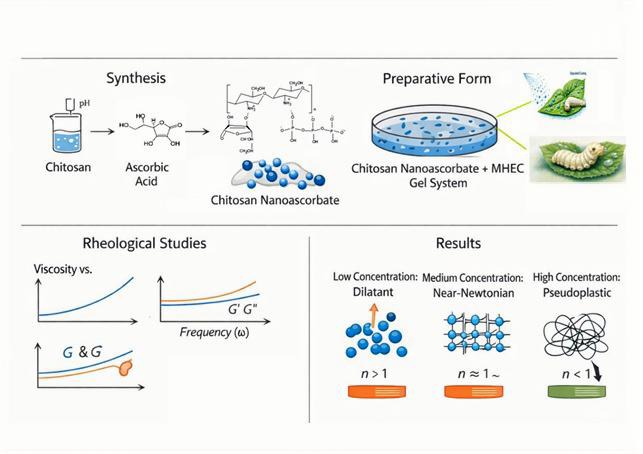
Chitosan nanoascorbate samples were synthesized by controlling the pH of the solution and the ratio of the initial components: ascorbic acid and chitosan derived from Bombyx mori. In this study, the rheological properties of polymeric preparative forms based on chitosan nanoascorbate and methylhydroxyethylcellulose systems at different concentrations were investigated. The chitosan nanoascorbate samples were obtained by regulating the ratio of Bombyx mori chitosan to ascorbic acid and adjusting the pH of the reaction medium during the synthesis process. In the initial 0.025 % chitosan nanoascorbate solution, the viscosity increased from 0.33 Pa·s to 4.14 Pa·s under shear, indicating possible hydrodynamic clustering and the formation of temporary aggregates between nanoparticles. In dilute systems containing 0.0125 % chitosan nanoascorbate and 0.1 % methylhydroxyethylcellulose, the viscosity increased from 3.1 Pa·s to 5.0 Pa·s, suggesting interactions between polymer chains and nanoparticles, although a fully developed spatial network was not formed. In the system with intermediate concentrations (0.025 % chitosan nanoascorbate : 0.2 % methylhydroxyethylcellulose), the viscosity varied from 6.2 Pa·s to 10.9 Pa·s and exhibited near-Newtonian flow behavior. In the system with the highest concentration (0.05 % chitosan nanoascorbate : 0.4 % methylhydroxyethylcellulose), the viscosity decreased from 45 Pa·s to 18 Pa·s, indicating pseudoplastic behavior and the partial disruption of the three-dimensional spatial network under shear. Frequency analysis and the Power-law model confirmed the viscosity and elastic properties of these two types of systems.
References
Milusheva, R. Yu., & Rashidova, S. Sh. (2019). Bombyx Mori Chitosan Nanoparticles: Synthesis and Properties. Open Journal of Organic Polymer Materials, 09(04), 63–73. https://doi.org/10.4236/ojopm.2019.94004 DOI: https://doi.org/10.4236/ojopm.2019.94004
Pirniyazov, K.K., Milusheva, R.Yu., Rashidova, S.Sh. (2023). Production and biological activity of chitosan nanoascorbate. INEOS OPEN, 6(6), 156–162. https://doi.org/10.32931/io2326r DOI: https://doi.org/10.32931/io2326r
Pirniyazov, K.K., Rashidova, S.Sh. (2020). Synthesis of Ascorbate and Chitosan Nanoascorbate and Their Biologically Active Properties. Journal of Science and Innovative Development, 3(5), 47–62. https://doi.org/10.36522/2181-9637-2020-5-6 DOI: https://doi.org/10.36522/2181-9637-2020-5-6
Pirniyazov, K.K., Tixonov, V.E., Rashidova, S.Sh. (2021). Synthesis and properties of oligochitosan ascorbate from Bombyx mori. Bulletin of the Karaganda University. Chemistry Series, 1(101), 91–98. https://doi.org/10.31489/2021Ch1/91-98 DOI: https://doi.org/10.31489/2021Ch1/91-98
Wang, W., Meng, Q., Li, Q., Liu, J., Zhou, M., Jin, Z., & Zhao, K. (2020). Chitosan Derivatives and Their Application in Biomedicine. International Journal of Molecular Sciences, 21(2), 487. https://doi.org/10.3390/ijms21020487 DOI: https://doi.org/10.3390/ijms21020487
Pirniyazov, K.K., Asrakulova, D.I., Rashidova, S.Sh. (2024). Synthesis and antimicrobial properties of chitosan nanoascorbate of Bombyx mori. Moscow University Chemistry Bulletin, 79(5), 345–350. https://doi.org/10.3103/S002713142470038X DOI: https://doi.org/10.3103/S002713142470038X
Tian, X.L., Tian, D.F., Wang, Z.Y., Mo, F.K. (2009). Synthesis and evaluation of chitosan-vitamin C complex. Indian J. Pharm Sci., 71(4), 371–376. https://doi.org/10.4103/0250-474X.57284 DOI: https://doi.org/10.4103/0250-474X.57284
Liping, L., Kexin, L., Huipu, D., Jia, L., Jie, Z. (2020). Study on Preparation of a Chitosan/Vitamin C Complex and Its Properties in Cosmetics. Natural Product Communications, 15, 1–9. https://doi.org/10.1177/1934578X20946876 DOI: https://doi.org/10.1177/1934578X20946876
Hafsa, J., Charfeddine, B., Smach, M.A., Limem, K., Majdoub, H., Sonia, R. (2014). Synthesis, characterization, antioxidant and antibacterial proprieties of chitosan ascorbate. International Journal of Pharmaceutical and Chemical Sciences, 4, 1072–1081. https://www.ijpcbs.com/articles/synthesis-characterization-antioxidant-and-antibacterial-proprieties-of-chitosan-ascorbate.pdf
Muzzarelli, R.A.A., Tanfani, F., Emanuelli, M. (1984). Chelating Derivatives of Chitosan Obtained by Reaction with Ascorbic Acid. Carbohydrate Polymers, 4(2), 137–151. https://doi.org/10.1016/0144-8617(84)90020-1 DOI: https://doi.org/10.1016/0144-8617(84)90020-1
Zhuang, L., Zhi, X., Du, B., Yuan, S. (2020). Preparation of Elastic and Antibacterial Chitosan–Citric Membranes with High Oxygen Barrier Ability by in Situ Cross-Linking. ACS Omega, 5, 1086–1097. https://doi.org/10.1021/acsomega.9b03206 DOI: https://doi.org/10.1021/acsomega.9b03206
Yalinca, Z., Yilmaz, E., Taneri, B., Bullici, F., Tuzmen, S.J. (2013). Blood contact properties of ascorbyl chitosan. Journal of Biomaterials Science, Polymer Edition, 24, 1969–1987. https://doi.org/10.1080/09205063.2013.816929 DOI: https://doi.org/10.1080/09205063.2013.816929
Othman, N., Masarudin, M.J., Kuen, C.Y., Dasuan, N.A., Abdullah, L.C., Jamil, S.N.A. Md. (2018). Synthesis and Optimization of Chitosan Nanoparticles Loaded with l-Ascorbic Acid and Thymoquinone. Nanomaterials, 8, 920. https://doi.org/10.3390/nano8110920 DOI: https://doi.org/10.3390/nano8110920
Soliman, A., Gad, A. (2020). The Impact of Ascorbic Acid, Some Nanomaterials and Their Mixtures on Some Biological and Physiological Parameters of the Mulberry Silkworm Bombyx mori L. Alexandria Science Exchange Journal, 41, 393–398. https://doi.org/10.21608/asejaiqjsae.2020.119307 DOI: https://doi.org/10.21608/asejaiqjsae.2020.119307
Ren, H., Liu, Y., Arshad, M., Dou, Z., Han, X. (2024). Effect of formulations and adjuvants on the properties of acetamiprid solution and droplet deposition characteristics sprayed by UAV. Frontiers in Plant Science, 15, 1441193. https://doi.org/10.3389/fpls.2024.1441193 DOI: https://doi.org/10.3389/fpls.2024.1441193
Basílio, S., Furtado, Júnior, M.R., Alvarenga, C.B., da Vitória, E.L., Costalonga Vargas, B., Privitera, S., Caruso, L., Cerruto, E., Manetto, G., Caruso, L. (2024). Effect of adjuvants on physical–chemical properties, droplet size and drift reduction potential in agricultural spraying. Agriculture, 14(12), 2271. https://doi.org/10.3390/agriculture14122271 DOI: https://doi.org/10.3390/agriculture14122271
Hu, P., Zhang, R., Chen, L., Li, L., Tang, Q., Yan, W., Yang, J. (2024). Effect of polymer adjuvant type and concentration on atomization characteristics of agricultural spray nozzles. Agriculture, 14(3), 404. https://doi.org/10.3390/agriculture14030404 DOI: https://doi.org/10.3390/agriculture14030404
Mewis, J., Wagner, N.J. (2012). Colloidal suspension rheology. Advances in Colloid and Interface Science, 147–148, 214–227. https://doi.org/10.1016/j.cis.2008.09.005 DOI: https://doi.org/10.1016/j.cis.2008.09.005
Barnes, H.A. (1997). Thixotropy—a review. Journal of Non-Newtonian Fluid Mechanics, 70(1–2), 1–33. https://doi.org/10.1016/S0377-0257(97)00004-9 DOI: https://doi.org/10.1016/S0377-0257(97)00004-9
Butler Ellis, M.C., Tuck, C.R. (1999). How adjuvants influence spray formation with different hydraulic nozzles. Crop Protection, 18(2), 101–109. https://doi.org/10.1016/S0261-2194(98)00098-5 DOI: https://doi.org/10.1016/S0261-2194(98)00097-0
Zhao, H. and Liu, H. (2019). Breakup Morphology and Mechanisms of Liquid Atomization. Environmental Impact of Aviation and Sustainable Solutions, IntechOpen, 1-19. https://doi.org/10.5772/intechopen.84998 DOI: https://doi.org/10.5772/intechopen.84998
Mun, R.P., Young, B.W., Boger, D.V. (1999). Atomisation of dilute polymer solutions in agricultural sprays. Journal of Non-Newtonian Fluid Mechanics, 83(1–2), 163–178. https://doi.org/10.1016/S0377-0257(98)00130-7 DOI: https://doi.org/10.1016/S0377-0257(98)00135-9
Rinaudo, M. (2006). Chitin and chitosan: Properties and applications. Progress in Polymer Science, 31(7), 603–632. https://doi.org/10.1016/j.progpolymsci.2006.06.001 DOI: https://doi.org/10.1016/j.progpolymsci.2006.06.001
Pirniyazov, K.K., Nurgaliyev, I.N., Rashidova, S.Sh. (2023). Reaction of the Formation of Chitosan Nanoascorbate Bombyx Mori and Computer Simulation of Its Structure. Intelligent Biotechnologies of Natural and Synthetic Biologically Active Substances AIP Conference Proceedings, 2931, 060002-1–060002-9. https://doi.org/10.1063/5.0182628 DOI: https://doi.org/10.1063/5.0182628
Kumar, M.N.V.R. (2000). A review of chitin and chitosan applications. Reactive and Functional Polymers, 46(1), 1–27. https://doi.org/10.1016/S1381-5148(00)00038-9 DOI: https://doi.org/10.1016/S1381-5148(00)00038-9
Fan, W., Yan, W., Xu, Z., Ni, H. (2012). Formation mechanism of monodisperse, low molecular weight chitosan nanoparticles by ionic gelation technique. Colloids and Surfaces B: Biointerfaces, 90, 21–27. https://doi.org/10.1016/j.colsurfb.2011.09.042 DOI: https://doi.org/10.1016/j.colsurfb.2011.09.042
Younes, I., Rinaudo, M. (2015). Chitin and chitosan preparation from marine sources: Structure, properties and applications. Marine Drugs, 13(3), 1133–1174. https://doi.org/10.3390/md13031133 DOI: https://doi.org/10.3390/md13031133
Desai, M.P., Labhasetwar, V., Amidon, G.L., Levy, R.J. (1996). Gastrointestinal uptake of biodegradable microparticles: effect of particle size. Pharmaceutical Research, 13(12), 1838–1845. https://doi.org/10.1023/a:1016085108889 DOI: https://doi.org/10.1023/A:1016085108889
Downloads
Published
How to Cite
Issue
Section
License
Copyright (c) 2026 Oynavod B. Avazova, Kudrat K. Pirniyazov, Sayyora Sh. Rashidova

This work is licensed under a Creative Commons Attribution-NonCommercial-NoDerivatives 4.0 International License.

This work is licensed under a Creative Commons Attribution-NonCommercial-NoDerivatives 4.0 International License.
Authors retain copyright and grant the journal right of first publication with the work simultaneously licensed under a Creative Commons Attribution License (CC BY-NC-ND 4.0) that allows others to share the work with an acknowledgement of the work's authorship and initial publication in this journal.
