
Simultaneous RP-HPLC Quantification and Characterization of Apigenin-Naringenin Co-Loaded ZnO Nanoparticles for Topical Delivery
DOI:
https://doi.org/10.31489/2959-0663/2-26-3Keywords:
HPLC, polyphenols, simultaneous method, nanoparticles, apigenin, naringenin, isocratic, validationAbstract
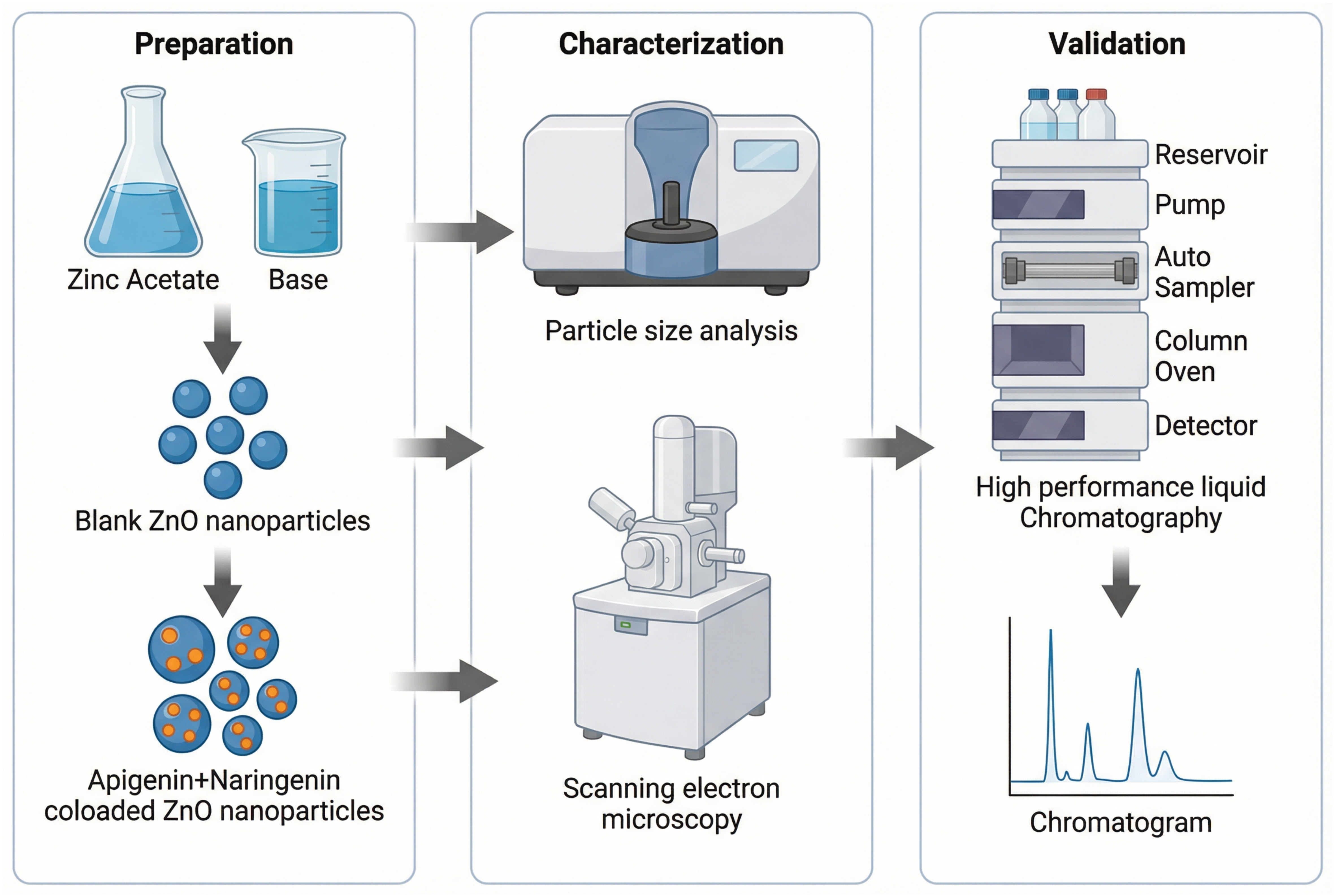
Apigenin and Naringenin has proven beneficial prospects owing to an anti-inflammatory, antioxidant and wound healing effects. But having poor water solubility and low bioavailability hinders their application. Therefore, we developed a dual drug-loaded zinc oxide nanoparticle and validated a sensitive and selective liquid chromatography method for simultaneous determination. The nanoparticles were synthesized through chemical precipitation method followed by drug loading. They were evaluated for particle size, surface potential and FTIR, while morphology was determined by scanning electron microscopy. RP-HPLC method utilizing a C18 column as stationary phase and methanol/0.1 % orthophosphoric acid (75:25 v/v) as eluent at a flow rate of 1.0 mL/min with detection at 272 nm. Method was validated as per to ICH Q2(R1) guidelines and having linearity (5–25 µg/mL), accuracy, precision, specificity and robustness. The entrapment efficiencies of Apigenin and Naringenin were 88.6 ± 2.1 % and 85.2 ±1.8 %, respectively. The average size by dynamic-light scattering was 202.67 ± 3.2 nm and zeta potential were –30.51 ± 0.6 mV. Electron-microscopy confirmed mixture of mildly aggregated spherical and rod-shaped particles, size less than 200 nm. The validated analytical method and the nanoparticle system would together serve as a propitious groundwork, for combinatorial delivery of Apigenin and Naringenin.
References
Ghasemi, J., Shamsabadi, S., Mahzoon, E., Nazer, Y., Rahimi, V.B., & Askari, V.R. (2024). A Mechanistic Insight into the Effects of Marine Sources as Functional Foods Against Metabolic Syndrome: A Review Article. Letters in Drug Design & Discovery, 21(19), 4668–4682. https://doi.org/10.2174/0115701808344500250115114637 DOI: https://doi.org/10.2174/0115701808344500250115114637
Li, J., Mao, B., Tang, X., Zhang, Q., Zhao, J., Zhang, H., & Cui, S. (2023). Protective effects of naringenin and apigenin in ameliorating skin damage via mediating the Nrf2 and NF-κB pathways in mice. Foods, 12(11), 2120. https://doi.org/10.3390/foods12112120 DOI: https://doi.org/10.3390/foods12112120
Yoon, J.H., Kim, M.Y., & Cho, J.Y. (2023). Apigenin: A therapeutic agent for treatment of skin inflammatory diseases and cancer. International Journal of Molecular Sciences, 24(2), 1498. https://doi.org/10.3390/ijms24021498 DOI: https://doi.org/10.3390/ijms24021498
Xie, J., Li, H., Zhang, T., Song, B., Wang, X., & Gu, Z. (2023). Recent advances in ZnO nanomaterial-mediated biological applications and action mechanisms. Nanomaterials, 13(9), 1500. https://doi.org/10.3390/nano13091500 DOI: https://doi.org/10.3390/nano13091500
Gouda, A., Sakr, O.S., Nasr, M., & Sammour, O.A. (2024). Developing a rapid analytical method for simultaneous determination of apigenin and gallic acid: validation and application in a nanoliposomal formulation. Drug Development and Industrial Pharmacy, 50(3), 274–283. https://doi.org/10.1080/03639045.2024.2318386 DOI: https://doi.org/10.1080/03639045.2024.2318386
Bhia, M., Motallebi, M., Abadi, B., Zarepour, A., Pereira-Silva, M., Saremnejad, F., ... & Shakibaei, M. (2021). Naringenin nano-delivery systems and their therapeutic applications. Pharmaceutics, 13(2), 291. https://doi.org/10.3390/pharmaceutics13020291 DOI: https://doi.org/10.3390/pharmaceutics13020291
Manyasree, D., Kiranmayi, P., & Venkata, R.K. (2018). Characterization and antibacterial activity of ZnO nanoparticles synthesized by co-precipitation method. International Journal of Applied Pharmaceutics, 10(6), 224–228. http://dx.doi.org/10.22159/ijap.2018v10i6.29376 DOI: https://doi.org/10.22159/ijap.2018v10i6.29376
Mandal, A.K., Katuwal, S., Tettey, F., Gupta, A., Bhattarai, S., Jaisi, S., Bhandari, D.P., Shah, A.K., Bhattarai, N., & Parajuli, N. (2022). Current Research on Zinc Oxide Nanoparticles: Synthesis, Characterization, and Biomedical Applications. Nanomaterials, 12(17), 3066. https://doi.org/10.3390/nano12173066 DOI: https://doi.org/10.3390/nano12173066
Rajabi, H.R., Naghiha, R., Kheirizadeh, M., Sadatfaraji, H., Mirzaei, A., & Alvand, Z.M. (2017). Microwave assisted extraction as an efficient approach for biosynthesis of zinc oxide nanoparticles: synthesis, characterization, and biological properties. Materials Science and Engineering: C, 78, 1109–1118. https://doi.org/10.1016/j.msec.2017.03.090 DOI: https://doi.org/10.1016/j.msec.2017.03.090
Chaudhari, V.S., Borkar, R.M., Murty, U.S., & Banerjee, S. (2020). Analytical method development and validation of reverse-phase high-performance liquid chromatography (RP-HPLC) method for simultaneous quantifications of quercetin and piperine in dual-drug loaded nanostructured lipid carriers. Journal of Pharmaceutical and Biomedical Analysis, 186, 113325. https://doi.org/10.1016/j.jpba.2020.113325 DOI: https://doi.org/10.1016/j.jpba.2020.113325
Bhutia, G.T., Kumar DE.A., & Bera, T. (2022). Validation, stability studies, and simultaneous estimation of co-encapsulated curcumin, epigallocatechin gallate nanoformulation by RP-HPLC method. International Journal of Applied Pharmaceutics, 14, 186–195. https://dx.doi.org/10.22159/ijap.2022v14i6.45818 DOI: https://doi.org/10.22159/ijap.2022v14i6.45818
Khismatrao, A., Bhairy, S., & Hirlekar, R. (2018). Development and validation of RP-HPLC method for simultaneous estimation of curcumin and piperine. International Journal of Applied Pharmaceutics, 10(5), 43. https://doi.org/10.22159/ijap.2018v10i5.21140 DOI: https://doi.org/10.22159/ijap.2018v10i5.21140
Patil, C., Naik, P., Mallamma, T., & Goudanavar, P. (2025). Exploring the potential of a quick and simultaneous DoE-based stability indicating novel RP-HPLC method for the estimation of capecitabine and curcumin in biodegradable nanoparticles and human plasma. Journal of Chromatography B, 124731. https://doi.org/10.1016/j.jchromb.2025.124731 DOI: https://doi.org/10.1016/j.jchromb.2025.124731
Khatak, S., Khatak, M., Ali, F., Rathi, A., Singh, R., Singh, G.N., & Dureja, H. (2018). Development and Validation of a RP-HPLC Method for Simultaneous Estimation of Antitubercular Drugs in Solid Lipid Nanoparticles. Indian Journal of Pharmaceutical Sciences, 80(6). https://doi.org/10.4172/pharmaceutical-sciences.1000449 DOI: https://doi.org/10.4172/pharmaceutical-sciences.1000449
Venishetty, V.K., Parikh, N., Sistla, R., Ahmed, F.J., & Diwan, P.V. (2011). Application of validated RP-HPLC method for simultaneous determination of docetaxel and ketoconazole in solid lipid nanoparticles. Journal of Chromatographic Science, 49(2), 136–141. https://doi.org/10.1093/chrsci/49.2.136 DOI: https://doi.org/10.1093/chrsci/49.2.136
Downloads
Published
How to Cite
Issue
Section
License
Copyright (c) 2026 Ayusha O. Dondulkar, Mandar Muley, Raksha A. Purohit, Nikhil Y. Yenorkar, Natasha S. Akojwar, Satyendra K. Prasad

This work is licensed under a Creative Commons Attribution-NonCommercial-NoDerivatives 4.0 International License.

This work is licensed under a Creative Commons Attribution-NonCommercial-NoDerivatives 4.0 International License.
Authors retain copyright and grant the journal right of first publication with the work simultaneously licensed under a Creative Commons Attribution License (CC BY-NC-ND 4.0) that allows others to share the work with an acknowledgement of the work's authorship and initial publication in this journal.
