
Analytical Characterization and Molecular Interaction Study of Quercetin-Loaded Transferosomes
DOI:
https://doi.org/10.31489/2959-0663/3-26-2Keywords:
quercetin, transferosomes, drug delivery, molecular docking, RP-HPLC, method validation, anti-inflammatory activity, skin disordersAbstract
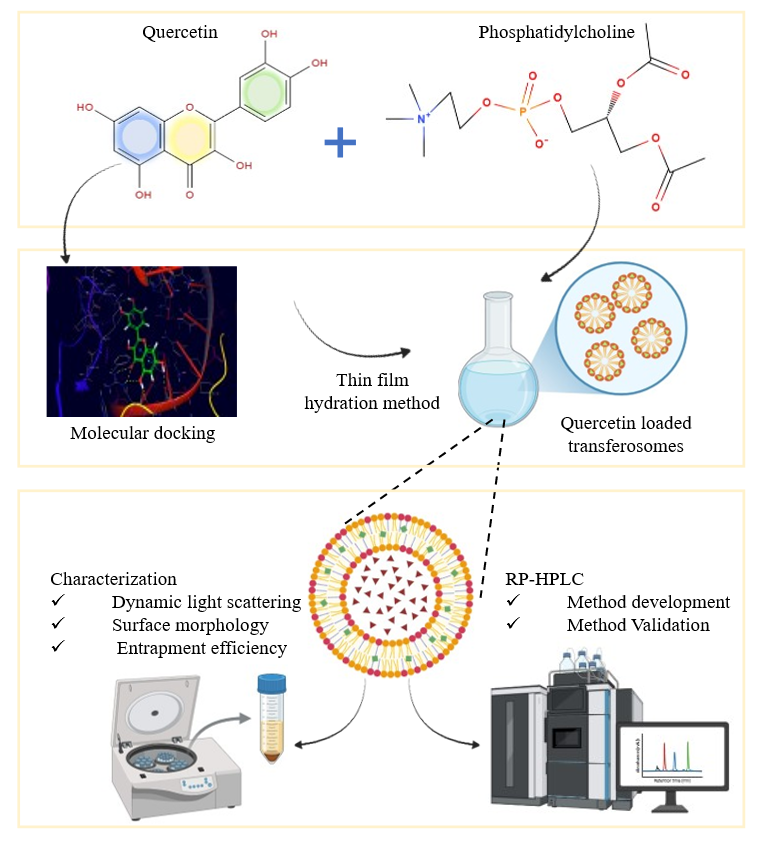
Quercetin is a bioactive flavonoid that has potent anti-inflammatory activity. Its topical applications are limited due to poor solubility and permeability. The present study aims to develop and characterize quercetin-loaded transferosomes and to establish a validated RP-HPLC method for its quantification. Molecular docking studies revealed favourable binding of quercetin with key inflammatory targets. This included NF-kB (-8.66 kcal/mol), IgE (-7.22 kcal/mol), and TSLP (-6.54 kcal/mol). An RP-HPLC method was developed using C18 column with the mobile phase of acetonitrile and 0.3 % OPA (50:50 v/v). The method showed good linearity over the range of 20-120 µg/mL (R = 0.998). The retention time of quercetin was 4.303 min. Validation parameters demonstrated accuracy (99.89-100.11 %), precision (RSD <2 %), and sensitivity with LOD and LOQ of 0.57 µg/mL and 1.69 µg/mL, respectively. Transferosomes prepared using the thin-film hydration method exhibited a mean particle size of 190.4±1.6 nm, PDI of 0.324, and zeta potential of -22.4 mV. The entrapment efficiency was found to be 86.24 ± 1.61 %. FTIR, DSC, and SEM confirmed successful drug incorporation and vesicle formation. The transferosome exhibited sustained release (93.6 ± 0.9 % at 24 h) and Korsmeyer-Peppas kinetics. Hence, the developed system represents a promising platform for transferosome-loaded quercetin assessment.
References
Shabir, I., Kumar Pandey, V., Shams, R., Dar, A. H., Dash, K. K., Khan, S. A., ... & Pandiselvam, R. (2022). Promising bioactive properties of quercetin for potential food applications and health benefits: A review. Frontiers in nutrition, 9, 999752. https://doi.org/10.3389/fnut.2022.999752
Tomou, E. M., Papakyriakopoulou, P., Saitani, E. M., Valsami, G., Pippa, N., & Skaltsa, H. (2023). Recent advances in nanoformulations for quercetin delivery. Pharmaceutics, 15(6), 1656. 10.3390/pharmaceutics15061656
Simrah, Hafeez, A., Usmani, S. A., & Izhar, M. P. (2024). Transfersome, an ultra-deformable lipid-based drug nanocarrier: an updated review with therapeutic applications. Naunyn-Schmiedeberg's Archives of Pharmacology, 397(2), 639-673. 10.1007/s00210-023-02670-8
Mali, A. J., Kakade, S., Khardekar, A., Ganeshpurkar, A., & Kumari, A. (2025). Development of novel emulgel comprising quercetin-loaded transferosomes and thuja oil for enhanced anti-inflammatory efficacy. Next Nanotechnology, 8, 100246. https://doi.org/10.1016/j.nxnano.2025.100246
Sabarathinam, S. (2024). Unraveling the therapeutic potential of quercetin and quercetin-3-O-glucuronide in Alzheimer's disease through network pharmacology, molecular docking, and dynamic simulations. Scientific Reports, 14(1), 14852. https://doi.org/10.1038/s41598-024-61779-9
Elkomy, M. H., Zaki, R. M., Alsaidan, O. A., Elmowafy, M., Zafar, A., Shalaby, K., Abdelgawad, M. A., Abd El-Hack, M. E., & Mahgoub, S. A. (2023). Intranasal nanotransferosomal gel for quercetin brain targeting: I. Optimization, characterization, brain localization, and cytotoxic studies. Pharmaceutics, 15(7), 1805. https://doi.org/10.3390/pharmaceutics15071805
Chen, X., Shen, Q., Zhou, R., Lin, Y., Zhou, T., Chen, K., ... & Yang, A. (2026). Screening of active constituents in camellia oil against atopic dermatitis via molecular docking and experimental validation: elucidation of the underlying molecular mechanism: X. Chen et al. Inflammopharmacology, 1-14. 10.1007/s10787-026-02118-4
Suleman, M., Moltrasio, C., Tricarico, P. M., Marzano, A. V., & Crovella, S. (2024). Natural compounds targeting thymic stromal lymphopoietin (TSLP): a promising therapeutic strategy for atopic dermatitis. Biomolecules, 14(12), 1521. https://doi.org/10.3390/biom14121521
Ang, L. F., Yam, M. F., Fung, Y. T. T., Kiang, P. K., & Darwin, Y. (2014). HPLC method for simultaneous quantitative detection of quercetin and curcuminoids in traditional chinese medicines. Journal of pharmacopuncture, 17(4), 36. 10.3831/KPI.2014.17.035
Mustafa, A. M., Abouelenein, D., Angeloni, S., Maggi, F., Navarini, L., Sagratini, G., ... & Caprioli, G. (2022). A new HPLC-MS/MS method for the simultaneous determination of quercetin and its derivatives in green coffee beans. Foods, 11(19), 3033. https://doi.org/10.3390/foods11193033
Khursheed, R., Wadhwa, S., Kumar, B., Gulati, M., Gupta, S., Chaitanya, M. V. N. L., ... & Singh, S. K. (2022). Development and validation of RP-HPLC based bioanalytical method for simultaneous estimation of curcumin and quercetin in rat's plasma. South African Journal of Botany, 149, 870-877. 10.1016/j.sajb.2021.12.009
Li, L., Cheng, J., Lu, F., Du, Y., Xie, Y., Zhou, C., ... & Feng, Y. (2023). Optimized HPLC extraction method of quercetin and berberine based on response surface analysis. RSC advances, 13(42), 29427-29437. 10.1039/d3ra04384c
Mansour, F. R., Abdallah, I. A., Bedair, A., & Hamed, M. (2025). Analytical methods for the determination of quercetin and quercetin glycosides in pharmaceuticals and biological samples. Critical Reviews in Analytical Chemistry, 55(1), 187-212. 10.1080/10408347.2023.2269421
Karnam, S., Jindal, A. B., & Paul, A. T. (2024). Quality by design-based optimization of teriflunomide and quercetin combinational topical transferosomes for the treatment of rheumatoid arthritis. International Journal of Pharmaceutics, 666, 124829. 10.1016/j.ijpharm.2024.124829
Pandit, A. P., Omase, S. B., & Mute, V. M. (2020). A chitosan film containing quercetin-loaded transfersomes for treatment of secondary osteoporosis. Drug delivery and translational research, 10(5), 1495-1506. 10.1007/s13346-020-00708-5
Nayak, S., Karmakar, A., Shinde, S., & Kumar, L. (2026). Development of Diclofenac Acid Encapsulated Transferosomal gel with Enhanced Antioxidant and Anti-Inflammatory Activities for the Management of Musculoskeletal Pain. AAPS PharmSciTech, 27(1), 68. 10.1208/s12249-025-03276-4
Rasheed, M. S., Ansari, S. F., & Shahzadi, I. (2022). Formulation, characterization of glucosamine loaded transfersomes and in vivo evaluation using papain induced arthritis model. Scientific Reports, 12(1), 19813. https://doi.org/10.1038/s41598-022-23103-1
Xing, H., Yang, Y., Zhao, Z., Lv, K., Shao, Y., Zhang, Z., & Ma, D. (2026). Transfersomes with core and surface‐loaded NF‐κB p65 siRNA for enhanced transdermal transfection and effective treatment of psoriasis. BMEMat, e70084. https://doi.org/10.1002/bmm2.70084
Chen, H., Lu, C., Liu, H., Wang, M., Zhao, H., Yan, Y., & Han, L. (2017). Quercetin ameliorates imiquimod-induced psoriasis-like skin inflammation in mice via the NF-κB pathway. International immunopharmacology, 48, 110-117. 10.1016/j.intimp.2017.04.022
Beken, B., Serttas, R., Yazicioglu, M., Turkekul, K., & Erdogan, S. (2020). Quercetin improves inflammation, oxidative stress, and impaired wound healing in atopic dermatitis model of human keratinocytes. Pediatric allergy, immunology, and pulmonology, 33(2), 69-79. https://doi.org/10.1089/ped.2019.1137
Lin, C. F., Leu, Y. L., Al-Suwayeh, S. A., Ku, M. C., Hwang, T. L., & Fang, J. Y. (2012). Anti-inflammatory activity and percutaneous absorption of quercetin and its polymethoxylated compound and glycosides: The relationships to chemical structures. European Journal of Pharmaceutical Sciences, 47(5), 857-864. 10.1016/j.ejps.2012.04.024
Srivastava, A. K., Srivastava, S., Kumar, V., Ghosh, S., Yadav, S., Malik, R., ... & Prasad, R. (2024). Identification and mechanistic exploration of structural and conformational dynamics of NF-kB inhibitors: rationale insights from in silico and in vitro studies. Journal of Biomolecular Structure and Dynamics, 42(3), 1485-1505. https://doi.org/10.1080/07391102.2023.2200490
Sarkar, M., Khandavilli, S., & Panchagnula, R. (2006). Development and validation of RP-HPLC and ultraviolet spectrophotometric methods of analysis for the quantitative estimation of antiretroviral drugs in pharmaceutical dosage forms. Journal of Chromatography B, 830(2), 349-354. 10.1016/j.jchromb.2005.11.014
Wu, T. H., Yen, F. L., Lin, L. T., Tsai, T. R., Lin, C. C., & Cham, T. M. (2008). Preparation, physicochemical characterization, and antioxidant effects of quercetin nanoparticles. International journal of pharmaceutics, 346(1-2), 160-168. https://doi.org/10.1016/j.ijpharm.2007.06.036
Sahu, A. N., & Mohapatra, D. (2021). Nanovesicular transferosomes for the topical delivery of plant bioactives. Nanomedicine, 16(28), 2491-2495. 10.2217/nnm-2021-0316
Zhang, Z. J., & Michniak-Kohn, B. (2020). Flavosomes, novel deformable liposomes for the co-delivery of anti-inflammatory compounds to skin. International journal of pharmaceutics, 585, 119500. https://doi.org/10.1016/j.ijpharm.2020.119500
Geara, D., Fayad, S., Chebil, L., & Harb, W. (2026). Molecular interactions of quercetin in menthol-based type V deep eutectic solvents: An integrated FTIR spectroscopy and molecular dynamics study. Journal of Molecular Liquids, 457, 129714. https://doi.org/10.1016/j.molliq.2026.129714
Pawlikowska-Pawlęga, B., Dziubińska, H., Król, E., Trębacz, K., Jarosz-Wilkołazka, A., Paduch, R., Gawron, A., & Gruszecki, W. I. (2014). Characteristics of quercetin interactions with liposomal and vacuolar membranes. Biochimica et Biophysica Acta (BBA)-Biomembranes, 1838(1), 254–265. http://dx.doi.org/10.1016/j.bbamem.2013.08.014
Anwer, M. K., Al-Mansoor, M. A., Jamil, S., Al-Shdefat, R., Ansari, M. N., & Shakeel, F. (2016). Development and evaluation of PLGA polymer based nanoparticles of quercetin. International Journal of Biological Macromolecules, 92, 213–219. https://doi.org/10.1016/j.ijbiomac.2016.07.025
Zhang, Y., Yang, Y., Tang, K., Hu, X., & Zou, G. (2008). Physicochemical characterization and antioxidant activity of quercetin‐loaded chitosan nanoparticles. Journal of Applied Polymer Science, 107(2), 891-897. 10.1002/app.26402
Carvalho, D., Jesus, Â., Pinho, C., Oliveira, R. F., Moreira, F., & Oliveira, A. I. (2023). Validation of an HPLC-DAD method for quercetin quantification in nanoparticles. Pharmaceuticals, 16(12), 1736. https://doi.org/10.3390/ph16121736
Milutinov, J., Krstonošić, V., Ćirin, D., Hadnađev, M., Đanić, M., & Pavlović, N. (2025). Development and evaluation of quercetin topical emulgels: Physicochemical and rheological properties, stability and sun protective potential. Journal of Molecular Liquids, 417, 126568. https://doi.org/10.1016/j.molliq.2024.126568
Rosita, N., Ambarwati, N., Erawati, T., & Hariyadi, D. M. (2022). Characterization and in vitro release of inhalation quercetin solid lipid microparticles: Effect of lipid. Journal of Advanced Pharmaceutical Technology & Research, 13(1), 11–17. https://doi.org/10.4103/japtr.japtr_108_21
Downloads
Additional Files
Published
How to Cite
Issue
Section
License
Copyright (c) 2026 Natasha S. Akojwar, Nikhil Y. Yenorkar, Ayusha O. Dondulkar, Ankit Ganeshpurkar, Beauty Behera, Satyendra K. Prasad

This work is licensed under a Creative Commons Attribution-NonCommercial-NoDerivatives 4.0 International License.

This work is licensed under a Creative Commons Attribution-NonCommercial-NoDerivatives 4.0 International License.
Authors retain copyright and grant the journal right of first publication with the work simultaneously licensed under a Creative Commons Attribution License (CC BY-NC-ND 4.0) that allows others to share the work with an acknowledgement of the work's authorship and initial publication in this journal.
