

Synthesis of Amphiphilic Derivatives of Fusidane Triterpenoids
DOI:
https://doi.org/10.31489/2959-0663/3-26-7Keywords:
triterpenoids, fusidic acid, amphiphilic derivatives, tertiary amines, quaternization reaction, quaternary ammonium salts, reductive aminationAbstract
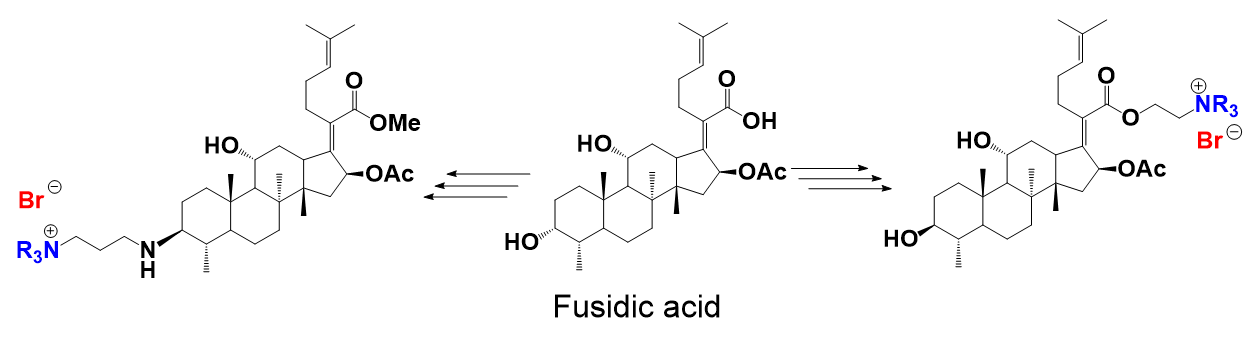
Fusidic acid exhibits bacteriostatic activity, transitioning to bactericidal at high doses, primarily against Gram-positive bacteria, including methicillin-resistant Staphylococcus aureus. This underscores its high potential for functionalizing reactive centers with pharmacophore groups to develop semisynthetic analogs as promising antibiotics. In medicinal chemistry, studies on amphiphilic fusidic acid derivatives with enhanced bioavailability and biological activity are highly relevant. In this work, amphiphilic derivatives of the fusidic acid (FA) were synthesized via quaternization of tertiary amines and pyridines (triethylamine, pyridine, N, N-dimethylaminopyridine, N-methylpiperidine) by bromoethyl fusidate and 3-bromopropylamine methylfusidate. The carboxylic group of FA was brominated using 1,2-dibromoethane in dry acetone with K2CO3 under reflux. Reaction of the FA bromo- derivative with tertiary amines and pyridines in DMF at 70 °C afforded ammonium salts in 62–70 % yields. The FA bromoamine, obtained via reductive amination, was involved into the reaction with N-containing compounds in DMF upon heating to yield target products in 60–67 % yields. Structures of novel FA analogs were confirmed by NMR spectroscopy and mass-spectrometry. The obtained FA amphiphilic analogs hold potential for further development of antimicrobial agents.
References
Gerba, C. P. (2015). Quaternary ammonium biocides: Efficacy in application. Applied and Environmental Microbiology, 81(2), 464–469. https://doi.org/10.1128/AEM.02633-14
Chanawanno, K., Thuptimdang, P., Chantrapromma, S., & Fun, H. K. (2022). New tunable pyridinium benzenesulfonate amphiphiles as anti-MRSA quaternary ammonium compounds (QACs) Journal of Molecular Structure, 1254, 132389. https://doi.org/10.1016/j.molstruc.2022.132389
Walker, E. B. (2002). Chapter 5. In D.S. Paulson (Ed.), Handbook of topical antimicrobials: Industrial applications in consumer products and pharmaceuticals. CRC Press. https://doi.org/10.1201/9780203909256
Savage, P. B., Li, C., Taotafa, U., Ding, B., & Guan, Q. (2002). Antibacterial properties of cationic steroid antibiotics. FEMS Microbiology Letters, 217(1), 1–7. https://doi.org/10.1111/j.1574-6968.2002.tb11448.x
Wessels, S., & Ingmer, H. (2013). Modes of action of three disinfectant active substances: a review. Regulatory Toxicology and Pharmacology, 67, 456–467. https://doi.org/10.1016/j.yrtph.2013.09.006
Jennings, M. C., Minbiole, K. P. C., & Wuest, W. M. (2015). Quaternary Ammonium Compounds: An Antimicrobial Mainstay and Platform for Innovation to Address Bacterial Resistance. ACS Infectious Diseases, 1, 288–303. https://doi.org/10.1021/acsinfecdis.5b00047
Schrank, C. L., Minbiole, K. P. C., & Wuest, W. M. (2020). Are Quaternary Ammonium Compounds, the Workhorse Disinfectants, Effective against Severe Acute Respiratory Syndrome-Coronavirus-2?. ACS Infectious Diseases, 6, 1553–1557. https://doi.org/10.1021/acsinfecdis.0c00265
Chanawanno, K., Chantrapromma, S., Anantapong, T., Kanjana-Opas, A., & Fun, H. K. (2010). Synthesis, structure and in vitro antibacterial activities of new hybrid disinfectants quaternary ammonium compounds: Pyridinium and quinolinium stilbene benzenesulfonates. European Journal of Medicinal Chemistry, 45, 4199–4208. https://doi.org/10.1016/j.ejmech.2010.06.014
Forman, M. E., Jennings, M. C., Wuest, W. M., & Minbiole, K. P. C. (2016). Building a Better Quaternary Ammonium Compound (QAC): Branched Tetracationic Antiseptic Amphiphiles. ChemMedChem, 11, 1401–1405. https://doi.org/10.1002/cmdc.201600176
Joyce, M. D., Jennings, M. C., Santiago, C. N., Fletcher, M. H., Wuest, W. M., & Mibiole, K. P. (2016). Natural product-derived quaternary ammonium compounds with potent antimicrobial activity. Journal of Antibiotics, 69, 344–347. https://doi.org/10.1038/ja.2015.107
Sapozhnikov, S. V., Sabirova, A. E., Shtyrlin, N. V., Druk, A. Y., Agafonova, M. N., Chirkova, M. N., Kazakova, R. R., Grishaev, D. Y., Nikishova, T. V., Krylova, E. S., Nikitina, E. V., Kayumov, A. R., & Shtyrlin, Y. G. (2021). Design, synthesis, antibacterial activity and toxicity of novel quaternary ammonium compounds based on pyridoxine and fatty acids. European Journal of Medicinal Chemistry, 211, 113100. https://doi.org/10.1016/j.ejmech.2020.113100
Yamanaka, T., Bannai, H., Tsujimura, K., Nemoto, M., Kondo, T., & Matsumura, T. (2014). Comparison of the Virucidal Effects of Disinfectant Agents Against Equine Influenza A Virus. Journal of Equine Veterinary Science, 34, 715–718. https://doi.org/10.1016/j.jevs.2013.12.010
Nyström, L., & Malmsten, M. (2018). Membrane interactions and cell selectivity of amphiphilic anticancer peptides. Current Opinion in Colloid & Interface Science, 38, 1–17. https://doi.org/10.1016/j.cocis.2018.06.009
Yang, J. S., Song, D., Lee, B., Ko, W. J., Park, S. K., Won, M., Lee, K., Kim, H. M., & Han, G. (2011). Synthesis and biological evaluation of novel aliphatic amido-quaternary ammonium salts for anticancer chemotherapy: Part I. European Journal of Medicinal Chemistry, 46, 2861–2866. https://doi.org/10.1016/j.ejmech.2011.04.009
Song, D., Yang, J. S., Oh, C., Cui, S., Kim, B. K., Won, M., Lee, J. I., Kim, H. M., & Han, G. (2013). New synthetic aliphatic sulfonamido-quaternary ammonium salts as anticancer chemotherapeutic agents. European Journal of Medicinal Chemistry, 69, 670–677. https://doi.org/10.1016/j.ejmech.2013.09.022
Dubinin, M. V., Semenova, A. A., Ilzorkina, A. I., Penkov, N. V., Nedopekina, D. A., Sharapov, V. A., Khoroshavina, E. I., Davletshin, E. V., Belosludtseva, N. V., Spivak, A. Y., Belosludtsev, K. N., et al. (2021). Mitochondria-targeted prooxidant effects of betulinic acid conjugated with delocalized lipophilic cation F16. Free Radical Biology and Medicine, 168, 55–69. https://doi.org/10.1016/j.freeradbiomed.2021.03.036
Dey, G., Bharti, R., Sen, R., & Mandal, M. (2015). Microbial amphiphiles: a class of promising new-generation anticancer agents. Drug Discovery Today, 20, 136–146. https://doi.org/10.1016/j.drudis.2014.09.006
Ciumac, D., Gong, H., Hu, X., & Lu, J. R. (2019). Membrane targeting cationic antimicrobial peptides. Journal of Colloid and Interface Science, 537, 163–185. https://doi.org/10.1016/j.jcis.2018.10.103
Dubinin, M. V., Semenova, A. A., Ilzorkina, A. I., Markelova, N. Y., Penkov, N. V., Shakurova, E. R., Belosludtsev, K. N., & Parfenova, L. V. (2021). New quaternized pyridinium derivatives of betulin: Synthesis and evaluation of membranotropic properties on liposomes, pro- and eukaryotic cells, and isolated mitochondria. Chemico-Biological Interactions, 349, 109678. https://doi.org/10.1016/j.cbi.2021.109678
Pasquale, E. D., Salmi-Smail, C., Brunel, J. M., Sanchez, P., Fantini, J., & Maresca, M. (2010). Biophysical studies of the interaction of squalamine and other cationic amphiphilic molecules with bacterial and eukaryotic membranes: Importance of the distribution coefficient in membrane selectivity. Chemistry and Physics of Lipids, 163, 131–140. https://doi.org/10.1016/j.chemphyslip.2009.10.006
Krasutsky, P. A., Avilov, D., Sergeeva, T., Krasutsky, D. A., & Kolomitsyna, O. (2008). US Patent No. 7,199,114 B2.
Kataev, V. E., Strobykina, I. Yu., & Zakharova, L. Ya. (2014). Quaternary ammonium derivatives of natural terpenoids. Synthesis and properties. Russian Chemical Bulletin, 63, 1884–1900. https://doi.org/10.1007/s11172-014-0680-x
Zhao, M., Godecke, T., Gunn, J., Duan, J. A., & Che, C. T. (2013). Protostane and Fusidane Triterpenes: A Mini-Review. Molecules, 18, 4054–4080. https://doi.org/10.3390/molecules18044054
Dziwornu, G. A., Kamunya, S., Ntsabo, T., & Chibale, K. (2019). Novel antimycobacterial C-21 amide derivatives of the antibiotic fusidic acid: synthesis, pharmacological evaluation and rationalization of media-dependent activity using molecular docking studies in the binding site of human serum albumin. MedChemComm, 10, 961–969. https://doi.org/10.1039/c9md00161a
Guo, M., Ren, Q., Wang, B., Ji, W., Ni, J., Feng, Y., Bi, Y., Tian, J., & Wang, H. (2019). Discovery and synthesis of 3- and 21-substituted fusidic acid derivatives as reversal agents of P-glycoprotein-mediated multidrug resistance. European Journal of Medicinal Chemistry, 182, 111668. https://doi.org/10.1016/j.ejmech.2019.111668
Ni, J., Guo, M., Cao, Y., Lei, L., Liu, K., Wang, B., Lu, F., Zhai, R., Gao, X., Yan, C., Wang, H., & Bi, Y. (2019). Discovery, synthesis of novel fusidic acid derivatives possessed amino-terminal groups at the 3-hydroxyl position with anticancer activity. European Journal of Medicinal Chemistry, 162, 122–131. https://doi.org/10.1016/j.ejmech.2018.10.059
Espinoza-Moraga, M., Singh, K., Njoroge, M., Kaur, G., Okombo, J., De Kock, C., Smith, P. J., Wittlin, S., & Chibale, K. (2017). Synthesis and biological characterisation of ester and amide derivatives of fusidic acid as antiplasmodial agents. Bioorganic & Medicinal Chemistry Letters, 27, 658–661. https://doi.org/10.1016/j.bmcl.2016.11.077
Salimova, E. V., Magafurova, A. A., Tretyakova, E. V., Kukovinets, O. S., & Parfenova, L. V. (2020). Indole Derivatives of Fusidane Triterpenoids: Synthesis and the Antibacterial Activity. Chemistry of Heterocyclic Compounds, 56, 800–804. https://doi.org/10.1007/s10593-020-02733-1
- Salimova, E. V., & Parfenova, L. V. (2021). Synthesis and Biological Activity of Oximes, Amines, and Lactams of Fusidane Triterpenoids. ChemistrySelect, 6, 8848–8854. https://doi.org/10.1002/slct.202102019
Salimova, E. V., Mamaev, A. G., Tretyakova, E. V., Kukovinets, O. S., Mavzyutov, A. R., Shvets, K. Yu., & Parfenova, L. V. (2018). Synthesis and Biological Activity of Cyanoethyl Derivatives of Fusidic Acid. Russian Journal of Organic Chemistry, 54, 1411–1418. https://doi.org/10.1134/S1070428018090245
Salimova, E. V., Mamaev, A. G., Tretyakova, E. V., Kukovinets, O. S., & Parfenova, L. V. (2018). Reductive amination of fusidane triterpenoid ketones. Mediterranean Journal of Chemistry, 7, 198–203. https://doi.org/10.13171/mjc7318106921-salimova
Salimova, E. V., Tret’yakova, E. V., & Parfenova, L. V. (2019). Synthesis and cytotoxic activity of 3-amino substituted fusidane triterpenoids. Medicinal Chemistry Research, 28, 2171–2183. https://doi.org/10.1007/s00044-019-02445-y
Salimova, E. V., Tret’yakova, E. V., Kukovinets, O. S., & Parfenova, L. V. (2020). Beckmann Rearrangement of Oximes of the Fusidane Series. Russian Journal of Organic Chemistry, 56, 11–19. https://doi.org/10.31857/S0514749220010036
Salimova, E. V., & Parfenova, L. V. (2022). Fischer Reaction in the Synthesis of New Triterpene Indoles of the Fusidane Series. Russian Journal of Organic Chemistry, 58, 25–37. https://doi.org/10.1134/S1070428022010031
Salimova, E. V., Mannanova, L. R., Kukovinets, O. S., & Parfenova, L. V. (2022). Synthesis of Halo Derivatives of Fusidane Triterpenoids. Russian Journal of Organic Chemistry, 58, 968–976. https://doi.org/10.1134/S1070428022070041
Geresh, S., Dawadi, R. P., & Arad, S. M. (2000). Chemical modifications of biopolymers: quaternization of the extracellular polysaccharide of the red microalga Porphyridium sp. Carbohydrate Polymers, 43, 75–80. https://doi.org/10.1016/S0144-8617(99)00194-0
Vila, C., Díaz-García, P., Ladeira, S., Balerdi, M., & Freixa, Z. (2020). Catalytic reductive amination of aldehydes and ketones with nitro compounds: New light on an old reaction. Frontiers in Chemistry, 8, 215. https://doi.org/10.3389/fchem.2020.00215
Downloads
Published
How to Cite
Issue
Section
License
Copyright (c) 2026 Elena V. Salimova, Rinat R. Gubaidullin, Lyudmila V. Parfenova

This work is licensed under a Creative Commons Attribution-NonCommercial-NoDerivatives 4.0 International License.

This work is licensed under a Creative Commons Attribution-NonCommercial-NoDerivatives 4.0 International License.
Authors retain copyright and grant the journal right of first publication with the work simultaneously licensed under a Creative Commons Attribution License (CC BY-NC-ND 4.0) that allows others to share the work with an acknowledgement of the work's authorship and initial publication in this journal.
