

Development of a Sensitive Potentiometric Method for the Determination of Metoclopramide Using Quercetin as a Reagent: A Statistical Comparison and Sensitivity Study of the Resulting Azo Dye
DOI:
https://doi.org/10.31489/2959-0663/3-26-11Keywords:
quercetin, double platinum electrode, central composite design , CCD, sensitivity analysis, mutual information, non-Nernstian response, metoclopramide , potentiometric methodAbstract
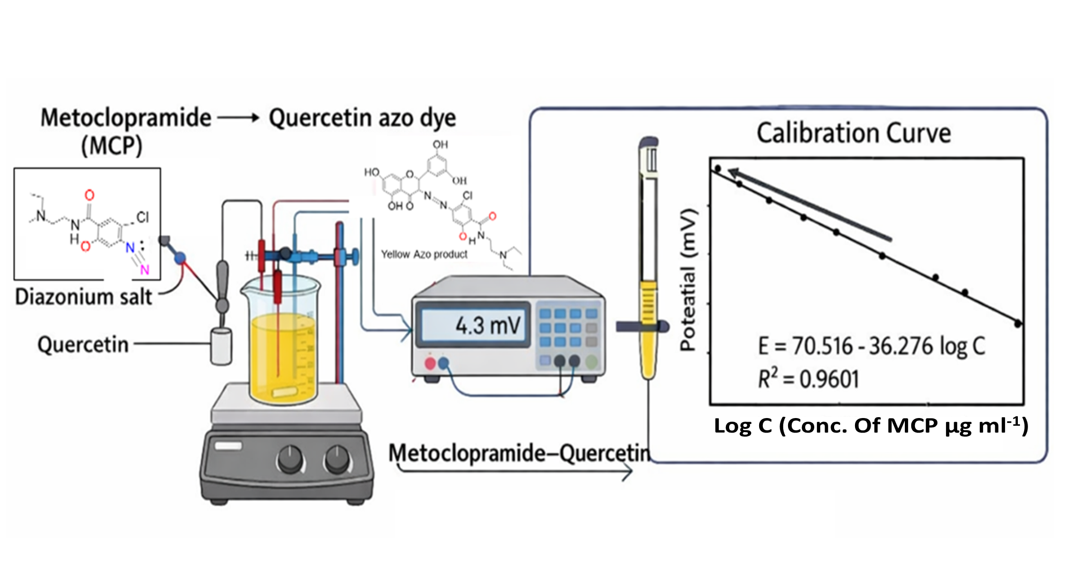
This study presents a direct potentiometric method for the quantitative determination of metoclopramide (MCP) based on the formation of a stable organic azo dye through the coupling of MCP diazonium salt with quercetin. The chromophore was monitored using a dual-platinum electrode over a concentration range of 2.0−20.0 μg·mL⁻¹, exhibiting an inverse linear relationship between the electrode potential and the logarithm of MCP concentration. The calibration equation was E = 70.517−36.276 log C (R2 = 0.9601). Transient sensitivity analysis identified a localized near-Nernstian region at 2.0−4.0 μg·mL⁻¹ with a slope of −58.90 mV per log C, whereas the overall working range exhibited a highly reproducible empirical non-Nernstian response. Information-theoretic analysis yielded a mutual information value, I(C; E), of 1.89 bits, corresponding to 57 % of the theoretical maximum information capacity. Based on ten independent blank measurements (σ = 0.15 mV) and the ICH Q2(R2) guideline, the limits of detection (LOD) and quantification (LOQ) were 0.253 and 0.767 μg·mL⁻¹, respectively, with a repeatability of RSD=2.62 %. The proposed double platinum potentiometric configuration provides a rapid, simple, low-cost electroanalytical approach for the direct quantitative determination of metoclopramide.
References
Shteingolts, S. A., Davydova, V. V., Mar’yasov, M. A., Nasakin, O. E., Fayzullin, R. R., & Lodochnikova, O. A. (2020). Crystal structure of dacarbazine, metoclopramide, and acetylcholine pentacyanopropenides. Journal of Structural Chemistry, 61, 928–936. https://doi.org/10.1134/S002247662006013X
Flayyih, F. H., Alshirifi, A. N., & Kadem, K. J. (2025). A new spectrophotometric method for the determination of imidacloprid in real samples by diazotization-coupling reaction. Methods and Objects of Chemical Analysis, 20, 46–51. https://doi.org/10.17721/moca.2025.46-51
Aghababaei, F., & Hadidi, M. (2023). Recent advances in potential health benefits of quercetin. Pharmaceuticals, 16, 1020. https://doi.org/10.3390/ph16071020
Carrillo-Martinez, E. J., Flores-Hernández, F. Y., Salazar-Montes, A. M., Nario-Chaidez, H. F., & Hernández-Ortega, L. D. (2024). Quercetin, a flavonoid with great pharmacological capacity. Molecules, 29, 1000. https://doi.org/10.3390/molecules29051000
Rao, M. J., & Zheng, B. (2025). The role of polyphenols in abiotic stress tolerance and their antioxidant properties to scavenge reactive oxygen species and free radicals. Antioxidants, 14, 74. https://doi.org/10.3390/antiox14010074
Nazarnezhad, S., Nasiri, S. N., Gorgani, S., Aghajanloo, B., & Seyedasli, N. (2026). Quercetin-loaded biocomposites for wound healing applications: From therapeutic efficacy to delivery platforms. Phytochemistry Reviews, 25, 1899–1928. https://doi.org/10.1007/s11101-025-10185-8
Qi, W., Qi, W., Xiong, D., & Long, M. (2022). Quercetin: Its antioxidant mechanism, antibacterial properties and potential application in prevention and control of toxipathy. Molecules, 27, 6545. https://doi.org/10.3390/molecules27196545
Sinan, R. (2010). Spectrophotometric determination of metoclopramide hydrochloride in pharmaceutical tablets by diazotization-coupling method with 1-naphthol as the coupling agent. Baghdad Science Journal, 7, 704–712. https://doi.org/10.21123/bsj.2010.7.1.704-712
Barzani, H. A. H., Omer, R. A., Barzani, K. I. S., Jawhar, Z. H., & Sulaiman, S. H. (2026). Evolving methodologies for the analytical determination of metoclopramide. Critical Reviews in Analytical Chemistry. https://doi.org/10.1080/10408347.2025.2612234
Hamamoto, K., Mizuno, Y., Kato, M., Yamagishi, N., & Furuhama, K. (2013). Simple and sensitive method for measurement of metoclopramide in cattle plasma by LC-MS/MS using a multimode chromatography. Journal of Veterinary Medical Science, 75, 509–514. https://doi.org/10.1292/jvms.12-0220
Ghasemi, M., Rahmani, M., & Khajeh, M. (2024). Development of a liquid-phase microextraction method prior to HPLC analysis of quercetin in food samples. Journal of Chromatographic Science, 62, 390–398. https://doi.org/10.1093/chromsci/bmad028
Barzani, H. A. H., Omer, R. A., Barzani, K. I. S., Jawhar, Z. H., & Sulaiman, S. H. (2026). Analytical techniques for quantification of metoclopramide: A comprehensive review. Biomedical Chromatography, 40, e70316. https://doi.org/10.1002/bmc.70316
Wu, J., Liu, H., Chen, W., Ma, B., & Ju, H. (2023). Device integration of electrochemical biosensors. Nature Reviews Bioengineering, 1, 346–360. https://doi.org/10.1038/s44222-023-00032-w
Theyagarajan, K., & Kim, Y. J. (2023). Recent developments in the design and fabrication of electrochemical biosensors using functional materials and molecules. Biosensors, 13, 424. https://doi.org/10.3390/bios13040424
Xhanari, K., & Finšgar, M. (2023). Recent advances in the modification of electrodes for trace metal analysis: A review. Analyst, 148, 5805–5821. https://doi.org/10.1039/D3AN01252B
Jampasa, S., Khamcharoen, W., Traipop, S., Jesadabundit, W., Ozer, T., & Chailapakul, O. (2023). Recent advances on nanomaterial-modified film-electrode-based sensors: Approach to clinical purpose. Current Opinion in Electrochemistry, 42, 101420. https://doi.org/10.1016/j.coelec.2023.101420
Drużyńska, M., Lenar, N., & Paczosa-Bator, B. (2025). Advances in reference membranes for potentiometric sensing applications. Membranes, 15, 376. https://doi.org/10.3390/membranes15120376
Al-Haideri, A. A., Abdulla, N. I., & Malih, I. K. (2017). Polymeric membrane sensors for the selective determination of metoclopramide hydrochloride and their applications to pharmaceutical analysis. Iraqi Journal of Pharmaceutical Sciences, 21, 70–77. https://doi.org/10.31351/vol21iss1pp70-77
Demir, İ., Bulduk, İ., Darwish, I. A., & Enginar, H. (2024). A green approach for metoclopramide quantification in pharmaceutical products: New HPLC and spectrophotometric methods. Scientific Reports, 14, 8765. https://doi.org/10.1038/s41598-024-59149-6
Singh, R., Gupta, R., Bansal, D., Bhateria, R., & Sharma, M. (2024). A review on recent trends and future developments in electrochemical sensing. ACS Omega, 9, 7336–7356. https://doi.org/10.1021/acsomega.3c080
Rahn, K. L., Peramune, U., Zhang, T., & Anand, R. K. (2023). Label-free electrochemical methods for disease detection. Annual Review of Analytical Chemistry, 16, 49–69. https://doi.org/10.1146/annurev-anchem-091622-085754
Dorschel, C. A. (1989). LC detectors: Evaluation and practical implications of linearity. Analytical Chemistry, 61, 951A–958A. https://doi.org/10.1021/ac00192a001
Ahmed, A. A., & Mohammed, M. A. (2026). UV–visible spectrophotometric determination of metoclopramide using quercetin in pure and pharmaceutical forms. Analytical Methods in Environmental Chemistry Journal, 9, 131–141. https://doi.org/10.24200/amecj.v9.i01.1113
Stock, J. T. (1971). Bipotentiometric titration: Microchemical and general applications. Microchemical Journal, 16, 557–570. https://doi.org/10.1016/0026-265X(71)90049-X
Kirowa-Eisner, E., Golombek, G., & Ariel, M. (1968). New indicating system: Twin electrodes, at zero current. II. The choice of electrodes. Journal of Electroanalytical Chemistry, 16, 33–40. https://doi.org/10.1016/S0022-0728(68)80274-8
Kirowa-Eisner, E., & Ariel, M. (1966). New indicating system: Twin electrodes, at zero current. I. Proposed mechanism. Journal of Electroanalytical Chemistry, 12, 286–293. https://doi.org/10.1016/S0022-0728(96)80003-9
Abdulkareem, H. M., Al-Tameemi, M., Ibraheem, I. H., & Hadi, M. S. (2020). Surfactant cloud point extraction as a procedure of preconcentrating for metoclopramide determination using spectroanalytical technique. Baghdad Science Journal, 17, 57–64. https://doi.org/10.21123/bsj.2020.17.1.0057
Duesselberg, A. L. M., Weber, I. C., Zosso, Y., Salah, P., & Bao, Z. (2026). Machine learning-driven multiplexed biomarker detection with polymer-enhanced electrochemical sensors. ACS Electrochemistry, 2, 1444–1455. https://doi.org/10.1021/acselectrochem.6c00079
European Medicines Agency. (2022). ICH Q2(R2): Validation of analytical procedures. https://www.ema.europa.eu/en/ich-q2r2-validation-analytical-procedures-scientific-guideline
International Council for Harmonisation. (2022). ICH guideline Q2(R2): Validation of analytical procedures. International Council for Harmonisation.
Simončič, B., Špan, J., & Vesnaver, G. (1994). A study of the self-association of simple azo dyes using the potentiometric method. Dyes and Pigments, 26, 257–266. https://doi.org/10.1016/0143-7208(94)80041-3
Bakker, E., & Pretsch, E. (2007). Modern potentiometry. Angewandte Chemie International Edition, 46, 5660–5668. https://doi.org/10.1002/anie.200605068
Cammann, K. (1979). Analysis techniques using ion-selective electrodes. In Working with ion-selective electrodes (pp. 121–161). Springer. https://doi.org/10.1007/978-3-642-67276-7_6
González-Franco, J., Olmos, J., Ruiz, A., & Ortuño, J. Á. (2025). Principal component analysis of transient potential signals from ion-selective electrodes for the identification and quantification of different ions. Chemosensors, 13, 305. https://doi.org/10.3390/chemosensors13080305
Shannon, C. E. (1948). The mathematical theory of communication. Bell System Technical Journal, 27, 379–423. https://doi.org/10.1002/j.1538-7305.1948.tb01338.x
Heragy, M. O., Moustafa, A. A. M., ElZanfaly, E. S., Al-Shareef, W. A., & Saad, A. S. (2022). Miniaturized solid-state sensor for inline monitoring of the microbial biodegradation of a biohazardous textile azo dye (Direct Red-81). Talanta Open, 6, 100146. https://doi.org/10.1016/j.talo.2022.100146
Boumya, W., Achak, M., Bakasse, M., & El Mhammedi, M. A. (2020). Indirect determination of dopamine and paracetamol by electrochemical impedance spectroscopy using azo coupling reaction with oxidized 2,4-dinitrophenylhydrazine (DNPH): Application in commercial tablets. Journal of Science: Advanced Materials and Devices, 5, 218–225. https://doi.org/10.1016/j.jsamd.2020.04.003
Almansrawi, S. A., & Alrufaie, M. M. (2023). Spectrophotometric determination of sulfanilamide using oxidative coupling reaction with the presence of the peroxidase enzyme. Egyptian Academic Journal of Biological Sciences, Section C: Physiology and Molecular Biology, 15, 573.
El-Mossalamy, E. H. (2009). Potentiometric and spectroscopic studies of sulfonamide azo-dye complexes with some transition metal ions and uranium. Portuguese Electrochimica Acta, 27, 143–154. https://doi.org/10.4152/pea.200902143
Downloads
Published
How to Cite
Issue
Section
License
Copyright (c) 2026 A'laa Abdulnabi Ahmed, Maha A. Mohammed

This work is licensed under a Creative Commons Attribution-NonCommercial-NoDerivatives 4.0 International License.

This work is licensed under a Creative Commons Attribution-NonCommercial-NoDerivatives 4.0 International License.
Authors retain copyright and grant the journal right of first publication with the work simultaneously licensed under a Creative Commons Attribution License (CC BY-NC-ND 4.0) that allows others to share the work with an acknowledgement of the work's authorship and initial publication in this journal.
