

Effect of Graphite Content on the Structural and Electrochemical Properties of MIL-88B(Fe)/Graphite Composites
DOI:
https://doi.org/10.31489/2959-0663/3-26-5Keywords:
MIL-88B(Fe), Metal-Organic Framework (MOF), graphite composites, electrocatalytic activity, glucose, electrochemical sensors, in situ synthesis, porous structureAbstract
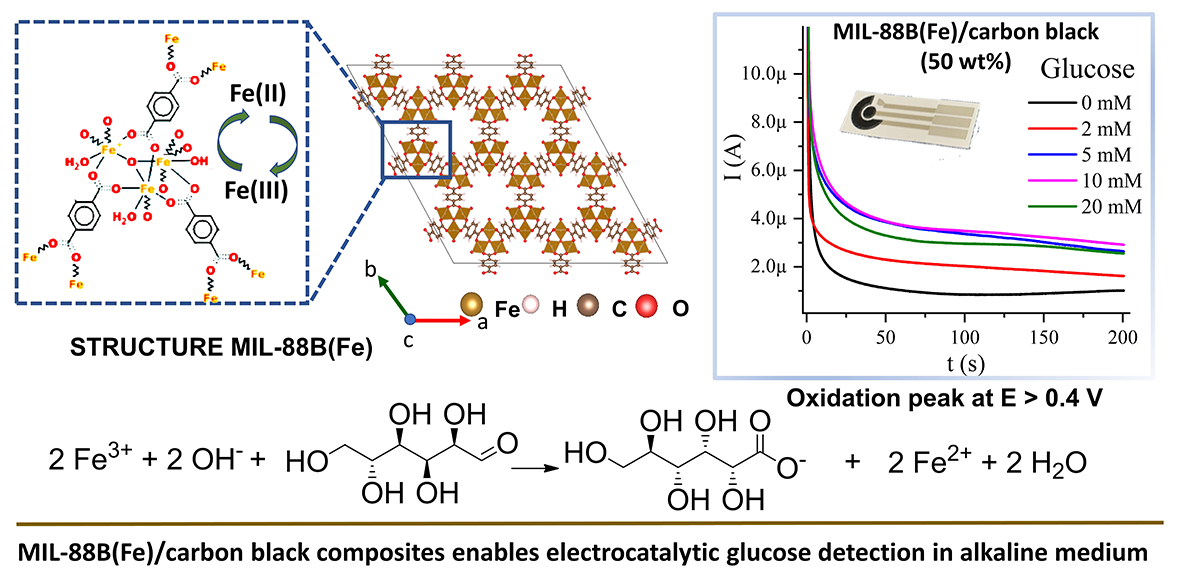
MIL-88B(Fe)/graphite composites are promising conductive materials for electrochemistry, combining the advantages of metal-organic frameworks and carbon. A series of composites with graphite contents from 12.5 to 75 wt.% was synthesized via in situ precipitation in aqueous medium at room temperature, using a trinuclear iron(III) oxoacetate complex as an inorganic precursor. The physicochemical characteristics were investigated by X-ray diffraction, Raman spectroscopy, SEM, TGA, nitrogen adsorption–desorption analysis, and infrared spectroscopy. An inverse linear correlation was found between the graphite content and the mass loss of the MOF composite at the first decomposition stage, attributed to dehydration. With increasing graphite weight fraction, the rate of mass loss of the composite decreases. The specific surface area nonlinearly decreases with increasing graphite content from 220 m2/g for pristine MIL-88B(Fe) to 15.2 m2/g for the composite with 75 wt.% graphite, while the calculated QSDFT pore diameter shifts from 4.6 nm for pure MIL-88B(Fe) to a stable 3.1 nm for the composites, indicating that graphite localizes on the outer crystal surfaces rather than penetrating the MOF pores. Electrocatalytic activity of MIL-88B(Fe) toward glucose oxidation was demonstrated by cyclic voltammetry. The results provide a physicochemical foundation for the development of electrode materials for non-enzymatic electrochemical glucose sensors based on MIL-88B(Fe) systems.
References
Raveendran, A. V., Chandran, M., & Dhanusuraman, R. (2023). A comprehensive review on the electrochemical parameters and recent material development of electrochemical water splitting electrocatalysts. RSC Advances, 13, 3843–3876. https://doi.org/10.1039/d2ra07642j
Water electrolysis: From textbook knowledge to the latest scientific strategies and industrial developments. (2022). Chemical Society Reviews, 51, 4583–4762. https://doi.org/10.1039/d0cs01079k
Zhai, Q., Huang, H., Lawson, T., Xia, Z., Giusto, P., Antonietti, M., Jaroniec, M., Chhowalla, M., Baek, J. -B., Liu, Y., Qiao, S., & Dai, L. (2024). Recent Advances on Carbon‐Based Metal‐Free Electrocatalysts for Energy and Chemical Conversions. Advanced Materials, 36. https://doi.org/10.1002/adma.202405664
Fan, L., Xia, C., Yang, F., Wang, J., Wang, H., & Lu, Y. (2020). Strategies in catalysts and electrolyzer design for electrochemical CO2 reduction toward C2+ products. Science Advances, 6. https://doi.org/10.1126/sciadv.aay3111
Overa, S., Ko, B., Zhao, Y., & Jiao, F. (2022). Electrochemical Approaches for CO2 Conversion to Chemicals: A Journey toward Practical Applications. Accounts of chemical research. https://doi.org/10.1021/acs.accounts.1c00674
Singh, S., Yadav, R. K., Kim, T. W., Singh, C., Singh, P., Chaubey, S., Rose, B., Gulzhian, D., & Khare, P. (2022). In Situ Prepared NRCPFs as Highly Active Photo Platforms for in Situ Bond Formation Between Aryldiazonium Salts and Heteroarenes. Photochemistry and Photobiology, 98(4), 748–753. https://doi.org/10.1111/php.13639
Ferreira, A. P. R. A., Oliveira, R. C. P., Mateus, M., & Santos, D. (2023). A Review of the Use of Electrolytic Cells for Energy and Environmental Applications. Energies. https://doi.org/10.3390/en16041593
Azari, P., Hasheminejad, H., & Zarean Mousaabadi, K. (2025). Synthesis and characterization of MIL-88 A (Fe)/C composite for treatment of dairy factory’s wastewater by enhanced electro-Fenton method. Scientific Reports, 15(1), 8503. https://doi.org/10.1038/s41598-025-92765-4
Dhara, K., & Mahapatra, D. (2017). Electrochemical nonenzymatic sensing of glucose using advanced nanomaterials. Microchimica Acta, 185, 1–32. https://doi.org/10.1007/s00604-017-2609-1
Li, H., Xiao, N., Jiang, M., Long, J., Li, Z., & Zhu, Z. (2024). Advances of Transition Metal-Based Electrochemical Non-enzymatic Glucose Sensors for Glucose Analysis: A Review. Critical Reviews in Analytical Chemistry, 55, 1099–1135. https://doi.org/10.1080/10408347.2024.2339955
Zhang, J., Xiong, Q., & Xu, J. (2024). Research progress in non-precious metal oxide/compound-based electrodes for non-enzymatic electrochemical glucose sensor applications. Materials Science in Semiconductor Processing. https://doi.org/10.1016/j.mssp.2024.108643
Batten, S. R., Champness, N. R., Chen, X. -M., Garcia-Martinez, J., Kitagawa, S., Öhrström, L., O’Keeffe, M., Paik Suh, M., & Reedijk, J. (2013). Terminology of metal–organic frameworks and coordination polymers (IUPAC Recommendations 2013). Pure and Applied Chemistry, 85(8), 1715–1724. https://doi.org/10.1351/PAC-REC-12-11-20
Gao, Q., Sheng, Q., Zhang, S., & Tang, Y. (2025). Recent trends on MIL-88(Fe) metal–organic frameworks: Synthesis and applications in pollutant removal and detection. RSC Advances, 15(32), 26184–26200. https://doi.org/10.1039/D5RA03049H
Channab, B. -E., El Ouardi, M., Ait Layachi, O., Marrane, S. E., El Idrissi, A., BaQais, A., & Ait Ahsaine, H. (2023). Recent trends on MIL-Fe metal–organic frameworks: Synthesis approaches, structural insights, and applications in organic pollutant adsorption and photocatalytic degradation. Environmental Science: Nano, 10(11), 2957–2988. https://doi.org/10.1039/d3en00332a
Huang, Q., Zeb, A., Xu, Z., Sahar, S., Zhou, J. -E., Lin, X., Wu, Z., Reddy, R. C. K., Xiao, X., & Hu, L. (2023). Fe-based metal-organic frameworks and their derivatives for electrochemical energy conversion and storage. Coordination Chemistry Reviews, 494, 215335. https://doi.org/10.1016/j.ccr.2023.215335
Morozan, A., & Jaouen, F. (2012). Metal organic frameworks for electrochemical applications. Energy & Environmental Science, 5(11), 9269–9290. https://doi.org/10.1039/C2EE22989G
Ishimoto, T., Ogura, T., Koyama, M., Yang, L., Kinoshita, S., Yamada, T., Tokunaga, M., & Kitagawa, H. (2013). A Key Mechanism of Ethanol Electrooxidation Reaction in a Noble-Metal-Free Metal–Organic Framework. The Journal of Physical Chemistry C, 117(20), 10607–10614. https://doi.org/10.1021/jp4031046
Serre, C., Mellot-Draznieks, C., Surblé, S., Audebrand, N., Filinchuk, Y., & Férey, G. (2007). Role of solvent-host interactions that lead to very large swelling of hybrid frameworks. Science, 315(5820), 1828–1831.
Horcajada, P., Serre, C., Maurin, G., Ramsahye, N. A., Balas, F., Vallet-Regí, M., Sebban, M., Taulelle, F., & Férey, G. (2008). Flexible Porous Metal-Organic Frameworks for a Controlled Drug Delivery. Journal of the American Chemical Society, 130(21), 6774–6780. https://doi.org/10.1021/ja710973k
Ma, M., Bétard, A., Weber, I., Al-Hokbany, N. S., Fischer, R. A., & Metzler-Nolte, N. (2013). Iron-Based Metal–Organic Frameworks MIL-88B and NH2-MIL-88B: High Quality Microwave Synthesis and Solvent-Induced Lattice “Breathing”. Crystal Growth & Design, 13(6), 2286–2291. https://doi.org/10.1021/cg301738p
Gao, F., Yan, R., Shu, Y., Cao, Q., & Zhang, L. (2022). Strategies for the application of metal–organic frameworks in catalytic reactions. RSC Advances, 12(16), 10114–10125. https://doi.org/10.1039/D2RA01175A
Zhu, Q. -L., & Xu, Q. (2014). Metal–organic framework composites. Chem. Soc. Rev., 43(16), 5468–5512. https://doi.org/10.1039/C3CS60472A
Liew, A. S. Y., Nguang, S. Y., Minggu, L. J., Tahir, N., & Moh, P. Y. (2021). Graphene oxide incorporated amino‐functionalized iron terephthalate composite as a heterogeneous Fenton‐like catalyst. Journal of the Chinese Chemical Society, 68(10), 1887–1896. https://doi.org/10.1002/jccs.202100183
Elmowafy, M. E., Zorainy, M., Abuzalat, O., Baraka, A., Sadek, R., & Tantawy, H. (2025). A novel double-layer MIL-88B (Fe/Co)/RGO composite as a superior microwave shielding material. Journal of Nanoparticle Research, 27(8), 211. https://doi.org/10.1007/s11051-025-06393-0
Abazari, R., Sanati, S., & Morsali, A. (2022). Mixed metal Fe2Ni MIL-88B metal–organic frameworks decorated on reduced graphene oxide as a robust and highly efficient electrocatalyst for alkaline water oxidation. Inorganic Chemistry, 61(8), 3396–3405.
Jia, D., Shen, Z., Lv, Y., Chen, Z., Li, H., Yu, Y., Qiu, J., & He, X. (2024). In situ electrochemical tuning of MIL‐88B (V)@ rGO into amorphous V2O5@ rGO as cathode for high‐performance aqueous zinc‐ion battery. Advanced Functional Materials, 34(2), 2308319. https://doi.org/10.1002/adfm.202308319
Zhang, C., Weiqiang, H., Jiang, H., Chang, J. -K., Zheng, M. -S., Wu, Q., & Dong, Q. (2017). Electrochemical performance of MIL-53(Fe)@RGO as an Organic Anode Material for Li-ion Batteries. Electrochimica Acta, 246. https://doi.org/10.1016/j.electacta.2017.06.059
Jin, Y., Zhao, C., Lin, Y., Wang, D., Chen, L., & Shen, C. (2017). Fe-Based Metal-Organic Framework and Its Derivatives for Reversible Lithium Storage. Journal of Materials Science & Technology, 33(8), 768–774. https://doi.org/10.1016/j.jmst.2016.11.021
Zhang, H., Chen, S., Zhang, H., Fan, X., Gao, C., Yu, H., & Quan, X. (2019). Carbon nanotubes-incorporated MIL-88B-Fe as highly efficient Fenton-like catalyst for degradation of organic pollutants. Frontiers of Environmental Science & Engineering, 13(2), 18. https://doi.org/10.1007/s11783-019-1101-z
Qin, W., He, L., Zhang, Y., Li, B., Han, L., & Xu, Y. (2024). Synchronous wrapping and inward-etching strategy on constructing yolk-shell MIL-88A@ NiFe-PB heterostructures for electrochemical non-enzymatic glucose detection. Microchemical Journal, 196, 109641. https://doi.org/10.1016/j.microc.2023.109641
Baimuratova, R. K., Zhinzhilo, V. A., Uflyand, I. E., Dmitriev, A. I., Zhidkov, M. V., Ovanesyan, N. S., Kugabaeva, G. D., & Dzhardimalieva, G. I. (2023). Low-Temperature Synthesis of Metal–Organic Coordination Polymers Based on Oxo-centered Iron Complexes: Magnetic and Adsorption Properties. Russian Journal of Physical Chemistry A, 97(4), 735–748. https://doi.org/10.1134/S0036024423040064
Sidorov, V. I., Baimuratova, R. K., Korchagin, D. V., Ivanov, A. I., Kydralieva, K. A., & Dzhardimalieva, G. I. (2024). Magnetically Separable Fe3O4/γ-Fe2O3@MIL-88b(Fe) and Fe3O4/γ-Fe2O3@NH2-MIL-88b(Fe) Composites for the Photocatalytic Degradation of Congo Red Dye. Eurasian Journal of Chemistry, 29(3 (115)), 130–147. https://doi.org/10.31489/2959-0663/3-24-5
Collins, T. J. (2007). ImageJ for microscopy. Biotechniques, 43(sup1), S25–S30.
Chen, Z., Hanna, S. L., Redfern, L. R., Alezi, D., Islamoglu, T., & Farha, O. K. (2019). Reticular chemistry in the rational synthesis of functional zirconium cluster-based MOFs. Coordination Chemistry Reviews, 386, 32–49. https://doi.org/10.1016/j.ccr.2019.01.017
Kumar, P., & Bohidar, H. B. (2010). Aqueous dispersion stability of multi-carbon nanoparticles in anionic, cationic, neutral, bile salt and pulmonary surfactant solutions. Colloids and Surfaces A: Physicochemical and Engineering Aspects, 361(1–3), 13–24.
Agola, P., & Taddei, M. (2026). A water-based synthetic route to the metal–organic framework UiO-66 starting from PET-derived terephthalate esters. RSC Sustainability, 4(1), 466–476. https://doi.org/10.1039/D5SU00463B
Sánchez-Sánchez, M., Getachew, N., Díaz, K., Díaz-García, M., Chebude, Y., & Díaz, I. (2015). Synthesis of metal–organic frameworks in water at room temperature: Salts as linker sources. Green Chemistry, 17, 1500–1509. https://doi.org/10.1039/c4gc01861c
Kondo, Y., Kuwahara, Y., Mori, K., & Yamashita, H. (2021). Dual role of missing-linker defects terminated by acetate ligands in a zirconium-based MOF in promoting photocatalytic hydrogen peroxide production. The Journal of Physical Chemistry C, 125(51), 27909–27918. https://doi.org/10.1021/acs.jpcc.1c07735
Shearer, G. C., Chavan, S., Bordiga, S., Svelle, S., Olsbye, U., & Lillerud, K. P. (2016). Defect Engineering: Tuning the Porosity and Composition of the Metal–Organic Framework UiO-66 via Modulated Synthesis. Chemistry of Materials, 28(11), 3749–3761. https://doi.org/10.1021/acs.chemmater.6b00602
Pangestu, A., Lestari, W. W., Wibowo, F. R., & Larasati, L. (2022). Green Electro-Synthesized MIL-101(Fe) and Its Aspirin Detoxification Performance Compared to MOF-808. Journal of Inorganic and Organometallic Polymers and Materials, 32(5), 1828–1839. https://doi.org/10.1007/s10904-022-02235-x
Chávez, A. M., Rey, A., López, J., Álvarez, P., & Beltrán, F. (2021). Critical aspects of the stability and catalytic activity of MIL-100(Fe) in different advanced oxidation processes. Separation and Purification Technology, 255. https://doi.org/10.1016/j.seppur.2020.117660
Wang, K. -Y., Yang, Z., Zhang, J., Banerjee, S., Joseph, E., Hsu, Y. -C., Yuan, S., Feng, L., & Zhou, H. (2022). Creating hierarchical pores in metal–organic frameworks via postsynthetic reactions. Nature Protocols, 18, 604–625. https://doi.org/10.1038/s41596-022-00759-7
Schneemann, A., Bon, V., Schwedler, I., Senkovska, I., Kaskel, S., & Fischer, R. A. (2014). Flexible metal–organic frameworks. Chem. Soc. Rev., 43(16), 6062–6096. https://doi.org/10.1039/C4CS00101J
Li, Y., Wang, Y., Fan, W., & Sun, D. (2022). Flexible metal–organic frameworks for gas storage and separation. Dalton Transactions, 51(12), 4608–4618. https://doi.org/10.1039/D1DT03842G
Pallach, R., Keupp, J., Terlinden, K., Frentzel-Beyme, L., Kloß, M., Machalica, A., Kotschy, J., Vasa, S. K., Chater, P. A., Sternemann, C., Wharmby, M. T., Linser, R., Schmid, R., & Henke, S. (2021). Frustrated flexibility in metal-organic frameworks. Nature Communications, 12(1), 4097. https://doi.org/10.1038/s41467-021-24188-4
Mellot-Draznieks, C., Serre, C., Surblé, S., Audebrand, N., & Férey, G. (2005). Very Large Swelling in Hybrid Frameworks: A Combined Computational and Powder Diffraction Study. Journal of the American Chemical Society, 127(46), 16273–16278. https://doi.org/10.1021/ja054900x
Ye, Z., Zhang, W., Lanzalaco, S., Zhao, L., Sirés, I., Xia, P., Zhai, J., & He, Q. (2023). Ultra-uniform MIL-88B(Fe)/Fe3S4 hybrids engineered by partial sulfidation to boost catalysis in electro-Fenton treatment of micropollutants: Experimental and mechanistic insights. Chemical Engineering Journal, 455, 140757. https://doi.org/10.1016/j.cej.2022.140757
Zhang, S., Zhuo, Y., Ezugwu, C. I., Wang, C., Li, C., & Liu, S. (2021). Synergetic Molecular Oxygen Activation and Catalytic Oxidation of Formaldehyde over Defective MIL-88B(Fe) Nanorods at Room Temperature. Environmental Science & Technology, 55(12), 8341–8350. https://doi.org/10.1021/acs.est.1c01277
Karagiaridi, O., Vermeulen, N. A., Klet, R. C., Wang, T. C., Moghadam, P. Z., Al-Juaid, S. S., Stoddart, J. F., Hupp, J. T., & Farha, O. K. (2015). Functionalized defects through solvent-assisted linker exchange: Synthesis, characterization, and partial postsynthesis elaboration of a metal–organic framework containing free carboxylic acid moieties. Inorganic chemistry, 54(4), 1785–1790. https://doi.org/10.1021/ic502697y
Nakamoto, K. (2009). Infrared and Raman spectra of inorganic and coordination compounds (6th ed). Wiley. https://doi.org/10.1002/9780470405840
Aizyatullov, A. S., Baimuratova, R. K., Sidorov, V. L., Spirin, M. G., Shilov, G. V., Dremova, N. N., & Dzhardimalieva, G. I. (2026). Engineering TiO2/MIL-88b(Fe) heterostructures for enhanced photocatalytic degradation of organic dyes. Materials Science in Semiconductor Processing, 211, 110725. https://doi.org/10.1016/j.mssp.2026.110725
Hollauer, E., Mondragon, M. A., & Castaño, V. M. (2001). Fourier transform infrared and Raman spectra, vibrational assignment and ab initio calculations of terephthalic acid and related compounds. Spectrochimica Acta Part A: Molecular and Biomolecular Spectroscopy, 57(5), 993–1007. https://doi.org/10.1016/s1386-1425(00)00428-5
Deacon, G. B., & Phillips, R. J. (1980). Relationships between the carbon-oxygen stretching frequencies of carboxylato complexes and the type of carboxylate coordination. Coordination chemistry reviews, 33(3), 227–250. https://doi.org/10.1016/s0010-8545(00)80455-5
Tuinstra, F., & Koenig, J. L. (1970). Raman spectrum of graphite. The Journal of chemical physics, 53(3), 1126–1130. https://doi.org/10.1063/1.1674108
Ferrari, A. C., & Robertson, J. (2000). Interpretation of Raman spectra of disordered and amorphous carbon. Physical review B, 61(20), 14095. https://doi.org/10.1103/physrevb.61.14095
Nguyen, V. H., Nguyen, T. D., Bach, L. G., Hoang, T., Bui, Q. T. P., Tran, L. D., Nguyen, C. V., Vo, D. -V. N., & Do, S. T. (2018). Effective Photocatalytic Activity of Mixed Ni/Fe-Base Metal-Organic Framework under a Compact Fluorescent Daylight Lamp. Catalysts, 8(11), 487. https://doi.org/10.3390/catal8110487
Hadjiivanov, K. I., Panayotov, D. A., Mihaylov, M. Y., Ivanova, E. Z., Chakarova, K. K., Andonova, S. M., & Drenchev, N. L. (2020). Power of infrared and Raman spectroscopies to characterize metal-organic frameworks and investigate their interaction with guest molecules. Chemical Reviews, 121(3), 1286–1424. https://doi.org/10.1021/acs.chemrev.0c00487
Banerjee, P. C., Lobo, D. E., Middag, R., Ng, W. K., & Et., A. (2015). Electrochemical Capacitance of Ni-Doped Metal Organic Framework and Reduced Graphene Oxide Composites: More than the Sum of Its Parts. ACS Applied Materials & Interfaces. https://doi.org/10.1021/am508119c
Guo, M., & Li, H. (2021). The Hydrolyzed Mil-88B(Fe) With Improved Surface Area for High-Capacity Lithium Ion Battery. Frontiers in Energy Research, 9, 781008. https://doi.org/10.3389/fenrg.2021.781008
Hou, S., Wu, Y., Feng, L., Chen, W., Wang, Y., Morlay, C., & Li, F. (2018). Green synthesis and evaluation of an iron-based metal–organic framework MIL-88B for efficient decontamination of arsenate from water. Dalton Transactions, 47(7), 2222–2231. https://doi.org/10.1039/C7DT03775A
Morsy, M., Hassan, S. S., Shaker, H. M., & Ismail, K. M. (2025). Synthesis and characterization of MIL-88B(Fe) MOF for high-performance humidity sensing. Sensors and Actuators B: Chemical, 438, 137806. https://doi.org/10.1016/j.snb.2025.137806
Zorainy, M. Y., Kaliaguine, S., Gobara, M., Elbasuney, S., & Boffito, D. C. (2022). Microwave-Assisted Synthesis of the Flexible Iron-based MIL-88B Metal–Organic Framework for Advanced Energetic Systems. Journal of Inorganic and Organometallic Polymers and Materials, 32(7), 2538–2556. https://doi.org/10.1007/s10904-022-02353-6
Xu, B., Yang, H., Cai, Y., Yang, H., & Li, C. (2016). Preparation and photocatalytic property of spindle-like MIL-88B (Fe) nanoparticles. Inorganic Chemistry Communications, 67, 29–31. https://doi.org/10.1016/j.inoche.2016.03.003
Bhardwaj, U., Janjani, P., Sharma, R., & Kushwaha, H. S. (2023). Investigation of Single-Metal Fe-Based Metal–Organic Framework as an Electrocatalyst for a Rechargeable Zinc-Air Battery. Journal of Electronic Materials, 52(2), 917–924. https://doi.org/10.1007/s11664-022-10106-x
Downloads
Additional Files
Published
How to Cite
Issue
Section
License
Copyright (c) 2026 Rose K. Baimuratova, Ravil N. Bazargulov, Sofia A. Kleinikova, Ekaterina V. Zolotukhina , Konstantin V. Gor'kov , Mikhail V. Zhidkov , Gulzhian I. Dzhardimalieva

This work is licensed under a Creative Commons Attribution-NonCommercial-NoDerivatives 4.0 International License.

This work is licensed under a Creative Commons Attribution-NonCommercial-NoDerivatives 4.0 International License.
Authors retain copyright and grant the journal right of first publication with the work simultaneously licensed under a Creative Commons Attribution License (CC BY-NC-ND 4.0) that allows others to share the work with an acknowledgement of the work's authorship and initial publication in this journal.
