
Comparative Electrochemical and Corrosion Inhibition Assessment of Commercial Tannic Acid, Crude Extracts, and n-Butanol Fractions of Quercus robur Stem Bark
DOI:
https://doi.org/10.31489/2959-0663/3-26-13Keywords:
Quercus robur, tannins, corrosion inhibitor, mild steel, potentiodynamic polarization, Langmuir adsorption isotherm, n-butanol fraction, commercial tannic acid, adsorption isothermsAbstract
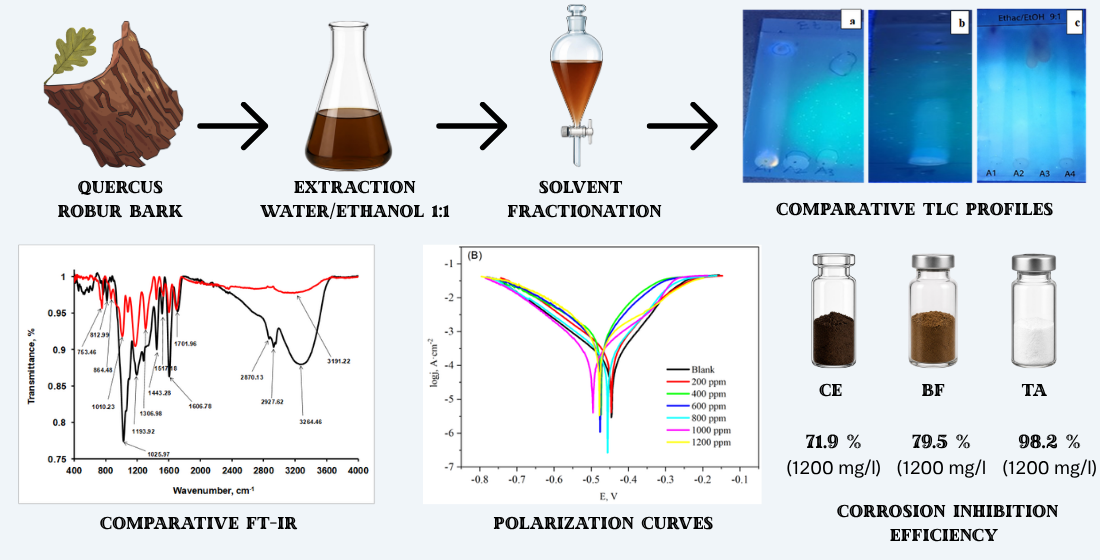
In this study, crude aqueous-ethanolic extract and n-butanol fraction of Quercus robur stem bark were obtained, and their corrosion-inhibition performance on mild steel in 1 M HCl was evaluated while their performances are compared to the commercial tannic acid used as standard. Corrosion inhibition was assessed by potentiodynamic polarization at 200 mg L⁻¹ after 1 hour of immersion. The n-butanol fraction exceeded the 71.9 % efficiency of the crude extract, though remaining below the 98.2 % maximum efficiency observed for the tannic acid standard at 1000 mg L⁻¹. Polarization curve shifts support classifying the tannin-containing samples as mixed-type inhibitors. Adsorption-isotherm analysis showed model-dependent behavior: the Freundlich model provided the highest R2 for the crude extract, while the Langmuir model provided the highest R2 for the n-butanol fraction and tannic acid. These fits represent empirical descriptions of concentration-dependent inhibition rather than direct molecular mechanisms. For commercial tannic acid, the standard Gibbs free energy of adsorption as approximately -33.3 kJ mol⁻¹, indicating thermodynamically favorable adsorption. Overall, solvent fractionation improved inhibition performance. These findings indicate the n-butanol fraction's potential as a plant-derived inhibitor. Further phytochemical investigation, isolation and characterization are required to properly identify the active constituents underlying the adsorption mechanisms.
References
Rahim, A., & Kassim, J. (2008). Recent Development of Vegetal Tannins in Corrosion Protection of Iron and Steel. Recent Patents on Materials Sciencee, 1(3), 223-231 https://doi.org/10.2174/1874464810801030223
Agi, A., Junin, R., Rasol, M., et al. (2018) Treated Rhizophora mucronata tannin as a corrosion inhibitor in chloride solution. PLoS One, 13(8), e0200595 https://doi.org/10.1371/journal.pone.0200595
Scutareanu, P., & Lingeman, R. (1994). Natural Content of Phenols and Tannin in Quercus Robur Leaves Related to Development of Euproctis Chrysorrhoea Caterpillars. Acta Horticulturae, (381), 738–741. https://doi.org/10.17660/actahortic.1994.381.106
Ferreira, D., Gross, G.G., Hagerman, A.E., Kolodziej, H., & Yoshida, T. (2008) Tannins and related polyphenols: Perspectives on their chemistry, biology, ecological effects, and human health protection. Phytochem. 69, 3006-3008 https://doi.10.1016/j.phytochem.2008.10.018.
Gonzalez-Iglesias, D., Rubio, L., Martinez-Vazquez, F., Castillo, A., Celeiro, M., Garcia-Jares, C., Lores, M. (2025). Phytochemical and antioxidant comparison of Quercus ilex and Quercus robur acorn extracts obtained by matrix solid-phase dispersion. RSC Advances, 15(16), 12538–12546. https://doi.org/10.1039/d4ra08675a.
Qi, C., Li, Z., Bi, H., & Dam-Johansen, K. (2024) Towards sustainable steel corrosion protection: expanding the applicability of natural hydrolyzable tannin in epoxy coatings via metal complexation. Electrochimica Acta, 497, 144546. https://doi.org/10.1016/j.electacta.2024.144546
Oki, M., Charles, E., Alaka, C., & Oki, T.K. (2011) Corrosion inhibition of mild steel in hydrochloric acid by tannins from Rhizophora racemosa. Mat. Sci. App., 02, 592–595 https://doi.10.4236/msa.2011.26079
Proença, C.S., Serrano, B., Correia, J., & Araújo, M.E.M. (2022) Evaluation of tannins as potential green corrosion inhibitors of aluminium alloy used in aeronautical industry. Metals, 12, 508. https://doi.org/10.3390/met12030508
Qi, C., Li, Z., Bi, H., & Dam-Johansen, K (2024) Towards sustainable steel corrosion protection: Expanding the applicability of natural hydrolyzable tannin in epoxy coatings via metal complexation. Electrochimica Acta, 497, Article 144546. https://doi.org/10.1016/j.electacta.2024.144546
Kaco, H., Talib, N.A.A., Zakaria, S., Jaafar, S.N.S., Othman, N.K., Chia, C.H., & Gan, S. (2018) Enhanced corrosion inhibition using purified tannin in HCl medium, Malaysian J. Anal. Sci., 22, 931 — 942 https://mjas.analis.com.my/wp-content/uploads/2019/06/22_6_2.html
Vorobyova V., Sikorsky O., Skiba M., Vasyliev, G. (2023) Quebracho tannin as corrosion inhibitor in neutral media and novel rust conversion agent for enhanced corrosion protection. S. Afr. J. Chem. Eng., 44, 68-80 https://doi.org/10.1016/j.sajce.2023.01.003.
Dargahi M., Olsson A.L.J., Tufenkji N., Gaudreault R. (2015) Green technology: tannin-based corrosion inhibitor for protection of mild steel. Corr. Sci., 71, 1321-1329. https://doi.org/10.5006/1777
Azmir, J., Zaidul, I. S. M., Rahman, M. M., Sharif, K. M., Mohamed, A., Sahena, F., Jahurul, M. H. A., Ghafoor, K., Norulaini, N. A. N., & Omar, A. K. M. (2013) Techniques for extraction of bioactive compounds from plant materials: A review. J. Food Eng., 117, 426-436 https://doi.org/10.1016/j.jfoodeng.2013.01.014
Awe, E.O., Adeloye, A., Idowu, T., Olajide, O.A., & Makinde J. (2008). Antinociceptive effect of Russelia equisetiformis leave extracts: Identification of its active constituents, Phytomedicine, 15, 301–305. https://doi.org/10.1016/j.phymed.2007.03.012
Litvinenko, Y. A., Sassykova, L. R., Sassykova, A. R., Konysbayev, A. T., Aitbayeva, R. R., Abildin, T. S., Kanapiyeva, F. M., Zhakirova, N. K., Zhussupova, A. K., Sendilvelan, S., Bhaskar, K., Gomathi, K., & Hua, R. (2026). Elemental composition, heavy metal accumulation and biologically active substances in wild plants of Kazakhstan. Sci, 8(6), Article 123. https://doi.org/10.3390/sci8060123
Dai J., Mumper R.J. (2010) Plant phenolics: extraction, analysis and their antioxidant and anticancer properties. Molecules, 15, 7313-7352. https://doi.org/10.3390/molecules15107313
Sylla, T., Pouységu, L., Dacosta, G., Deffieux, D., Monti, J. P., & Quideau, S. (2015) Gallotannins and tannic acid: first chemical syntheses and in-vitro inhibitory activity on Alzheimer’s amyloid β-peptide aggregation. Angew. Chem., Int. Ed., 54, 8217-8221 https://doi.org/10.1002/anie.201411606
Khanbabaee, K., & van Ree, T (2001) Tannins: Classification and definition. Natural Product Reports, 18(6), 641–649. https://doi.org/10.1039/b101061l
Chua, L.S., Lau, C.H., Chew, C.Y., Dawood, D.A.S. (2019) Solvent fractionation and acetone precipitation for crude saponins from Eurycoma longifolia extract. Molecules, 24, 1416. https://doi.org/10.3390/molecules24071416
Vargas-Ramella, M., Ely, J., Favaro-Trindade, C.S., Alves dos Santos, B., Campagnol, P.C.B., Lorenzo, J.M. (2026) Analytical characterization and quantification of plant-derived antioxidants focusing on methods, limitations, and data comparability. Food Anal. Met., 19, 162. https://doi.org/10.1007/s12161-026-03075-y
Abeng, F.E., Oji, N.N., Osuwa, K.A. et al. (2026) Thermodynamic study and adsorption characteristics of mild steel corrosion inhibition in 0.1 M solution by orange peels (Citrus sinensis). Discov. Chem., 3, 81. https://doi.org/10.1007/s44371-026-00546-3
Akinbulumo, O. A., Odejobi, O. J., & Odekanle, E. L. (2020). Thermodynamics and adsorption study of the corrosion inhibition of mild steel by Euphorbia heterophylla L. extract in 1.5 M HCl. Results in Materials, 5, 100074. https://doi.org/10.1016/j.rinma.2020.100074
Downloads
Published
How to Cite
Issue
Section
License
Copyright (c) 2026 Bibisara D. Burkitbayeva, Adewale O. Adeloye, Alfira F. Miftakhova, Raigul Zh. Jumanova, Gulmira S. Beisenova, Akmaral M. Argimbayeva, Gulzhan Seit, Yeldana G. Bakhytzhan, Aruzhan B. Smail

This work is licensed under a Creative Commons Attribution-NonCommercial-NoDerivatives 4.0 International License.

This work is licensed under a Creative Commons Attribution-NonCommercial-NoDerivatives 4.0 International License.
Authors retain copyright and grant the journal right of first publication with the work simultaneously licensed under a Creative Commons Attribution License (CC BY-NC-ND 4.0) that allows others to share the work with an acknowledgement of the work's authorship and initial publication in this journal.
