

Comparison of the Influence of Polymer Additives on the Thermal and Electrochemical Reduction of Copper Ferrites and Electro-catalytic Activity of the Formed Fe-Cu Composites
DOI:
https://doi.org/10.31489/2959-0663/3-26-6Keywords:
copper ferrite, polymer additives, co-precipitation, heat treatment, electrochemical reduction, Fe-Cu composites, electrocatalytic hydrogenation, 4-nitrophenolAbstract
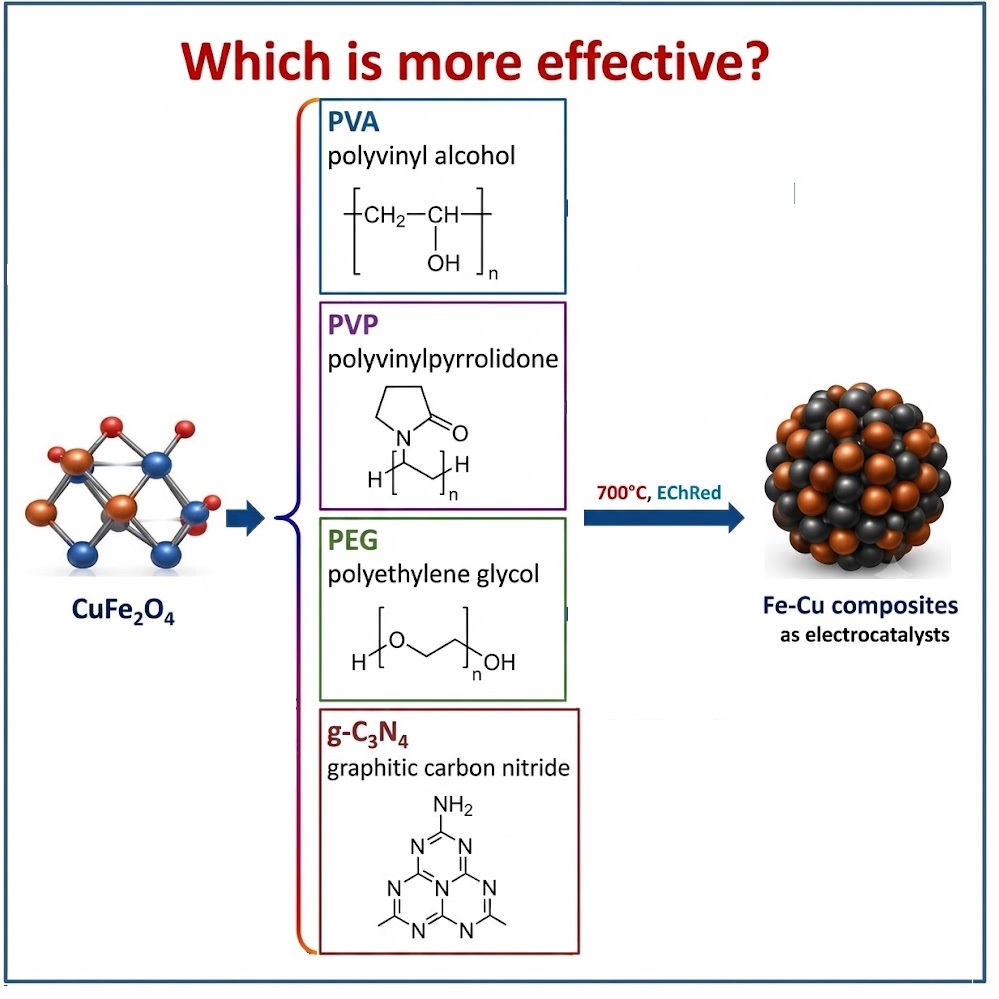
The conducted studies compared the influence of polymers (PVA, PVP, PEG and g-C3N4) added to the copper(II) and iron(III) cations co-precipitation environment during the preparation of copper(II) ferrite precursors on the phase compositions of CuFe2O4 + Polymer samples heat-treated at 700 °C, their electrochemical reduction, and the electrocatalytic activity of the resulting Fe-Cu composites. The structure and morphological features of CuFe2O4 + Polymer samples after heat treatment (HT) and electrochemical experiments were studied using XRD analysis and electron microscopy. Thermogravimetric studies were performed for the polymers and copper ferrite precursors. The results indicate that the thermal degradation products of PVA and g-C3N4 polymers induce a partial decomposition of copper ferrites during HT, yielding crystalline phases of copper and iron, thereby significantly decreasing the duration of the subsequent electrochemical reduction of these samples. "Pure" CuFe2O4 and samples containing other polymers remain stable at 700 °C. Electrochemical reduction of CuFe2O4 + PVP and CuFe2O4 + PEG samples result in a more complete reduction of iron cations than in other samples, which is favourable for intensifying the electrohydrogenation of 4-nitrophenol on Fe-Cu composites formed from these samples. The fabrication of a single product, 4-aminophenol, is confirmed by UV-vis spectra.
References
Rashad, M.M., Mohamed, R.M., Ibrahim, M.A., Ismail, L.F.M., Abdel-Aal, E.A. (2012). Magnetic and catalytic properties of cubic copper ferrite nanopowders synthesized from secondary resources. Adv. Powder Technol., 23, 315–323. https://doi.org/10.1016/j.apt.2011.04.005
Dey, A., Varshney, G., Maity, S., Sengupta, S. (2025). Hydrothermally synthesized ternary copper ferrite (CuFe2O4) micro-nano particles for high-capacity and long-life anodes in Li-ion batteries. Mater. Lett., 401, 139276. https://doi.org/10.1016/j.matlet.2025.139276
Wang, K., Yang, P., Guo, R., Yao, X., Yang, W. (2019). Photothermal performance of MFe2O4 nanoparticles. Chinese Chem. Lett., 30, 2013–2016. https://doi.org/10.1016/j.cclet.2019.04.005
Kharisov, B.I., Dias, H.V.R., Kharisova, O.V. (2019). Mini-review: Ferrite nanoparticles in the catalysis. Arabian J. Chem., 12, 1234–1246. http://dx.doi.org/10.1016/j.arabjc.2014.10.049
Dippong, T., Levei, E.A., Kadar, O. (2021). Recent advances in synthesis and applications of MFe2O4 (M = Co, Cu, Mn, Ni, Zn) nanoparticles. Nanomaterials, 11, 1560. https://doi.org/10.3390/nano11061560
Salih, S.J., Tahseen, Z.S. (2026). Spinel ferrite nanoparticles in environmental remediation: Adsorption, catalysis, and sustainability perspectives. Next Sustainability, 7, 100240. https://doi.org/10.1016/j.nxsust.2025.100240
Goya, G.F., Rechenberg, H.R. (1998). Superparamagnetic transition and local disorder in CuFe2O4 nanoparticles. Nanostruct. Mater., 10(6), 1001–1011. https://doi.org/10.1016/S0965-9773(98)00133-0
Marinca, T.F., Chicinaş, I., Isnard, O. (2012). Synthesis, structural and magnetic characterization of nanocrystalline CuFe2O4 as obtained by a combined method reactive milling, heat treatment and ball milling. Ceram. Int., 38(3), 1951–1957. https://doi.org/10.1016/j.ceramint.2011.10.026
Astaraki, H., Masoudpanah, S.M., Alamolhoda, S. (2021). Effects of ethylene glycol contents on phase formation, magnetic properties and photocatalytic activity of CuFe2O4/Cu2O/Cu nanocomposite powders synthesized by solvothermal method. J. Mater. Res. Technol., 14, 229–241. https://doi.org/10.1016/j.jmrt.2021.06.046
Calvo-de la Rosa, J., Segarra, M. (2019). Optimization of the synthesis of copper ferrite nanoparticles by a polymer-assisted sol-gel method. ACS Omega, 4(19), 18289–18298. https://doi.org/10.1021/acsomega.9b02295
Wu, X., Zhou, K., Wu, W., Cui, X., Li, Y. (2013). Magnetic properties of nanocrystalline CuFe2O4 and kinetics of thermal decomposition of precursor. J. Therm. Anal. Calorim., 111(1), 9–16. https://doi.org/10.1007/s10973-011-2104-6
Divakara, S. G., Jayanna, B. K., Mahesh, B., Anil Kumar, H. G., Reddy, M.A.H., Narasimhaswamy, N. (2026). Honey-assisted synthesis of CuFe2O4 nano pebbles: a sustainable approach to photocatalytic and antibacterial activity. J. Exp. Nanosci., 21(1), 2630356. https://doi.org/10.1080/17458080.2026.2630356
Kanagaraj, M., Sathishkumar, P., Selvan, K., In, P., Arumugam, S. (2014). Structural and magnetic properties of CuFe2O4 as-prepared and thermally treated spinel nanoferrites. Indian J. Pure Appl. Phys., 52(2), 124–130.
Ivanova, N.M., Soboleva, E.A., Visurkhanova, Ya.A., Muldakhmetov, Z. (2020). Electrochemical synthesis of Fe–Cu composites based on copper(II) ferrite and their electrocatalytic properties. Russ. J. Electrochem., 56, 533–543. http://doi.org/10.1134/S1023193520070034
Vissurkhanova, Ya.A., Ivanova, N.M., Soboleva, Ye.A., Muldakhmetov, Z.M. (2026). Fabrication and electrocatalytic activity of Fe-Cu/C composites based on copper ferrite modified with graphene oxide and graphitic carbon nitride. Materials, 19, 2273. https://doi.org/10.3390/ma19112273
- Vissurkhanova, Ya.A, Abulyaissova, L.K., Ivanova, N.M., Minaev, B.F. (2023). Molecular simulation of the interaction of polyvinyl alcohol with potential active centers of copper (II) oxide surface. News of the Academy of Sciences of RK. Series Chemistry and Technology, 457(4), 54–68. https://doi.org/10.32014/2023.2518-1491.192
Zhu, J., Xiao, P., Li, H., Carabineiro S.A.C. (2014). Graphitic Carbon Nitride: Synthesis, Properties, and Applications in Catalysis. ACS Appl. Mater. Interfaces, 6, 16449−16465. https://doi.org/10.1021/am502925j
Praus, P., Svoboda, L., Ritz, M., Troppova, I., Sihor, M., Koci, K. (2017). Graphitic carbon nitride: Synthesis, characterization and photocatalytic decomposition of nitrous oxide. Mater. Chem. Phys., 193, 438–446. https://doi.org/10.1016/j.matchemphys.2017.03.008
Taghizadeh, M.T., Yeganeh, N., Rezaei, M. (2015). The investigation of thermal decomposition pathway and products of poly(vinyl alcohol) by TG-FTIR. J. Appl. Polym. Sci., 132(25), 421177. https://doi.org/10.1002/APP.42117
Senkevich, S.I., Druzhinina, T.V., Kharchenko, I.M., Kryazhev, Yu.G. (2007). Thermal transformations of polyvinyl alcohol as a source for the preparation of carbon materials. Solid Fuel Chem., 41, 45–51. https://doi.org/10.3103/S0361521907010107
Lorı´a-Bastarrachea, M.I., Herrera-Kao, W., Cauich-Rodrı´guez, J.V., Cervantes-Uc, J.M., Va´zquez-Torres, H., A´vila-Ortega, A. (2011). A TGA/FTIR study on the thermal degradation of poly(vinyl pyrrolidone). A Therm. Anal. Calorim., 104, 737–742. https://doi.org/10.1007/s10973-010-1061-9
Jablonski, A.E., Lang, A. J., Vyazovkin, S. (2008). Isoconversional kinetics of degradation of polyvinylpyrrolidone used as a matrix for ammonium nitrate stabilization. Thermochimica Acta, 474(1-2), 78–80. https://doi.org/10.1016/j.tca.2008.06.003
Kou, Y., Wang, S., Luo, J., Sun, K., Zhang, J., Tan, Z., Shi, Q. (2019). Thermal analysis and heat capacity study of polyethylene glycol (PEG) phase change materials for thermal energy storage applications, J. Chem. Thermodynamics, 128, 259–274. https://doi.org/10.1016/j.jct.2018.08.031
Cheng, H., Cao, G., Ba, Z., Hu, D., Wang, Y., Li, Ch., Zhao, J (2026). Magnetite reduction kinetics under H2 and CO atmospheres at high temperature. Korean J. Chem. Eng., 43, 1493–1505. https://doi.org/10.1007/s11814-025-00643-6
Zhao, P., Feng, X., Huang, D., Yang, D., Astruc, D. (2015). Basic concepts and recent advances in nitrophenol reduction by gold- and other transition metal nanoparticles, Coord. Chem. Rev., 287, 114–136. https://doi.org/10.1016/j.ccr.2015.01.002
Din, M.I., Khalid, R., Hussain, Z., Hussain, T., Mujahid, A., Najeeb, J., Izhar, F. (2020). Nanocatalytic assemblies for catalytic reduction of nitrophenols: A critical review, Crit. Rev. Anal. Chem., 50(4), 322–338. https://doi.org/10.1080/10408347.2019.1637241
Mejía, Y.R., Bogireddy, N.K.R. (2022). Reduction of 4-nitrophenol using green-fabricated metal nanoparticles. RSC Advances, 12(29), 18661–18675. https://doi.org/10.1039/d2ra02663e
Simonetti, S.O., Beil, S.B., Waldvogel S.R. (2025). Nitro substrates in reductive electrosynthesis: A review. ACS Electrochem., 1, 805–818. https://doi.org/10.1021/acselectrochem.5c00081
Downloads
Published
How to Cite
Issue
Section
License
Copyright (c) 2026 Yakha A. Vissurkhanova, Nina M. Ivanova, Yelena A. Soboleva, Zainulla M. Muldakhmetov

This work is licensed under a Creative Commons Attribution-NonCommercial-NoDerivatives 4.0 International License.

This work is licensed under a Creative Commons Attribution-NonCommercial-NoDerivatives 4.0 International License.
Authors retain copyright and grant the journal right of first publication with the work simultaneously licensed under a Creative Commons Attribution License (CC BY-NC-ND 4.0) that allows others to share the work with an acknowledgement of the work's authorship and initial publication in this journal.
