Sulfoethyl Chitosan: From Synthesis and Physicochemical Characterization to Functional Applications and Patent Perspectives
DOI:
https://doi.org/10.31489/2959-0663/3-26-12Keywords:
sulfoethyl chitosan, biopolymer, polysaccharide, sulfoethylation, synthesis, characterization, chitosan derivatives, patent landscapeAbstract
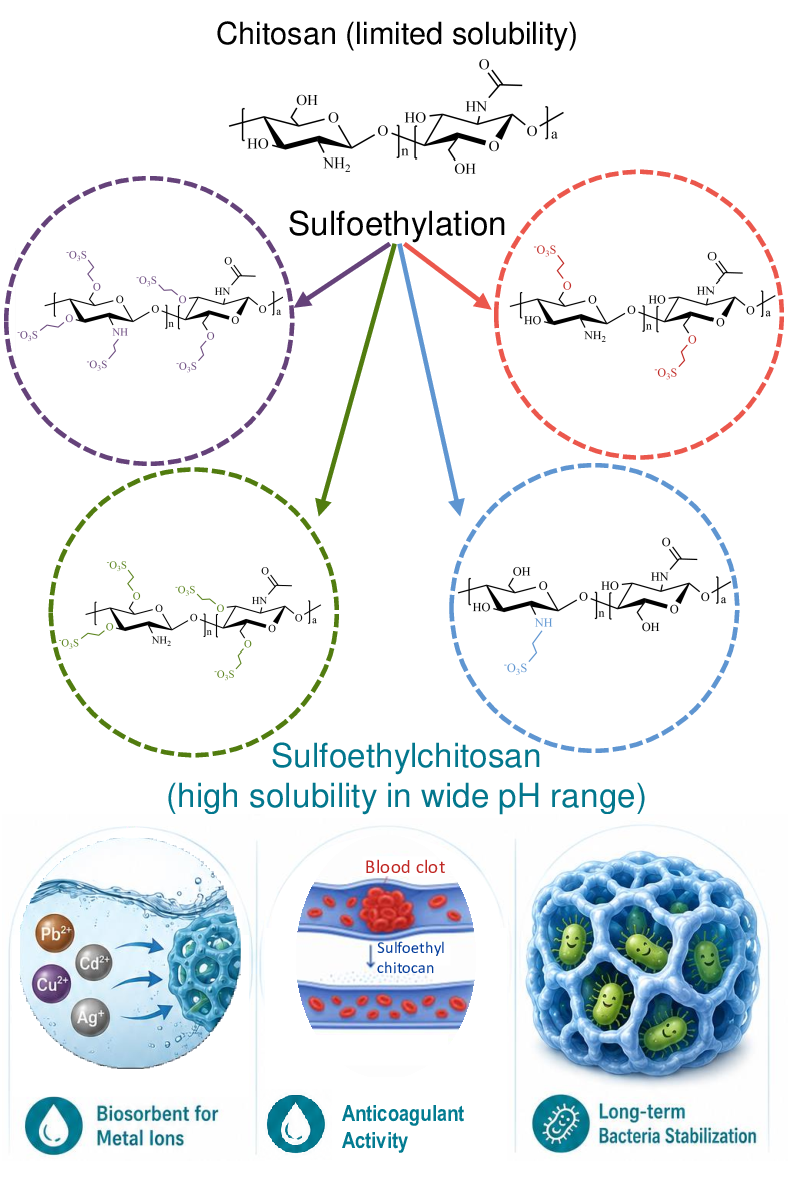
Sulfoethyl chitosan (SEC) is an anionic chitosan derivative obtained through N‑, O‑, or mixed O, N‑substitution with sulfoethyl groups, which significantly enhances water solubility across a wide pH range, imparts strong polyelectrolyte character, and confers heparin‑mimicking biological properties. This review provides a comprehensive overview of SEC synthesis approaches, chemoselective routes thereof, and the influence of the degree of substitution (DS) and substitution pattern on solubility, swelling, thermal stability, and metal‑ion sorption selectivity. Characterization techniques including ¹H NMR, elemental analysis, FT‑IR, X-ray diffraction and molecular weight determination approaches are discussed with their specific challenges for polyelectrolyte derivatives, including sample purity and aggregation. The impact of sulfoethylation on biological properties including anticoagulant activity, hemocompatibility, cytotoxicity, antimicrobial effect, DNA protective activity was evaluated for sulfoethylated chitosan and its precursors, chitin and chitin‑glucan complex, revealing distinct structure-activity trends governed by the degree of acetylation and substitution pattern. Representative applications include selective solid‑phase extraction of copper from environmental waters, anticoagulant coatings, and macroporous cryogels for long‑term bacterial stabilization at ambient temperatures over 12 months. Despite its versatility, SEC remains under‑patented compared to other chitosan derivatives. Critical knowledge gaps persist, including the absence of systematic DS-bioactivity and regioselectivity-bioactivity relationships and long‑term stability studies, which raises doubts on the industrial demand of the biopolymer. Future perspectives emphasize standardized protocols for characterization and for biological activity assessment, pilot manufacturing with reduced toxic and environmental impact, and interdisciplinary efforts to develop advanced functional materials. With focused attention on these priorities, SEC has potential to transition from a laboratory derivative to a commercially viable biopolymer.
References
El-Saadony, M. T., Saad, A. M., Alkafaas, S. S., Dladla, M., Ghosh, S., Elkafas, S. S., Hafez, W., Ezzat, S. M., Khedr, S. A., Hussien, A. M., Fahmy, M. A., Elesawi, I. E., Salem, H. M., Mohammed, D. M., Abd El-Mageed, T. A., Ahmed, A. E., Mosa, W. F. A., El-Tarabily, M. K., AbuQamar, S. F., & El-Tarabily, K. A. (2025). Chitosan, derivatives, and its nanoparticles: Preparation, physicochemical properties, biological activities, and biomedical applications–A comprehensive review. International Journal of Biological Macromolecules, 313, 142832. https://doi.org/10.1016/j.ijbiomac.2025.142832
Sharkawy, A., Barreiro, M. F., & Rodrigues, A. E. (2020). Chitosan-based Pickering emulsions and their applications: A review. Carbohydrate Polymers, 250, 116885. https://doi.org/10.1016/j.carbpol.2020.116885
Dambuza, A., Mokolokolo, P. P., Makhatha, M. E., & Sibeko, M. A. (2025). Pharmacological and biological efficacy of chitosan-based materials. International Journal of Molecular Sciences, 26(21), 10735. https://doi.org/10.3390/ijms262110735
Gao, Y., & Wu, Y. (2022). Recent advances of chitosan-based nanoparticles for biomedical and biotechnological applications. International Journal of Biological Macromolecules, 203, 379–388. https://doi.org/10.1016/j.ijbiomac.2022.01.162
Karimlar, S., Pirbalouti, A. G., Teymuori, Z., Moslehishad, M., & Hamidi‐Esfahani, Z. (2026). Applications of Chitosan, an Eco‐Friendly Biopolymer in Agricultural Systems, Herbal Products, and Functional Foods: A Review. Food Science & Nutrition, 14(1), e71367. https://doi.org/10.1002/fsn3.71367
Suryani, S., Chaerunisaa, A. Y., Joni, I. M., Ruslin, R., Aspadiah, V., Anton, A., Sartinah, A., & Ramadhan, L. O. A. N. (2024). The chemical modification to improve solubility of chitosan and its derivatives application, preparation method, toxicity as a nanoparticles. Nanotechnology, Science and Applications, 41–57. https://doi.org/10.2147/NSA.S450026
Qin, C., Li, H., Xiao, Q., Liu, Y., Zhu, J., & Du, Y. (2006). Water-solubility of chitosan and its antimicrobial activity. Carbohydrate polymers, 63(3), 367–374. https://doi.org/10.1016/j.carbpol.2005.09.023
Argilashki, D., & Uzunova, Y. (2026). Enhancing drug delivery through chemical modification of chitosan: A review. Pharmacia, 73, 1–14. https://doi.org/10.3897/pharmacia.73.e180564
Zamruddin, N. D., Salleh, K. M., & Mutalib, H. A. A. (2026). Chemical Modification of Chitosan for Enhanced Environmental Applications. In Biopolymers from Plant Origin for Environmental Sustainability (pp. 307–332). Cham: Springer Nature Switzerland. https://doi.org/10.1007/978-3-032-16034-8_13
Argüelles-Monal, W. M., Lizardi-Mendoza, J., Fernández-Quiroz, D., Recillas-Mota, M. T., & Montiel-Herrera, M. (2018). Chitosan derivatives: introducing new functionalities with a controlled molecular architecture for innovative materials. Polymers, 10(3), 342. https://doi.org/10.3390/polym10030342
Zhang, J., Xia, W., Liu, P., Cheng, Q., Tahirou, T., Gu, W., & Li, B. (2010). Chitosan modification and pharmaceutical/biomedical applications. Marine drugs, 8(7), 1962-1987. https://doi.org/10.3390/md8071962
Szabová, J., Mravec, F., Mokhtari, M., Le Borgne, R., Kalina, M., & Berret, J. F. (2023). N, N, N-Trimethyl chitosan as a permeation enhancer for inhalation drug delivery: Interaction with a model pulmonary surfactant. International Journal of Biological Macromolecules, 239, 124235. https://doi.org/10.1016/j.ijbiomac.2023.124235
Nagy, V., Snorradóttir, B. S., Lauzon, H. L., & Másson, M. (2024). Design of experiments optimization of N, N, N-trimethyl chitosan synthesis using N, N-diisopropylethylamine base. Carbohydrate Research, 545, 109289. https://doi.org/10.1016/j.carres.2024.109289
Borsagli, F. G. M., Mansur, A. A., Chagas, P., Oliveira, L. C., & Mansur, H. S. (2015). O-carboxymethyl functionalization of chitosan: complexation and adsorption of Cd (II) and Cr (VI) as heavy metal pollutant ions. Reactive and Functional Polymers, 97, 37–47. https://doi.org/10.1016/j.reactfunctpolym.2015.10.005
Chen, L., Tian, Z., & Du, Y. (2004). Synthesis and pH sensitivity of carboxymethyl chitosan-based polyampholyte hydrogels for protein carrier matrices. Biomaterials, 25(17), 3725–3732. https://doi.org/10.1016/j.biomaterials.2003.09.100
Jayakumar, R., Prabaharan, M., Nair, S. V., Tokura, S., Tamura, H., & Selvamurugan, N. (2010). Novel carboxymethyl derivatives of chitin and chitosan materials and their biomedical applications. Progress in Materials Science, 55(7), 675–709.https://doi.org/10.1016/j.pmatsci.2010.03.001
Dubovskaia, P. I., Saeidi, A., Pronchenko, A. A., Drannikova, A. I., Lukoyanov, I. A., Aripova, F. K., Savenko, M. E., Veretennikova, E. A., Pestov, A. V., Litvinova, E. A. & Drannikov, A. A. (2025). Gel-Phase Synthesis and pH-Sensitive Swelling-Structure Relationships of N-Carboxyethylchitosan. Eurasian Journal of Chemistry, 30(2 (118)), 19–33. https://doi.org/10.31489/2959-0663/2-25-6
Bernkop-Schnürch, A., Hornof, M., & Guggi, D. (2004). Thiolated chitosans. European Journal of Pharmaceutics and Biopharmaceutics, 57(1), 9–17. https://doi.org/10.1016/S0939-6411(03)00147-4
Wang, W., Meng, Q., Li, Q., Liu, J., Zhou, M., Jin, Z., & Zhao, K. (2020). Chitosan derivatives and their application in biomedicine. International journal of molecular sciences, 21(2), 487. https://doi.org/10.3390/ijms21020487
Alfinaikh, R. S., Alamry, K. A., & Hussein, M. A. (2025). Sustainable and biocompatible hybrid materials-based sulfated polysaccharides for biomedical applications: a review. RSC advances, 15(6), 4708–4767. https://doi.org/10.1039/d4ra07277d
Jiao, G., Yu, G., Zhang, J., & Ewart, H. S. (2011). Chemical structures and bioactivities of sulfated polysaccharides from marine algae. Marine drugs, 9(2), 196–223. https://doi.org/10.3390/md9020196
Yermak, I. M., Mischchenko, N. P., Davydova, V. N., Glazunov, V. P., Tarbeeva, D. V., Kravchenko, A. O., Pimenova., E. A. & Sorokina, I. V. (2017). Carrageenans-sulfated polysaccharides from red seaweeds as matrices for the inclusion of echinochrome. Marine Drugs, 15(11), 337. https://doi.org/10.3390/md15110337
Pereira, L., & Valado, A. (2025). Beyond Nutrition: The Therapeutic Promise of Seaweed-Derived Polysaccharides Against Bacterial and Viral Threats. Marine Drugs, 23(10), 407. https://doi.org/10.3390/md23100407
Nikitina, M., Kochkina, N., Arinina, M., Kulichikhin, V., & Terekhova, I. (2023). β-cyclodextrin modified hydrogels of kappa-carrageenan for methotrexate delivery. Pharmaceutics, 15(9), 2244. https://doi.org/10.3390/pharmaceutics15092244
Mikami, T., & Kitagawa, H. (2017). Sulfated glycosaminoglycans: their distinct roles in stem cell biology. Glycoconjugate Journal, 34(6), 725–735. https://doi.org/10.1007/s10719-016-9732-9
Esposito, F., Vessella, G., Sinquin, C., Traboni, S., Iadonisi, A., Colliec-Jouault, S., Zykwinska, A. & Bedini, E. (2022). Glycosaminoglycan-like sulfated polysaccharides from Vibrio diabolicus bacterium: Semi-synthesis and characterization. Carbohydrate polymers, 283, 119054. https://doi.org/10.1016/j.carbpol.2021.119054
Feng, Q., Lin, S., Zhang, K., Dong, C., Wu, T., Huang, H., Xiaohui, Y.,.Zhang, L., Gang, L. & Bian, L. (2017). Sulfated hyaluronic acid hydrogels with retarded degradation and enhanced growth factor retention promote hMSC chondrogenesis and articular cartilage integrity with reduced hypertrophy. Acta biomaterialia, 53, 329–342. https://doi.org/10.1016/j.actbio.2017.02.015
Wang, X., Hadi, M. K., Niu, J., Zhou, Q., & Ran, F. (2023). Anticoagulant macromolecules. Macromolecules, 56(12), 4387–4430. https://doi.org/10.1021/acs.macromol.2c02501
Liu, J., & Pedersen, L. C. (2007). Anticoagulant heparan sulfate: structural specificity and biosynthesis. Applied microbiology and biotechnology, 74(2), 263–272. https://doi.org/10.1007/s00253-006-0722-x
Jabeen, F., Ahmad, R., Mir, S., Awwad, N. S., & Ibrahium, H. A. (2025). Carrageenan: structure, properties and applications with special emphasis on food science. RSC advances, 15(27), 22035–22062. https://doi.org/10.1039/d5ra03296b
Steiger, B. G., & Wilson, L. D. (2020). Modular chitosan-based adsorbents for tunable uptake of sulfate from water. International journal of molecular sciences, 21(19), 7130. https://doi.org/10.3390/ijms21197130
Aguanell, A., Del Pozo, M. L., Pérez-Martín, C., Pontes, G., Bastida, A., Fernández-Mayoralas, A., García-Junceda, E., & Revuelta, J. (2022). Chitosan sulfate-lysozyme hybrid hydrogels as platforms with fine-tuned degradability and sustained inherent antibiotic and antioxidant activities. Carbohydrate polymers, 291, 119611. https://doi.org/10.1016/j.carbpol.2022.119611
Karlybaeva, B. P., Berdimbetova, G. E., & Boymirzaev, A. S. (2023). Synthesis and characteristics of sulfated chitosan based on chitin/chitosan from artemia parthenogenetica cysts. Kimya Problemleri, 21(3), 242–250.
Zargar, V., Asghari, M., & Dashti, A. (2015). A review on chitin and chitosan polymers: structure, chemistry, solubility, derivatives, and applications. ChemBioEng reviews, 2(3), 204–226. https://doi.org/10.1002/cben.201400025
Heise, K., Hobisch, M., Sacarescu, L., Maver, U., Hobisch, J., Reichelt, T., Sega, M., Fischer, S., & Spirk, S. (2018). Low-molecular-weight sulfonated chitosan as template for anticoagulant nanoparticles. International journal of nanomedicine, 4881–4894. https://doi.org/10.2147/IJN.S172230
Suwan, J., Zhang, Z., Li, B., Vongchan, P., Meepowpan, P., Zhang, F., Mousa, S. A., Mousa, S., Premanode, B., Kongtawelert, P., & Linhardt, R. J. (2009). Sulfonation of papain-treated chitosan and its mechanism for anticoagulant activity. Carbohydrate research, 344(10), 1190–1196. https://doi.org/10.1016/j.carres.2009.04.016
Petrova, V. А., Chernyakov, D. D., Moskalenko, Y. E., Gasilova, E. R., Strelina, I. А., Okatova, O. V., Baklagina, Y. G., Vlasova, E.N. & Skorik, Y. А. (2017). O, N-(2-sulfoethyl) chitosan: Synthesis and properties of solutions and films. Carbohydrate polymers, 157, 866–874. https://doi.org/10.1016/j.carbpol.2016.10.058
Tsai, H. S., Wang, Y. Z., Lin, J. J., & Lien, W. F. (2010). Preparation and properties of sulfopropyl chitosan derivatives with various sulfonation degree. Journal of Applied Polymer Science, 116(3), 1686–1693. https://doi.org/10.1002/APP.31689
Gabriel, L., & Heinze, T. (2020). Structure design of polysaccharides–Chemoselective sulfoethylation of chitosan. European Polymer Journal, 140, 109978. https://doi.org/10.1016/j.eurpolymj.2020.109978
Nud'ga, L. A., Plisko, E. A., & Danilov, S. N. (1974). Zhurnal Prikladnoi Khimii, 47(4), 872–875.
Muzzarelli, R. A. (1992). Modified chitosans carrying sulfonic acid groups. Carbohydrate polymers, 19(4), 231–236. https://doi.org/10.1016/0144-8617(92)90074-Z
Plisko, E. A., Nud'ga, L. A., & Danilov, S. N. (1977). Chitin and its chemical transformations. Russian Chemical Reviews, 46(8), 764–774. https://doi.org/10.1070/rc1977v046n08abeh002171
Nud'ga, L. A., Plisko, E. A., & Danilov, S. N. (1973). Zhurnal Obshc. Khimii, 43, 2752.
Nud'ga, L. A., Petrova, V. A., Ben'kovich, A. E. А., & Petropavlovskii, G. A. (2001). Comparative study of reactivity of cellulose, chitosan, and chitin-glucan complex in sulfoethylation. Russian Journal of Applied Chemistry, 74(1), 145–148. https://doi.org/10.1023/A:1012776807384
Pestov, A. V., Petrova, Y. S., Bukharova, A. V., Neudachina, L. K., Koryakova, O. V., Matochkina, E. G., Kodess, M. I., & Yatluk, Y. G. (2013). Synthesis in a gel and sorption properties of N-2-sulfoethyl chitosan. Russian journal of applied chemistry, 86(2), 269–272. https://doi.org/10.1134/S1070427213020225
An, N. T., Dong, N. T., & Le Dung, P. (2009). Water-soluble N-carboxymethylchitosan derivatives: Preparation, characteristics and its application. Carbohydrate Polymers, 75(3), 489–497. https://doi.org/10.1016/j.carbpol.2008.08.017
Skorik, Y. A., Gomes, C. A., Vasconcelos, M. T. S., & Yatluk, Y. G. (2003). N-(2-Carboxyethyl) chitosans: regioselective synthesis, characterisation and protolytic equilibria. Carbohydrate Research, 338(3), 271–276. https://doi.org/10.1016/s0008-6215(02)00432-9
Desbrieres, J., & Babak, V. G. (2008). Interfacial properties of amphiphilic systems on the basis of natural polymers—chitin derivatives. Russian Journal of General Chemistry, 78(11), 2230–2238. https://doi.org/10.1134/S1070363208110443
Muzzarelli, R. A. (1988). Carboxymethylated chitins and chitosans. Carbohydrate polymers, 8(1), 1–21. https://doi.org/10.1016/0144-8617(88)90032-X
Aranaz, I., Alcántara, A. R., Civera, M. C., Arias, C., Elorza, B., Heras Caballero, A., & Acosta, N. (2021). Chitosan: An overview of its properties and applications. Polymers, 13(19), 3256. https://doi.org/10.3390/polym13193256
Petrova, Y. S., Bukharova, A. V., Neudachina, L. K., Adamova, L. V., Koryakova, O. V., & Pestov, A. V. (2014). Chemical properties of N-2-Sulfoethylchitosan with a medium degree of substitution. Polymer Science Series B, 56(4), 487–493. https://doi.org/10.1134/S1560090414040083
Petrova, Y. S., Neudachina, L. K., Mekhaev, A. V., & Pestov, A. V. (2014). Simple synthesis and chelation capacity of N-(2-sulfoethyl) chitosan, a taurine derivative. Carbohydrate polymers, 112, 462–468. http://dx.doi.org/10.1016/j.carbpol.2014.06.028
Petrova, Y. S., Pestov, A. V., Usoltseva, M. K., & Neudachina, L. K. (2015). Selective adsorption of silver (I) ions over copper (II) ions on a sulfoethyl derivative of chitosan. Journal of hazardous materials, 299, 696–701. http://dx.doi.org/10.1016/j.jhazmat.2015.08.001
Bolshakov, I. N., Gornostaev, L. M., Fominykh, O. I., & Svetlakov, A. V. (2022). Synthesis, chemical and biomedical aspects of the use of sulfated chitosan. Polymers, 14(16), 3431. https://doi.org/10.3390/polym14163431
Shetranjiwalla, S., & Ononiwu, A. (2025). Identifying barriers to scaled-up production and commercialization of chitin and chitosan using green technologies: A review and quantitative green chemistry assessment. International Journal of Biological Macromolecules, 305, 141062. https://doi.org/10.1016/j.ijbiomac.2025.141062
Wang, T., Kusumi, K., Zhu, L., Mei, L., Manabe, A., Asghari, M., Samani, B. H., Yamamoto, T. & Kanda, H. (2024). Removal of acetyl-rich impurities from chitosan using liquefied dimethyl ether. International Journal of Biological Macromolecules, 280, 136381. https://doi.org/10.1016/j.ijbiomac.2024.136381
Kasaai, M. R. (2007). Calculation of Mark–Houwink–Sakurada (MHS) equation viscometric constants for chitosan in any solvent–temperature system using experimental reported viscometric constants data. Carbohydrate polymers, 68(3), 477–488. https://doi.org/10.1016/j.carbpol.2006.11.006
Knight, B. M., Mondal, R., Han, N., Pietra, N. F., Hall, B. A., Edgar, K. J., Welborn, V.V., Madsen, L.A., Yoreo, J.J.D. & Dove, P. M. (2024). Kinetics of calcite nucleation onto sulfated chitosan derivatives and implications for water–polysaccharide interactions during crystallization of sparingly soluble salts. Crystal Growth & Design, 24(15), 6338. https://doi.org/10.1021/acs.cgd.4c00602
Caltabiano, A. M., Foley, J. P., & Striegel, A. M. (2018). Aqueous size-exclusion chromatography of polyelectrolytes on reversed-phase and hydrophilic interaction chromatography columns. Journal of Chromatography A, 1532, 161–174. https://doi.org/10.1016/j.chroma.2017.12.007
Nguyen, S., Winnik, F. M., & Buschmann, M. D. (2009). Improved reproducibility in the determination of the molecular weight of chitosan by analytical size exclusion chromatography. Carbohydrate polymers, 75(3), 528–533. https://doi.org/10.1016/j.carbpol.2008.08.013
Wu, C., Zhou, S., & Wang, W. (1995). A dynamic laser light‐scattering study of chitosan in aqueous solution. Biopolymers: Original Research on Biomolecules, 35(4), 385–392. https://doi.org/10.1002/bip.360350406
Fee, M., Errington, N., Jumel, K., Illum, L., Smith, A., & Harding, S. E. (2003). Correlation of SEC/MALLS with ultracentrifuge and viscometric data for chitosans. European Biophysics Journal, 32(5), 457–464. https://doi.org/10.1007/s00249-003-0317-8
Errington, N., Harding, S. E., Vårum, K. M., & Illum, L. (1993). Hydrodynamic characterization of chitosans varying in degree of acetylation. International Journal of Biological Macromolecules, 15(2), 113–117. https://doi.org/10.1016/0141-8130(93)90008-A
Konovalova, M., Shagdarova, B. T., Zubov, V., & Svirshchevskaya, E. (2019). Express analysis of chitosan and its derivatives by gel electrophoresis. Progress on Chemistry and Application of Chitin and its Derivatives, 24, 84–95. https://doi.org/10.15259/PCACD.24.007
Lootsik, M. D., Manko, N. O., Bilyy, R. O., Lutsyk, M. M., & Stoika, R. S. (2022). Analysis of chitosan molecular weight profile by electrophoresis in a porosity step gradient polyacrylamide gel. The Ukrainian Biochemical Journal, 94(2), 76–84. https://doi.org/10.15407/ubj94.02.076
Yanagisawa, M., Kato, Y., Yoshida, Y., & Isogai, A. (2006). SEC-MALS study on aggregates of chitosan molecules in aqueous solvents: Influence of residual N-acetyl groups. Carbohydrate polymers, 66(2), 192–198. https://doi.org/10.1016/j.carbpol.2006.03.008
Arpa, M. D., & Akbuğa, F. J. (2025). Chitosan-based nanogels in modern drug delivery: Focus on protein and gene applications. Gels, 11(9), 735. https://doi.org/10.3390/gels11090735
Hou, Y., Hu, J., Park, H., & Lee, M. (2012). Chitosan‐based nanoparticles as a sustained protein release carrier for tissue engineering applications. Journal of Biomedical Materials Research Part A, 100(4), 939–947. https://doi.org/10.1002/jbm.a.34031
Saputra, H. A. (2025). Chitosan and its biomedical applications: A review. Next Materials, 9, 101270. https://doi.org/10.1016/j.nxmate.2025.101270
Sajith, M. P., Pitchai, A., Ramasamy, P., & Sajith Jr, M. P. (2024). Anticoagulant protective effects of sulfated chitosan derived from the internal bone of spineless cuttlefish (Sepiella inermis). Cureus, 16(7). https://doi.org/10.7759/cureus.64558
Samokhin, A., Korel, A., Blinova, E., Pestov, A., Kalmykova, G., Akulova, N., Betz, V., Tkachenko, V., & Litvinova, E. (2023). Delivery of B. subtilis into animal intestine using chitosan-derived bioresorbable gel carrier: preliminary results. Gels, 9(2), 120. https://doi.org/10.3390/gels9020120
Kogan, G., Rauko, P., & Machová, E. (2003). Fungal chitin–glucan derivatives exert protective or damaging activity on plasmid DNA. Carbohydrate research, 338(9), 931–935. https://doi.org/10.1016/S0008-6215(03)00041-7
Slameňová, D., Lábaj, J., Križková, L., Kogan, G., Šandula, J., Bresgen, N., & Eckl, P. (2003). Protective effects of fungal (1→ 3)-β-D-glucan derivatives against oxidative DNA lesions in V79 hamster lung cells. Cancer Letters, 198(2), 153–160. https://doi.org/10.1016/S0304-3835(03)00336-7
Čipák, L., Miadoková, E., Dingová, H., Kogan, G., Novotný, L., & Rauko, P. (2001). Comparative DNA protectivity and antimutagenicity studies using DNA-topology and Ames assays. Toxicology in vitro, 15(6), 677–681. https://doi.org/10.1016/S0887-2333(01)00080-7
Matica, M. A., Aachmann, F. L., Tøndervik, A., Sletta, H., & Ostafe, V. (2019). Chitosan as a wound dressing starting material: Antimicrobial properties and mode of action. International journal of molecular sciences, 20(23), 5889. https://doi.org/10.3390/ijms20235889
Ren, D., Yi, H., Wang, W., & Ma, X. (2005). The enzymatic degradation and swelling properties of chitosan matrices with different degrees of N-acetylation. Carbohydrate Research, 340(15), 2403–2410. https://doi.org/10.1016/j.carres.2005.07.022
Pires, N. R., Cunha, P. L., Maciel, J. S., Angelim, A. L., Melo, V. M., de Paula, R. C., & Feitosa, J. P. (2013). Sulfated chitosan as tear substitute with no antimicrobial activity. Carbohydrate polymers, 91(1), 92–99. https://doi.org/10.1016/j.carbpol.2012.08.011
Zubareva, A. А., Gasilova, E. R., Poshina, D. N., & Skorik, Y. A. (2026). Molecular weight of chitosan: From structural complexity to analytical reliability. Carbohydrate Polymers, 125348. https://doi.org/10.1016/j.carbpol.2026.125348
Kurita, K. (2001). Controlled functionalization of the polysaccharide chitin. Progress in polymer science, 26(9), 1921–1971. https://doi.org/10.1016/S0079-6700(01)00007-7
Šandula, J., Kogan, G., Kačuráková, M., & Machová, E. (1999). Microbial (1→ 3)-β-d-glucans, their preparation, physico-chemical characterization and immunomodulatory activity. Carbohydrate polymers, 38(3), 247–253. https://doi.org/10.1016/S0144-8617(98)00099-X
Petrova, Y. S., & Neudachina, L. K. (2014). Complexing properties of N-2-sulfoethyl chitosans. Russian Journal of Inorganic Chemistry, 59(8), 907–911. https://doi.org/10.1134/S0036023614080166
Skorik, Y. A., Pestov, A. V., & Yatluk, Y. G. (2010). Evaluation of various chitin-glucan derivatives from Aspergillus niger as transition metal adsorbents. Bioresource technology, 101(6), 1769–1775. https://doi.org/10.1016/j.biortech.2009.10.033
Petrova, Y. S., Neudachina, L. K., Oseeva, M. Y., & Pestov, A. V. (2018). Effect of Complex-Former Ion Concentration on the Selectivity of Metal Ion Sorption on Cross-Linked N-2-Sulfoethylchitosan. Russian Journal of Inorganic Chemistry, 63(3), 400-405. https://doi.org/10.1134/S003602361803018X
Evdokimova, O. V., Pestov, A. V., Pechishcheva, N. V., & Shunyaev, K. Y. (2016). Preparation of sorbents based on chitosan and its sulfoethyl derivative for sorption of perrhenate ions. Russian Journal of Applied Chemistry, 89(8), 1377–1382. https://doi.org/10.1134/S1070427216080267
Petrova, Y. S., Neudachina, L. K., & Pestov, A. V. (2013). Method of identifying copper in natural and potable water (Patent No. RU 2532922 C1) Russian Federation Federal Service for Intellectual Property [in Russian]. https://new.fips.ru/Archive/PAT/2014FULL/2014.11.20/DOC/RUNWC1/000/000/002/532/922/DOCUMENT.PDF
Kropf, C., Gebert-Schwarzwaelder, A., Junkes, C., Falenski, L., Heinze, T., & Gabriel, L. (2022). Chitosan derivatives as soil release agents (Patent No. US 12570928 B2). U.S. Patent and Trademark Office. https://ppubs.uspto.gov/api/pdf/downloadPdf/US-12570928-B2? source=USPAT&requestToken=eyJzdWIiOiIwYjhjYTUwOC0yNzBmLTQ3NzEtOGY1ZC0yNTIxY2NiNTQ1MjUiLCJ2ZXIiOiJiMTUyMmZhMS04MWQ4LTRiZjgtYmJlMC01MDVjYWUzMDNiMzciLCJleHAiOjB9
Petrova, Y. S., Pestov, A. V., Alifkhanova, L. M. K., & Neudachina, L. K. (2015). Effect of the degree of cross-linking of N-2-sulfoethylchitosan on the sorption selectivity of copper (II) and silver (I). Russian Journal of Applied Chemistry, 88(9), 1434–1439. https://doi.org/10.1134/S1070427215090086
Korel, A. V., Drannikov, A. A., Pestov, A. V., Gribchenko, I. B., Goncharova, E. P., Samokhin, A. S., Aripova, F. K., Bets, V. D., Bogdanova, K. Y., Litvinova, E. A., Bedritskikh, K. S., & Pronchenko, A. A. (2026). Sulfoethyl chitosan cryogel, method for producing sulfoethyl chitosan cryogel and its use for stabilizing bacteria (Patent No. RU 2863024 C1). Russian Federation Federal Service for Intellectual Property [in Russian]. https://www1.fips.ru/ofpstorage/Doc/IZPM/RUNWC1
/000/000/002/863/024/%D0 %98 %D0 %97-02863024-00001/document.pdf
Pinto, R. V., Gomes, P. S., Fernandes, M. H., Costa, M. E., & Almeida, M. M. (2020). Glutaraldehyde-crosslinking chitosan scaffolds reinforced with calcium phosphate spray-dried granules for bone tissue applications. Materials Science and Engineering: C, 109, 110557. https://doi.org/10.1016/j.msec.2019.110557
Wegrzynowska-Drzymalska, K., Grebicka, P., Mlynarczyk, D. T., Chelminiak-Dudkiewicz, D., Kaczmarek, H., Goslinski, T., & Ziegler-Borowska, M. (2020). Crosslinking of chitosan with dialdehyde chitosan as a new approach for biomedical applications. Materials, 13(15), 3413. https://doi.org/10.3390/ma13153413
Nikonorov, V. V., Ivanov, R. V., Kil’Deeva, N. R., Bulatnikova, L. N., & Lozinskii, V. I. (2010). Synthesis and characteristics of cryogels of chitosan crosslinked by glutaric aldehyde. Polymer Science Series A, 52(8), 828–834. https://doi.org/10.1134/S0965545X10080092
Ye, J., Fu, S., Zhou, S., Li, M., Li, K., Sun, W., & Zhai, Y. (2020). Advances in hydrogels based on dynamic covalent bonding and prospects for its biomedical application. European Polymer Journal, 139, 110024. https://doi.org/10.1016/j.eurpolymj.2020.110024
Kil’deeva, N. R., Kasatkina, M. A., & Mikhailov, S. N. (2017). Peculiarities of obtaining biocompatible films based on chitosan cross linked by genipin. Polymer Science, Series D, 10(2), 189–193. https://doi.org/10.1134/S1995421217020095
Kildeeva, N. R., Privar, Y. O., & Bratskaya, S. Y. (2025). Crosslinking agents in the targeted design of chitosan-based materials. Colloid Journal, 87(6), 875–902. https://doi.org/10.7868/S3034543X25060094
Tian, B., Hua, S., Tian, Y., & Liu, J. (2020). Chemical and physical chitosan hydrogels as prospective carriers for drug delivery: A review. Journal of Materials Chemistry B, 8(44), 10050-10064. https://doi.org/10.1039/D0TB01869D
Tian, B., & Liu, J. (2023). Smart stimuli-responsive chitosan hydrogel for drug delivery: A review. International Journal of Biological Macromolecules, 235, 123902. https://doi.org/10.1016/j.ijbiomac.2023.123902
Tsai, C. C., Chandel, A. K. S., Mitsuhashi, K., Fujiyabu, T., Inagaki, N. F., & Ito, T. (2024). Injectable, shear-thinning, self-healing, and self-cross-linkable benzaldehyde-conjugated chitosan hydrogels as a tissue adhesive. Biomacromolecules, 25(2), 1084–1095. https://doi.org/10.1021/acs.biomac.3c01117
Sharmin, N., Rosnes, J. T., Prabhu, L., Böcker, U., & Sivertsvik, M. (2022). Effect of citric acid cross linking on the mechanical, rheological and barrier properties of chitosan. Molecules, 27(16), 5118. https://doi.org/10.3390/molecules27165118
Berger, J., Reist, M., Mayer, J. M., Felt, O., Peppas, N. A., & Gurny, R. J. E. J. O. P. (2004). Structure and interactions in covalently and ionically crosslinked chitosan hydrogels for biomedical applications. European journal of pharmaceutics and biopharmaceutics, 57(1), 19–34. https://doi.org/10.1016/S0939-6411(03)00161-9
Downloads
Published
How to Cite
Issue
Section
License
Copyright (c) 2026 Ksenia S. Bedritskikh, Arsalan Saeidi, Anna E. Ivanova, Alexander V. Pestov, Ekaterina A. Litvinova, Aleksandr A. Drannikov

This work is licensed under a Creative Commons Attribution-NonCommercial-NoDerivatives 4.0 International License.

This work is licensed under a Creative Commons Attribution-NonCommercial-NoDerivatives 4.0 International License.
Authors retain copyright and grant the journal right of first publication with the work simultaneously licensed under a Creative Commons Attribution License (CC BY-NC-ND 4.0) that allows others to share the work with an acknowledgement of the work's authorship and initial publication in this journal.
