

Stepwise Chemical Oxidation of Cellulose to Tricarboxycellulose: Synthesis, Structural Characterization, and Hemostatic Properties
DOI:
https://doi.org/10.31489/2959-0663/4-26-3Keywords:
cotton cellulose, woven gauze, medical cotton, tricarboxycellulose, cellulose oxidation, dialdehyde cellulose, carboxyl groups, swelling behavior, hemostatic propertiesAbstract
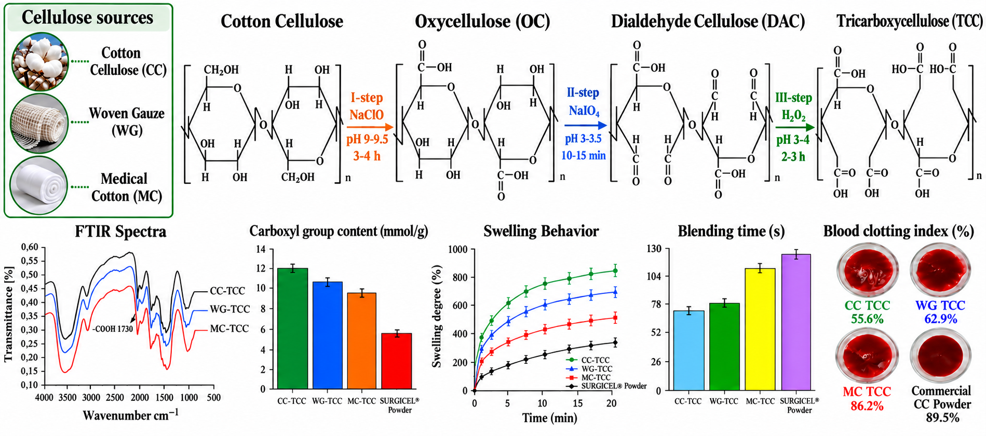
This study reports the preparation of highly functionalized tricarboxycellulose through the sequential oxidation of cotton cellulose (CC), woven gauze (WG), and medical cotton (MC) using sodium hypochlorite (NaClO), sodium periodate (NaIO₄), and hydrogen peroxide (H₂O₂). The structural evolution of cellulose during each oxidation step was investigated by Fourier-transform infrared (FT-IR) spectroscopy, which confirmed the formation of aldehyde, carboxyl, and carboxylate groups while preserving the β-1,4-glycosidic backbone. Quantitative analysis revealed that the final tricarboxycellulose samples contained up to 53.8%, 47.5%, and 42.3% carboxyl groups for CC-, WG-, and MC-derived materials, respectively. The introduction of multiple hydrophilic functionalities significantly improved water absorption and swelling behavior. The highest swelling degree was observed for tricarboxycellulose derived from cotton cellulose, reaching 830% after 20 min, whereas samples prepared from woven gauze and medical cotton exhibited maximum swelling values of 670% and 530%, respectively. The enhanced swelling capacity was attributed to increased hydrophilicity, disruption of crystalline regions, and the formation of a more open and porous polymer network. Tricarboxycellulose prepared from cotton cellulose exhibited the most effective hemostatic activity, with a bleeding time of 69±3 sec and a blood clotting index of 55.6%, outperforming commercial oxidized cellulose powder.
References
Grzybek, P., Dudek, G., & Van der Bruggen, B. (2024). Cellulose-based films and membranes: A comprehensive review on preparation and applications. Chemical Engineering Journal, 495, Article 153500. https://doi.org/10.1016/j.cej.2024.153500
Chen, Z., Aziz, T., Sun, H., Ullah, A., Ali, A., Cheng, L., Ullah, R., & Khan, F. U. (2023). Advances and applications of cellulose bio-composites in biodegradable materials. Journal of Polymers and the Environment, 31(6), 2273–2284. https://doi.org/10.1007/s10924-022-02561-8
Nawaz, H., He, A., Wu, Z., Wang, X., Jiang, Y., Ullah, A., Xu, F., & Xie, F. (2024). Revisiting various mechanistic approaches for cellulose dissolution in different solvent systems: A comprehensive review. International Journal of Biological Macromolecules, 273, 133012. https://doi.org/10.1016/j.ijbiomac.2024.133012
Li, F. H., Shen, Y. Y., Deng, Y. P., Zhang, J. C., Wang, Q. Q., Chen, H. Y., Ouyang, M., Jiang, Q. W., Wang, G. W., & Zhuang, L. H. (2023). Experimental and theoretical studies on dissolution and regeneration of microcrystalline cellulose with dihydroxyl ionic liquids. Journal of Molecular Liquids, 389, Article 122928. https://doi.org/10.1016/j.molliq.2023.122928
Acharya, S., Hu, Y., & Abidi, N. (2021). Cellulose dissolution in ionic liquid under mild conditions: Effect of hydrolysis and temperature. Fibers, 9(1), Article 5. https://doi.org/10.3390/fib9010005
Wohlert, M., Benselfelt, T., Wågberg, L., Furó, I., Berglund, L. A., & Wohlert, J. (2022). Cellulose and the role of hydrogen bonds: Not in charge of everything. Cellulose, 29, 1–23. https://doi.org/10.1007/s10570-021-04325-4
Madhushree, M., Mahesha, G. T., Venkatachalam, H., & Bhat, K. S. (2026). Green approaches to the surface modification of cellulose: Methods and mechanisms. Journal of Composites Science, 10(2), Article 99. https://doi.org/10.3390/jcs10020099
Baron, R. I., Biliuta, G., Macsim, A.-M., Dinu, M. V., & Coseri, S. (2023). Chemistry of hydroxypropyl cellulose oxidized by two selective oxidants. Polymers, 15(19), Article 3930. https://doi.org/10.3390/polym15193930
Kramar, A., Korica, M., & Kostić, M. (2024). Comparative analysis of electrokinetic properties of periodate- and TEMPO-oxidized regenerated cellulose fabric functionalized with chitosan. Textiles, 4(1), 57–69. https://doi.org/10.3390/textiles4010005
Rezaei, M., Das, R., Womack, N., Shojaeian, R., Pasha, S., Davoudi, M., Yu, S., Ilacas, G., Gersappe, D., & Hsiao, B. S. (2025). Pressure effect on nitro-oxidation process for converting cellulosic biomass into carboxylated nanocelluloses. Carbohydrate Polymer Technologies and Applications, 11, 100989. https://doi.org/10.1016/j.carpta.2025.100989
Baseer, R. A., Dacrory, S., El Gendy, M. A. M., Ewies, E. F., & Kamel, S. (2022). A biodegradable film based on cellulose and thiazolidine bearing UV shielding property. Scientific Reports, 12, 7887. https://doi.org/10.1038/s41598-022-11457-5
Duceac, I. A., Tanasa, F., & Coseri, S. (2022). Selective oxidation of cellulose—A multitask platform with significant environmental impact. Materials, 15(14), Article 5076. https://doi.org/10.3390/ma15145076
Yang, Z., Qian, J., Shan, C., Li, H., Yin, Y., & Pan, B. (2021). Toward selective oxidation of contaminants in aqueous systems. Environmental Science & Technology, 55(21), 14494–14514. https://doi.org/10.1021/acs.est.1c05862
Guo, M., Ede, J. D., Sayes, C. M., Shatkin, J. A., Stark, N., & Hsieh, Y.-L. (2024). Regioselectively carboxylated cellulose nanofibril models from dissolving pulp: C6 via TEMPO oxidation and C2,C3 via periodate–chlorite oxidation. Nanomaterials, 14(5), Article 479. https://doi.org/10.3390/nano14050479
Tang, Z., Lin, X., Yu, M., Mondal, A. K., & Wu, H. (2024). Recent advances in TEMPO-oxidized cellulose nanofibers: Oxidation mechanism, characterization, properties and applications. International Journal of Biological Macromolecules, 259, 129081. https://doi.org/10.1016/j.ijbiomac.2023.129081
Goyibnazarov, I. Sh., Yuldoshov, Sh. A., Sarymsakov, A. A., Yunusov, Kh. E., Yarmatov, S. S., Shukurov, A. I., Bobomurodova, M. S., & Wan, Y. (2025). Obtaining dialdehyde carboxymethylcellulose through microwave treatment. Advances in Polymer Technology, 2025, Article 9917563. https://doi.org/10.1155/adv/9917563
Brault, L., Marlin, N., Mortha, G., Boucher, J., & Lachenal, D. (2025). Periodate–chlorite oxidation for dicarboxylcellulose (DCC) production: Activation strategies for the dissolution and visualization of oxidized groups distribution. Cellulose, 32, 723–742. https://doi.org/10.1007/s10570-024-06312-x
Sun, X., & Jiang, F. (2024). Periodate oxidation-mediated nanocelluloses: Preparation, functionalization, structural design, and applications. Carbohydrate Polymers, 341, Article 122305. https://doi.org/10.1016/j.carbpol.2024.122305
Xu, Y., Xu, Y., Deng, W., Chen, H., & Xiong, J. (2023). Extracting dialdehyde cellulose nanocrystals using choline chloride/urea-based deep eutectic solvents: A comparative study in NaIO₄ pre-oxidation and synchronous oxidation. International Journal of Biological Macromolecules, 246, Article 125604. https://doi.org/10.1016/j.ijbiomac.2023.125604
Kadsanit, K., Sriariyanun, M., Phisalaphong, M., & Kirdponpattara, S. (2025). Tailoring dialdehyde bacterial cellulose synthesis for versatile applications. Polymers, 17(13), 1836. https://doi.org/10.3390/polym17131836
Simon, J., Fliri, L., Drexler, F., Bacher, M., Sapkota, J., Ristolainen, M., Hummel, M., Potthast, A., & Rosenau, T. (2023). Debugging periodate oxidation of cellulose: Why following the common protocol of quenching excess periodate with glycol is a bad idea. Carbohydrate Polymers, 310, Article 120691. https://doi.org/10.1016/j.carbpol.2023.120691
Aitbella, H., Belachemi, L., Merle, N., Zinck, P., & Kaddami, H. (2024). Schiff base functionalized cellulose: Towards strong support-cobalt nanoparticles interactions for high catalytic performances. Molecules, 29(8), 1734. https://doi.org/10.3390/molecules29081734
Tachai, K., Deenu, A., & Kamthai, S. (2024). Short synthesis time and characterization of dialdehyde carboxymethyl cellulose (DCMC) from high bagasse carboxymethyl cellulose (CMCᵦ) concentration. Journal of Natural Fibers, 21(1), 2371911. https://doi.org/10.1080/15440478.2024.2371911
Su, Z., Cui, L., Zhang, H., Xiao, L., Chi, B., Xu, H., Ning, L., Jia, S., & Wang, X. (2023). Robust, waterproof, and degradable cellulose-based polyimine vitrimer for plastic replacement. Chemical Engineering Journal, 471, 144501. https://doi.org/10.1016/j.cej.2023.144501
Simon, J., Fliri, L., Fröhlich, F., Sapkota, J., Ristolainen, M., Hummel, M., Rosenau, T., & Potthast, A. (2023). Insights into the borohydride reduction of dialdehyde cellulose: The dilemma of competing reduction and β-elimination reactions. Cellulose, 30(13), 8205–8220. https://doi.org/10.1007/s10570-023-05350-1
Sukhatskiy, Y., Znak, Z., Sozanskyi, M., Shepida, M., Gogate, P. R., & Tsymbaliuk, V. (2024). Activated periodates and sodium percarbonate in advanced oxidation processes of organic pollutants in aqueous media: A review. Chemistry & Chemical Technology, 18(2), 119–130. https://doi.org/10.23939/chcht18.02.119
Fernández-Santos, J., Valls, C., Cusola, O., & Roncero, M. B. (2024). Periodate oxidation of nanofibrillated cellulose films for active packaging applications. International Journal of Biological Macromolecules, 267, 131553. https://doi.org/10.1016/j.ijbiomac.2024.131553
Zhang, Y., Deng, W., Liu, C., Yan, F., Wu, M., Cui, Q., Willför, S., Xu, C., & Li, B. (2023). Preparation of antibacterial dialdehyde nanocellulose using LiBr·3H₂O non-dissolving pretreatment promoted periodate oxidation. ACS Sustainable Chemistry & Engineering, 11(17), 6641–6651. https://doi.org/10.1021/acssuschemeng.2c07746
Xie, F., Fardim, P., & Van den Mooter, G. (2022). Porous soluble dialdehyde cellulose beads: A new carrier for the formulation of poorly water-soluble drugs. International Journal of Pharmaceutics, 615, 121491. https://doi.org/10.1016/j.ijpharm.2022.121491.
Martinsson, A., Hasani, M., & Theliander, H. (2023). The influence of transition metal ions on the oxidation of kraft pulp using hydrogen peroxide under mildly acidic conditions. Holzforschung, 77(5), 318–325. https://doi.org/10.1515/hf-2022-0184
Rafat, A. A., Verdía Barbará, P., Ullah, A., Kontturi, E., Law, R. V., & Hallett, J. P. (2025). Efficient extraction of carboxylated nanocellulose from ionoSolv pulps with alkaline H₂O₂ assisted oxidation. Cellulose, 32(2), 853–875. https://doi.org/10.1007/s10570-024-06319-4
Morales-Urrea, D., López-Córdoba, A., & Contreras, E. M. (2023). Inactivation kinetics of horseradish peroxidase (HRP) by hydrogen peroxide. Scientific Reports, 13, 13363. https://doi.org/10.1038/s41598-023-39687-1
Xiao, J., Guo, S., Wang, D., & An, Q. (2024). Fenton-like reaction: Recent advances and new trends. Chemistry – A European Journal, 30(24), e202304337. https://doi.org/10.1002/chem.202304337
Li, W., Song, G., Jing, J., Ren, X., Zhang, C., Oturan, M. A., & Zhou, M. (2024). Identification and quantification of reactive species in aqueous medium during application of advanced oxidation processes: A critical review. Chemical Engineering Journal, 500, 156698. https://doi.org/10.1016/j.cej.2024.156698
Zhang, L., Fu, J., Gao, W., Li, Y., & Fan, X. (2024). Revealing the structural variation and degradation mechanism of cellulose during ozone oxidation treatment. Industrial Crops and Products, 219, 119101. https://doi.org/10.1016/j.indcrop.2024.119101
Valls, C., Cusola, O., & Roncero, M. B. (2022). Evaluating the potential of ozone in creating functional groups on cellulose. Cellulose, 29, 6595–6610. https://doi.org/10.1007/s10570-022-04694-4
Poursaitidis, E. T., Gkizis, P. L., Triandafillidi, I., & Kokotos, C. G. (2024). Organocatalytic activation of hydrogen peroxide: Towards green and sustainable oxidations. Chemical Science, 15(4), 1177–1203. https://doi.org/10.1039/D3SC05618J
Madhushree, M., Vairavel, P., Mahesha, G. T., & Bhat, K. S. (2025). Oxidative modifications of cellulose: Methods, mechanisms, and emerging applications. Journal of Natural Fibers, 22(1), Article 2497910. https://doi.org/10.1080/15440478.2025.2497910
Li, S., Gong, L., Chen, J., Wu, X., Liu, X., Fu, H., & Shou, Q. (2024). Fabricating the multibranch carboxyl-modified cellulose for hemorrhage control. Materials Today Bio, 24, 100878. https://doi.org/10.1016/j.mtbio.2023.100878
Zhang, X., Ni, H., Xu, X., Li, L., Kang, H., & Li, D. (2025). Recent advancements in the synthesis, functionalization, and utilization of cellulose nanocrystals. Resources Chemicals and Materials, 4(1), 100073. https://doi.org/10.1016/j.recm.2024.05.003
Støpamo, F. G., Sulaeva, I., Budischowsky, D., Rahikainen, J., Marjamaa, K., Potthast, A., Kruus, K., Eijsink, V. G. H., & Várnai, A. (2024). Oxidation of cellulose fibers using LPMOs with varying allomorphic substrate preferences, oxidative regioselectivities, and domain structures. Carbohydrate Polymers, 330, 121816. https://doi.org/10.1016/j.carbpol.2024.121816
Brault, L., Marlin, N., Mortha, G., Boucher, J., & Lachenal, D. (2025). About the assessment of the degree of oxidation of cellulose during periodate reaction: Comparison of different characterization techniques and their discrepancies. Carbohydrate Research, 552, 109438. https://doi.org/10.1016/j.carres.2025.109438
Vera-Loor, A., Rigou, P., Mortha, G., & Marlin, N. (2023). Oxidation Treatments Using Hydrogen Peroxide to Convert Paper-Grade Eucalyptus Kraft Pulp into Dissolving-Grade Pulp. Molecules, 28(23), 7927. https://doi.org/10.3390/molecules28237927
Wang, J., Wang, Y., Liu, Z., Shao, X., Lin, Y., Song, W., Xu, D., Gao, Y., & Han, J. (2024). Modification methods’ effects on the characteristics of carboxylated cellulose fibers: Carboxyl group introduction method versus physical properties. BioResources, 19(1), 1590–1601. https://doi.org/10.15376/biores.19.1.1590-1601
Kholturaev, B. Zh. (2023). Polymer-based biodegradable hemostatic agent: Preparation, structure, and properties [Candidate of chemical sciences dissertation, Institute of Chemical Physics of the Academy of Sciences of the Republic of Uzbekistan].
von Schreeb, A., Sjöstrand, B., Ek, M., & Henriksson, G. (2025). Drying and hornification of swollen cellulose. Cellulose, 32, 5179–5189. https://doi.org/10.1007/s10570-024-06352-3
Llàcer Navarro, S., Tõlgo, M., Olsson, L., & Nypelö, T. (2023). Carboxylation of sulfated cellulose nanocrystals by family AA9 lytic polysaccharide monooxygenases. Cellulose, 30, 9331–9347. https://doi.org/10.1007/s10570-023-05440-0
Silvestre, G. H., Pinto, L. O., Bernardes, J. S., Miwa, R. H., & Fazzio, A. (2021). Disassembling of TEMPO-oxidized cellulose fibers: Intersheet and interchain interactions in the isolation of nanofibers and unitary chains. Cellulose, 28, 441–455. https://doi.org/10.1007/s10570-020-03501-z
Sanchez-Salvador, J. L., Xu, H., Balea, A., Blanco, A., & Negro, C. (2024). Enhancement of the production of TEMPO-mediated oxidation cellulose nanofibrils by kneading. International Journal of Biological Macromolecules, 261, 129612. https://doi.org/10.1016/j.ijbiomac.2024.129612
Sultana, N., Edlund, U., Guria, C., & Westman, G. (2024). Kinetics of periodate-mediated oxidation of cellulose. Polymers, 16(3), Article 381. https://doi.org/10.3390/polym16030381
Knežević, N., Milanović, J., Veličković, Z., Milošević, M., Vuksanović, M. M., Onjia, A., & Marinković, A. (2023). A closed cycle of sustainable development: Effective removal and desorption of lead and dyes using an oxidized cellulose membrane. Journal of Industrial and Engineering Chemistry, 126, 520–536. https://doi.org/10.1016/j.jiec.2023.06.041
Park, J., Lee, D., Hwang, K., Lee, J., Lee, T.-J., Kim, Y., Kim, J. H., Lee, J., Youe, W.-J., Chun, S.-J., & Gwon, J. (2024). Effect of catalyst and oxidant concentrations in a TEMPO oxidation system on the production of cellulose nanofibers. RSC Advances, 14(45), 32852–32862. https://doi.org/10.1039/D4RA04948A
El Bourakadi, K., Semlali, F.-Z., Hammi, M., & El Achaby, M. (2024). A review on natural cellulose fiber applications: Empowering industry with sustainable solutions. International Journal of Biological Macromolecules, 281, 135773. https://doi.org/10.1016/j.ijbiomac.2024.135773
Etale, A., Onyianta, A. J., Turner, S. R., & Eichhorn, S. J. (2023). Cellulose: A review of water interactions, applications in composites, and water treatment. Chemical Reviews, 123(5), 2016–2048. https://doi.org/10.1021/acs.chemrev.2c00477
Nypelö, T., Berke, B., Spirk, S., & Sirviö, J. A. (2021). Periodate oxidation of wood polysaccharides—Modulation of hierarchies. Carbohydrate Polymers, 252, Article 117105. https://doi.org/10.1016/j.carbpol.2020.117105
Mehandzhiyski, A. Y., Engel, E., Larsson, P. A., Lo Re, G., & Zozoulenko, I. V. (2022). Microscopic insight into the structure–processing–property relationships of core–shell structured dialcohol cellulose nanoparticles. ACS Applied Bio Materials, 5(10), 4793–4802. https://doi.org/10.1021/acsabm.2c00505
Downloads
Additional Files
Published
How to Cite
Issue
Section
License
Copyright (c) 2026 Bakhriddin Zh. Kholturaev, Khaydar E. Yunusov , Sherzod A. Yuldoshov, Abdushkur A. Sarymsakov, Abdumutolib A. Atakhanov, Ziyoviddin Z. Xakimov, Somia Yassin Hussain Abdulkarim, Houyong Yu, Guohua Jiang, Niu Li‑Na

This work is licensed under a Creative Commons Attribution-NonCommercial-NoDerivatives 4.0 International License.

This work is licensed under a Creative Commons Attribution-NonCommercial-NoDerivatives 4.0 International License.
Authors retain copyright and grant the journal right of first publication with the work simultaneously licensed under a Creative Commons Attribution License (CC BY-NC-ND 4.0) that allows others to share the work with an acknowledgement of the work's authorship and initial publication in this journal.
