

Cobalt(II) and Silver(I) Complexes with 2-Amino-4-Thiazolinone: Synthesis, Structural Characterization, and Antibacterial Potential
DOI:
https://doi.org/10.31489/2959-0663/4-26-4Keywords:
2-amino-4-thiazolinone, cobalt(II) complex, silver(I) complex, crystal structure, antimicrobial activity, tautomerism, DNA gyrase, molecular dockingAbstract
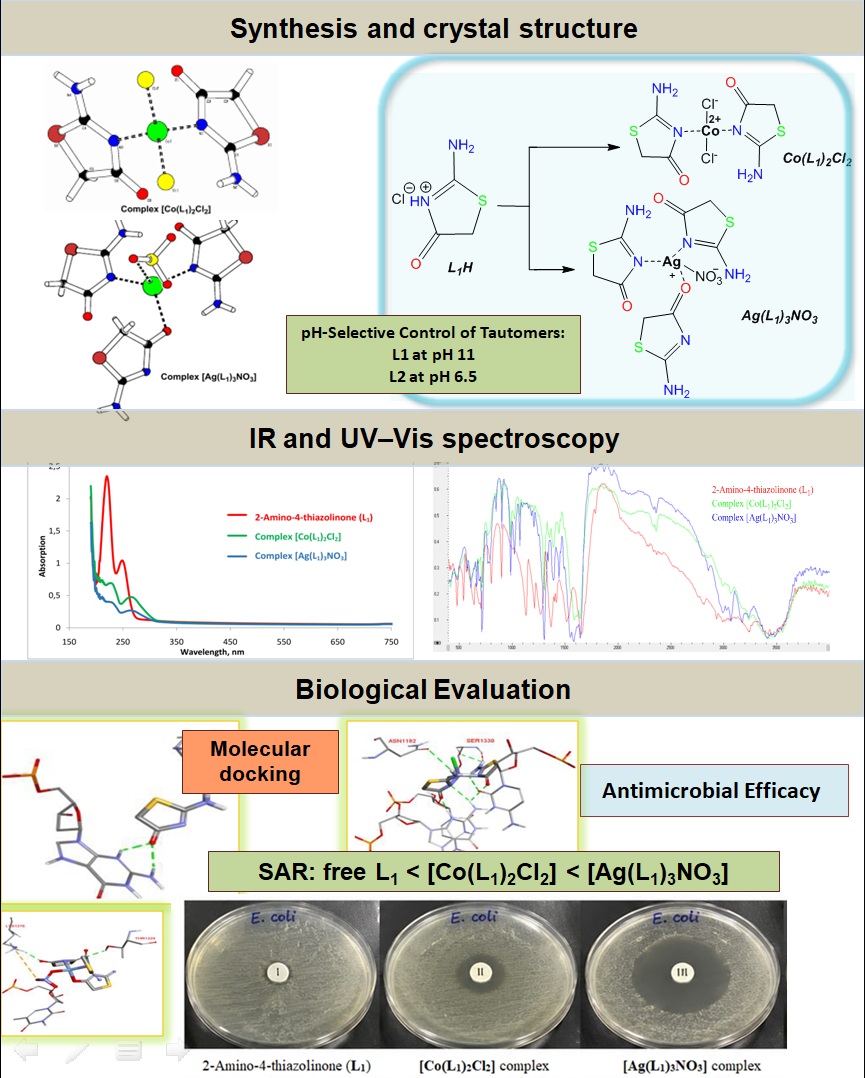
Selective control of amino- (L1) and imino- (L2) tautomeric forms of 2-amino-4-thiazolinone was achieved via precise pH regulation (pH 11 and 6.5, respectively) during hydrochloride precursor neutralization, as confirmed by ¹H and ¹³C NMR spectroscopy. Reaction of protonated ligand with cobalt(II) chloride and silver(I) nitrate yielded [Co(L1)2Cl2] and [Ag(L1)3NO3] complexes. X-ray diffraction, IR, and UV–Vis spectral analyses revealed a distorted tetrahedral geometry for [Co(L1)2Cl2] with monodentate endocyclic nitrogen coordination. In contrast, [Ag(L1)3NO3] adopted an irregular coordination environment via endocyclic nitrogen and carbonyl oxygen atoms, assembling into chains. In vitro antimicrobial assays against Gram-positive (S. aureus, B. subtilis), Gram-negative (E. coli, P. aeruginosa) bacteria, and Candida albicans demonstrated a clear structure–activity relationship: free L1 < [Co(L1)2Cl2] < [Ag(L1)3NO3]. Uncoordinated L1 showed low-to-moderate activity (MIC = 64–128 μg/mL), silver complexation significantly enhanced potency, displaying broad-spectrum efficacy (MIC = 4–8 μg/mL) comparable to reference drugs. Molecular docking simulations against key microbial targets (DNA gyrase, penicillin-binding proteins, and CYP51) corroborated experimental findings, revealing the strongest binding affinity for [Ag(L1)3NO3] (up to –8.8 kcal/mol against S. aureus DNA gyrase) stabilized by extensive hydrogen bonding, electrostatic, and hydrophobic interactions. These results highlight [Ag(L1)3NO3] as a promising lead candidate for novel antimicrobial agents.
References
Bhatia, R. (2026). Thiazolidinone spirocycles: synthetic routes and biological implications. Journal of Heterocyclic Chemistry, 63, 818–852 https://doi.org/10.1002/jhet.70175
Upadhyaya, A., & Dwivedi, J. (2026). Recent advances in the synthesis of biologically and pharmaceutically active thiazole and its analogues. Journal of Heterocyclic Chemistry, 63, 748–772. https://doi.org/10.1002/jhet.70170
Migulin, A. V., Milyutin, C. V., & Komogortsev, A. N. (2025). Design, Synthesis, and Biological Evaluation of Some New Thiazole-Based Compounds as Antioxidant and Antimicrobial Agents. Journal of Heterocyclic Chemistry, 63, 567–578. https://doi.org/10.1002/jhet.70155
Shehab, W. S., Abdelaziz, M., Elhoseni, N. K. R., Assy, M. G., Abdellattif, M. H., & Hamed, E. O. (2022). Design, synthesis, molecular docking, and evaluation of antioxidant and antimicrobial activities for novel 3-phenylimidazolidin-4-one and 2-aminothiazol-4-one derivatives. Molecules, 27(3), 767. https://doi.org/10.3390/molecules27030767
Kupczyk, D., Studzińska, R., Bilski, R., Baumgart, S., Kołodziejska, R., & Woźniak, A. (2020). Synthesis of novel 2-(isopropylamino)thiazol-4(5H)-one derivatives and their inhibitory activity of 11β-HSD1 and 11β-HSD2 in aspect of carcinogenesis prevention. Molecules, 25(18), 4233. https://doi.org/10.3390/molecules25184233
Zhortarova, A. A., Kubíček, V., Ibrayev, M. K., Panshina, S. Yu., & Kurmanova, A. F. (2026). Synthesis and structural features of novel phosphorylated aminothiazole. Tetrahedron, 200, 135426. https://doi.org/10.1016/j.tet.2026.135426
Khalifa, M. E. (2018). Recent developments and biological activities of 2-aminothiazole derivatives. Acta Chimica Slovenica, 65(1), 1–22. https://doi.org/10.17344/acsi.2017.3547
Patt, W. C., Hamilton, H. W., Taylor, M. D., Ryan, M. J., Taylor, D. G., Jr., Connolly, C. J. C., Doherty, A. M., Klutchko, S. R., Sircar, I., & Steinbaugh, B. A. (1992). Structure–activity relationships of a series of 2-amino-4-thiazole-containing renin inhibitors. Journal of Medicinal Chemistry, 35(14), 2562–2572. https://doi.org/10.1021/jm00092a006
Ramsh, S. M., Smorygo, N. A., & Ginak, A. I. (1984). Structure of 2-amino-4-thiazolinone. Chemistry of Heterocyclic Compounds, 20(8), 865–869. https://doi.org/10.1007/BF00513571
Ramsh, S. M., Smorygo, N. A., & Khrabrova, E. S. (1985). Structure of 2-amino-4-thiazolinone and its 2-aryl derivatives in the crystalline state. Chemistry of Heterocyclic Compounds, 21, 24–29. https://doi.org/10.1007/BF00505893
Raper, E. S., Oughtred, R. E., Nowell, I. W., & March, L. A. (1981). The structure of bis(2-aminothiazole)dichlorocobalt(II). Acta Crystallographica Section B, 37, 928–930. https://doi.org/10.1107/S0567740881004639
Bahsis, L., Hrimla, M., Ben El Ayouchia, H., Anane, H., Julve, M., & Stiriba, S. E. (2020). 2-Aminobenzothiazole-containing copper(II) complex as catalyst in click chemistry: an experimental and theoretical study. Catalysts, 10, 776. https://doi.org/10.3390/catal10070776
Keri, R. S., Patil, M. R., Patil, S. A., & Budagumpi, S. (2015). A comprehensive review in current developments of benzothiazole-based molecules in medicinal chemistry. European Journal of Medicinal Chemistry, 89, 207–251. https://doi.org/10.1016/j.ejmech.2014.10.059
Drzał, W., & Trotsko, N. (2025). Review of recent advances in thiazolidin-4-one derivatives as promising antitubercular agents (2021–present). Molecules, 30, 2201. https://doi.org/10.3390/molecules30102201
Juhás, M., Bachtíková, A., Nawrot, D. E., Hatoková, P., Pallabothula, V. S. K., Diepoltová, A., Janďourek, O., Bárta, P., Konečná, K., Paterová, P., Šesták, V., & Zitko, J. (2022). Improving Antimicrobial Activity and Physico-Chemical Properties by Isosteric Replacement of 2-Aminothiazole with 2-Aminooxazole. Pharmaceuticals, 15, 580. https://doi.org/10.3390/ph15050580
Loukrakpam, D. C., Mishra, D., Begum, J., & Phukan, P. (2023). TsNBr2 promoted cascade formation of C–N and C–S bond: Metal-free synthesis of 2-aminothiazoles from ketones or ketoximes using thiourea. Tetrahedron, 149, 133721. https://doi.org/10.1016/j.tet.2023.133721
Zhang, Q., Wu, J., Pan, Z., Zhang, W., & Zhou, W. (2021). A one-pot synthesis of 2-aminothiazoles via the coupling of ketones and thiourea using I2/dimethyl sulfoxide as a catalytic oxidative system. Journal of Chemical Research, 45(1–2), 89–94. https://doi.org/10.1177/1747519820930
Kalhor, M., Vahedi, Z., & Gharoubi, H. (2023). Design of a new method for one-pot synthesis of 2-amino thiazoles using trichloroisocyanuric acid in the presence of a novel multi-functional and magnetically catalytic nanosystem: Ca/4-MePy-IL@ZY-Fe3O4. RSC Advances, 13(13), 9208–9221. https://doi.org/10.1039/d3ra00758h
Fekri, R., Salehi, M., Asadi, A., & Kubicki, M. (2019). Synthesis, characterization, anticancer and antibacterial evaluation of Schiff base ligands derived from hydrazone and their transition metal complexes. Inorganica Chimica Acta, 484, 245–254. https://doi.org/10.1016/j.ica.2018.09.022
Kayed, S. F., & Farina, Y. (2025). Synthesis, characterization and biological study of 2-acetylbenzothiophene 4-cyclohexyl-3-thiosemicarbazone ligand and its transition metal complexes. Chemical Papers, 79, 961–981. https://doi.org/10.1007/s11696-024-03829-0
Al-Qadsy, I., Saeed, W. S., Al-Owais, A. A., Semlali, A., Alrabie, A., Al-Faqeeh, L. A. S., ALSaeedy, M., Al-Adhreai, A., Al-Odayni, A. B., & Farooqui, M. (2023). Antimicrobial activity of novel Ni(II) and Zn(II) complexes with (E)-2-((5-bromothiazol-2-yl)imino)methyl)phenol ligand: synthesis, characterization and molecular docking studies. Antibiotics, 12(11), 1634. https://doi.org/10.3390/antibiotics12111634
Marlin Risana, M., Balasubramaniyan, S., Govindharaju, R., Mohamed Azharudeen, A., Mary Juliet, B., MukilMeenakshi, V., Alsaiari, A. A., Roy, A., Verma, R., & Sharma, K. (2024). Comprehensive investigation on fabrication, spectral characterization and biological importance of Co(II) and Ni(II) heteroleptic complexes. Inorganica Chimica Acta, 569, 122125. https://doi.org/10.1016/j.ica.2024.122125
Hassoon, A. A., Abulkhair, H. S., Ashour, R. H., Abdelsamea, M. M., Abdullah, H. O., Eldesoky, M. A., Shaban, A. R., John, P., & Ghaith, E. A. (2026). Rational design and synthesis of Co(II), Ni(II) and Cu(II) complexes bearing 1,2,4-triazole scaffold for biological applications. RSC Advances, 16, 14509–14524. https://doi.org/10.1039/d5ra09383j
Ebrahimipour, S. Y., Mohamadi, M., Castro, J., Mollania, N., Rudbari, H. A., & Saccá, A. (2015). Syntheses, characterizations, crystal structures, and biological activities of two new mixed ligand Ni(II) and Cu(II) Schiff base complexes. Journal of Coordination Chemistry, 68(4), 632–649. https://doi.org/10.1080/00958972.2014.1000883
Hussain, R., Rubab, S. L., Maryam, A., Ashraf, T., Arshad, M., Lal, K., Sumrra, S. H., Ashraf, S., & Ali, B. (2023). Synthesis, spectroscopic and nonlinear optical properties, and antimicrobial activity of Cu(II), Co(II), and Ni(II) complexes: experimental and theoretical studies. ACS Omega, 8(45), 42598–42609. https://doi.org/10.1021/acsomega.3c05322
Pearson, R. G. (1963). Hard and soft acids and bases. Journal of the American Chemical Society, 85(22), 3533–3539. https://doi.org/10.1021/ja00905a001
Pearson, R. G. (1968). Hard and soft acids and bases, HSAB, part I: fundamental principles. Journal of Chemical Education, 45(9), 581–587. https://doi.org/10.1021/ed045p581
Cotton, F. A., Wilkinson, G., Murillo, C. A., & Bochmann, M. (1999). Advanced Inorganic Chemistry (6th ed.). Wiley-Interscience.
Greenwood, N. N., & Earnshaw, A. (1997). Chemistry of the Elements (2nd ed.). Butterworth-Heinemann.
Kumar, A., Kumar, S., Jain, S., Kumar, P., & Goyal, R. (2013). Study of binding of pyridoacridine alkaloids on topoisomerase II using in silico tools. Medicinal Chemistry Research, 22(11), 5431–5441. https://doi.org/10.1007/s00044-013-0496-5
Clinical and Laboratory Standards Institute. (2018). Performance Standards for Antimicrobial Disk Susceptibility Tests (CLSI Standard M02, 13th ed.). Clinical and Laboratory Standards Institute, Wayne
Clinical and Laboratory Standards Institute. (2018). Methods for Dilution Antimicrobial Susceptibility Tests for Bacteria That Grow Aerobically (CLSI Standard M07, 11th ed.). Clinical and Laboratory Standards Institute, Wayne
Kukushkin, A. A., Kudashova, E. V., Root, E. V., Kositsyna, A. S., Ponomarev, I. S., Lyubyashkin, A. V., & Pustolaikina, I. A. (2025). Synthesis, Characterization and Computational Study of Novel Copper(II) Chelate Complexes Ligated by Pyridyl-Containing Beta-Diketonates. Eurasian Journal of Chemistry, 30(2(118)), 4–18. https://doi.org/10.31489/2959-0663/2-25-5
Trott, O., & Olson, A. J. (2010). AutoDock Vina: improving the speed and accuracy of docking with a new scoring function, efficient optimization, and multithreading. Journal of Computational Chemistry, 31(2), 455–461. https://doi.org/10.1002/jcc.21334
Stalinskaya, A. L., Pustolaikina, I. A., Kurmanova, A. F., Rakhimzhanova, A. S., Muzaparov, R. A., Normatov, S., Novikov, A. S., & Kulakov, I. V. (2025). Synthesis, characterization, and computational study of s-methylthio- and n-methylamine substituted epoxybenzo[7,8]oxocyno[4,3-b]pyridine derivatives. Journal of Molecular Structure, 1348, 143346. https://doi.org/10.1016/j.molstruc.2025.143346
Gaussian 16, Revision A.03, M. J. Frisch, G. W. Trucks, H. B. Schlegel, G. E. Scuseria, M. A. Robb, J. R. Cheeseman, G. Scalmani, V. Barone, G. A. Petersson, H. Nakatsuji, X. Li, M. Caricato, A. V. Marenich, J. Bloino, B. G. Janesko, R. Gomperts, B. Mennucci, H. P. Hratchian, J. V. Ortiz, A. F. Izmaylov, J. L. Sonnenberg, D. Williams-Young, F. Ding, F. Lipparini, F. Egidi, J. Goings, B. Peng, A. Petrone, T. Henderson, D. Ranasinghe, V. G. Zakrzewski, J. Gao, N. Rega, G. Zheng, W. Liang, M. Hada, M. Ehara, K. Toyota, R. Fukuda, J. Hasegawa, M. Ishida, T. Nakajima, Y. Honda, O. Kitao, H. Nakai, T. Vreven, K. Throssell, J. A. Montgomery, Jr., J. E. Peralta, F. Ogliaro, M. J. Bearpark, J. J. Heyd, E. N. Brothers, K. N. Kudin, V. N. Staroverov, T. A. Keith, R. Kobayashi, J. Normand, K. Raghavachari, A. P. Rendell, J. C. Burant, S. S. Iyengar, J. Tomasi, M. Cossi, J. M. Millam, M. Klene, C. Adamo, R. Cammi, J. W. Ochterski, R. L. Martin, K. Morokuma, O. Farkas, J. B. Foresman, and D. J. Fox, Gaussian, Inc., Wallingford CT, 2016.
Vanden Broeck, A., Lotz, C., Ortiz, J., & Lamour, V. (2019). Cryo-EM structure of the complete E. coli DNA gyrase nucleoprotein complex. Nature Communications, 10, 4935. https://doi.org/10.1038/s41467-019-12914-y
Bax, B. D., Chan, P. F., Eggleston, D. S., Fosberry, A., Gentry, D. R., Gorrec, F., Giordano, I., Hann, M. M., Hennessy, A., Hibbs, M., Huang, J., Jones, E., Jones, J., Brown, K. K., Lewis, C. J., May, E. W., Saunders, M. R., Singh, O., Spitzfaden, C. E., Shen, C., Shillings, A., Theobald, A. J., Wohlkonig, A., Pearson, N. D., & Gwynn, M. N. (2010). Type IIA topoisomerase inhibition by a new class of antibacterial agents. Nature, 466(7309), 935–940. https://doi.org/10.1038/nature09197
Kishida, H., Unzai, S., Roper, D. I., Lloyd, A., Park, S. Y., & Tame, J. R. H. (2006). Crystal structure of penicillin binding protein 4 (dacB) from Escherichia coli, both in the native form and covalently linked to various antibiotics. Biochemistry, 45(3), 783–792. https://doi.org/10.1021/bi051533t
Sagatova, A. A., Keniya, M. V., Wilson, R. K., Monk, B. C., & Tyndall, J. D. A. (2015). Structural insights into binding of the antifungal drug fluconazole to Saccharomyces cerevisiae lanosterol 14α-demethylase. Antimicrobial Agents and Chemotherapy, 59(8), 4982–4989. https://doi.org/10.1128/AAC.00925-15
Meng, X. Y., Zhang, H. X., Mezei, M., & Cui, M. (2011). Molecular docking: a powerful approach for structure-based drug discovery. Current Computer-Aided Drug Design, 7(2), 146–157. https://doi.org/10.2174/157340911795677602
Morris, G. M., Goodsell, D. S., Halliday, R. S., Huey, R., Hart, W. E., Belew, R. K., & Olson, A. J. (1998). Automated docking using a Lamarckian genetic algorithm and an empirical binding free energy function. Journal of Computational Chemistry, 19(14), 1639–1662. https://doi.org/10.1002/(SICI)1096-987X(19981115)19:14<1639::AID-JCC10>3.0.CO;2-B
da Silva Santos, J., Junior, J. J., & da Silva, F. M. (2018). 1,3-Thiazolidin-4-ones: biological potential, history, synthetic development and green methodologies. Current Organic Synthesis, 15(8), 1109–1123. https://doi.org/10.2174/1570179415666180919125625
Abdu-Allah, H. H. M., Abdel-Moty, S. G., El-Awady, R., & El-Shorbagi, A. N. A. (2016). Design and synthesis of novel 5-aminosalicylate (5-ASA)–4-thiazolinone hybrid derivatives with promising antiproliferative activity. Bioorganic & Medicinal Chemistry Letters, 26(7), 1647–1650. https://doi.org/10.1016/j.bmcl.2016.02.073
Steel, P. J., & Guard, J. A. M. (1994). Heterocyclic tautomerism. VI. A redetermination and reassignment of the structure of 2-aminothiazol-4(5H)-one (pseudothiohydantoin). Acta Crystallographica Section C, 50, 1721–1723. https://doi.org/10.1107/S0108270194004750
Smokal, V., Derkowska, B., Czaplicki, R., Krupka, O., Kolendo, A., & Sahraoui, B. (2009). Nonlinear optical properties of thiazolidinone derivatives. Optical Materials, 31(3), 554–557. https://doi.org/10.1016/j.optmat.2007.10.019
AbdelLatif, S. A., & Issa, Y. M. (2010). Spectroscopic, thermal and magnetic properties of some transition metal complexes derived from 1-phenyl-3-substituted-4-nitroso-5-pyrazolones. Natural Science, 2(9), 1035–1043. https://doi.org/10.4236/ns.2010.29127
Tweedy, B. G. (1964). Plant extracts with metal ions as potential antimicrobial agents. Phytopathology, 55, 910–914.
Noreen, S., & Sumrra, S. H. (2021). Aminothiazole-linked metal chelates: synthesis, density functional theory, and antimicrobial studies with antioxidant correlations. ACS Omega, 6(48), 33085–33099. https://doi.org/10.1021/acsomega.1c05290
Wozniczka, M., Lichawska, M., Sutradhar, M., Chmiela, M., Gonciarz, W., & Pajak, M. (2021). Chemical characterization and biological evaluation of new cobalt(II) complexes with bioactive ligands, 2-picolinehydroxamic acid and reduced Schiff base N-(2-hydroxybenzyl)alanine, in terms of DNA binding and antimicrobial activity. Pharmaceuticals, 14(12), 1254. https://doi.org/10.3390/ph14121254
Salleh, A., Naomi, R., Utami, N. D., Mohammad, A. W., Mahmoudi, E., Mustafa, N., & Fauzi, M. B. (2020). The potential of silver nanoparticles for antiviral and antibacterial applications: a mechanism of action. Nanomaterials, 10(8), 1566. https://doi.org/10.3390/nano10081566
More, P. R., Pandit, S., De Filippis, A., Franci, G., Mijakovic, I., & Galdiero, M. (2023). Silver nanoparticles: bactericidal and mechanistic approach against drug resistant pathogens. Microorganisms, 11(2), 369. https://doi.org/10.3390/microorganisms11020369
Varna, D., Geromichalou, E., Papachristou, E., Papi, R., Hatzidimitriou, A. G., Panteris, E., Psomas, G., Geromichalos, G. D., Aslanidis, P., Choli-Papadopoulou, T., & Angaridis, P. A. (2022). Biocompatible silver(I) complexes with heterocyclic thioamide ligands for selective killing of cancer cells and high antimicrobial activity – a combined in vitro and in silico study. Journal of Inorganic Biochemistry, 228, 111695. https://doi.org/10.1016/j.jinorgbio.2021.111695
Bensalah, D., Gurbuz, N., Özdemir, I., Gatri, R., Mansour, L., & Hamdi, N. (2023). Synthesis, characterization, antimicrobial properties, and antioxidant activities of silver-N-heterocyclic carbene complexes. Bioinorganic Chemistry and Applications, 2023(1), 3066299. https://doi.org/10.1155/2023/3066299
Sharma, B., Shukla, S., Rattan, R., Fatima, M., Goel, M., Bhat, M., Dutta, S., Ranjan, R. K., & Sharma, M. (2022). Antimicrobial agents based on metal complexes: present situation and future prospects. International Journal of Biomaterials, 2022(1), 6819080. https://doi.org/10.1155/2022/6819080
Andrejević, T. P., Aleksic, I., Kljun, J., Počkaj, M., Zlatar, M., Vojnovic, S., Nikodinovic-Runic, J., Turel, I., Djuran, M. I., & Glišić, B. Đ. (2023). Copper(ii) and silver(i) complexes with dimethyl 6-(pyrazine-2-yl)pyridine-3,4-dicarboxylate (py-2pz): the influence of the metal ion on the antimicrobial potential of the complex. RSC Advances, 13(7), 4376–4393. https://doi.org/10.1039/d2ra07401j
Ran, K., Gao, C., Deng, H., Lei, Q., You, X., Wang, N., Shi, Y., Liu, Z., Wei, W., Peng, C., Xiong, L., Xiao, K., & Yu, L. (2016). Identification of novel 2-aminothiazole conjugated nitrofuran as antitubercular and antibacterial agents. Bioorganic & Medicinal Chemistry Letters, 26(15), 3669–3674. https://doi.org/10.1016/j.bmcl.2016.05.088
Gein, V. L., Bobrovskaya, O. V., Russkikh, A. A., Novikova, V. V., & Makhmudov, R. R. (2021). Use of silver salt of N-{4-[(1,3-thiazol-2-yl)sulfamoyl]phenyl}-1-phenyl-5-(4-ethoxyphenyl)pyrazole-3-carboxamide as an antifungal agent against strains of fungi C. tropicalis, C. krusei and C. glabrata (Russian Patent No. RU 2763724 C1). Federal Service for Intellectual Property. https://patents.google.com/patent/RU2763724C1/ru
Downloads
Additional Files
Published
How to Cite
Issue
Section
License
Copyright (c) 2026 Aigul A. Zhortarova, Vojtěch Kubíček , Marat K. Ibrayev , Svetlana Y. Panshina , Irina A. Pustolaikina , Roza B. Seidakhmetova

This work is licensed under a Creative Commons Attribution-NonCommercial-NoDerivatives 4.0 International License.

This work is licensed under a Creative Commons Attribution-NonCommercial-NoDerivatives 4.0 International License.
Authors retain copyright and grant the journal right of first publication with the work simultaneously licensed under a Creative Commons Attribution License (CC BY-NC-ND 4.0) that allows others to share the work with an acknowledgement of the work's authorship and initial publication in this journal.
