
Isoniazid-Loaded PEGylated Albumin Nanoparticles: Development and Taguchi Optimization
DOI:
https://doi.org/10.31489/2959-0663/4-26-5Keywords:
isoniazid, PEGylated albumin nanoparticles, bovine serum albumin, poly(ethylene glycol), Taguchi design, nanoparticle optimization, tuberculosis, desolvation method, drug delivery, orthogonal arrayAbstract
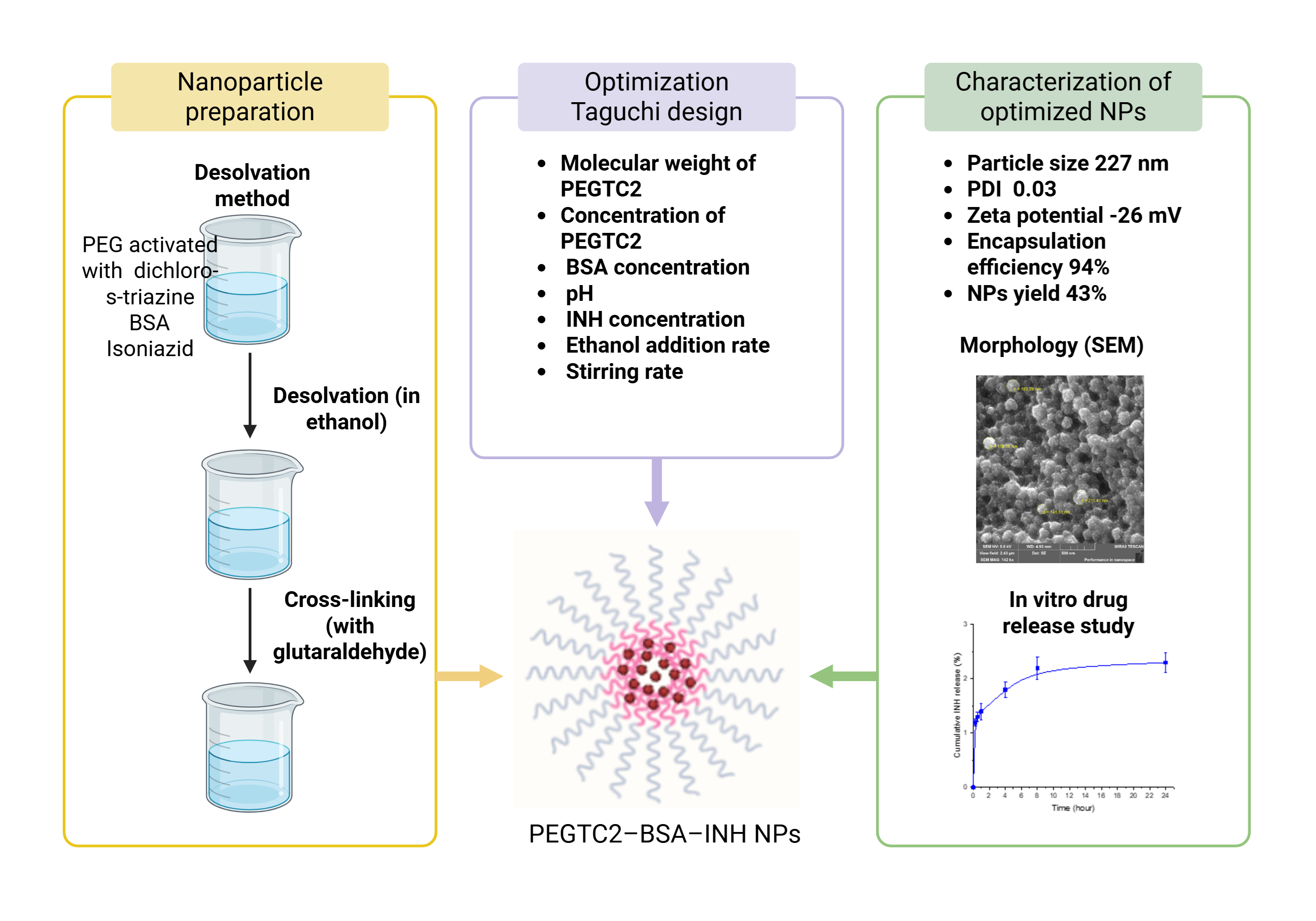
Tuberculosis remains a serious global health problem, which emphasizes the need to improve delivery systems for existing anti-tuberculosis drugs. The aim of this study was to develop nanoparticles based on bovine serum albumin (BSA) modified with polyethylene glycol (PEG) and containing isoniazid (INH), as well as to optimize the conditions for their preparation. The nanoparticles were synthesized using PEG activated with dichloro-s-triazine (PEGTC2) by desolvation followed by cross-linking with glutaraldehyde. The Taguchi orthogonal array method was used to evaluate the influence of seven formulation and process parameters, including the molecular weight and concentration of PEGTC2, BSA and INH concentrations, pH, ethanol addition rate, and stirring rate. The optimized nanoparticles were characterized by an average size of 227 ± 1 nm, a polydispersity index (PDI) of 0.026 ± 0.002, a zeta potential of −26 ± 2 mV, an encapsulation efficiency (EE) of 94%, and a nanoparticle yield of 43%. Analysis by scanning electron microscopy (SEM) showed that the nanoparticles were predominantly spherical, and In vitro release studies showed a gradual release of isoniazid from the nanoparticles, reaching approximately 2.3 mg after 24 h. These results support further study of PEGylated albumin nanoparticles as nanocarriers for the sustained delivery of isoniazid.
References
Global Tuberculosis Report 2025; World Health Organisation: Geneva, Switzerland, 2025
Cheung, S. -Y., Galiyeva, A., Tazhbayev, Y., Zhumagaliyeva, T., Bardadym, Y., & Aseyev, V. (2026). Mucoadhesive Chitosan–Gellan Gum Nanoparticles for Rifampicin Delivery: Taguchi Optimization and In Vitro Release Behavior. Pharmaceutics, 18(5), 627. https://doi.org/10.3390/pharmaceutics18050627
Omoteso, O. A., Fadaka, A. O., Walker, R. B., & Khamanga, S.M. Innovative Strategies for Combating Multidrug-Resistant Tuberculosis: Advances in Drug Delivery Systems and Treatment. Microorganisms, 2025, 13(4), 722. https://doi.org/10.3390/microorganisms13040722
Liebenberg, D., Gordhan, B. G., & Kana, B.D. Drug resistant tuberculosis: Implications for transmission, diagnosis, and disease management. Frontiers in Cellular and Infection Microbiology, 2022, 12. https://doi.org/10.3389/fcimb.2022.943545
Tazhbayev, Y.M., Galiyeva, A.R., Syrymova, U.Y., Zhaparova, L.Zh., Zhumagaliyeva, T.S. (2026). Rifampicin Loaded Chitosan-Based Nanoparticles: Optimization, Characterization, and Mucoadhesion. Eurasian Journal of Chemistry, 31, 1(121), 45‒60. https://doi.org/10.31489/2959-0663/1-26-4
Tanjung, Y., Dewi, M., Gatera, V., Barliana, M., Joni, I. M., & Chaerunisaa, A. (2024). Factors Affecting the Synthesis of Bovine Serum Albumin Nanoparticles Using the Desolvation Method. Nanotechnology, Sci. Appl., Volume 17, 21–40. https://doi.org/10.2147/nsa.s441324
Kouchakzadeh, H., Safavi, M. S., & Shojaosadati, S. A. (2015). Efficient Delivery of Therapeutic Agents by Using Targeted Albumin Nanoparticles. Protein and Peptide Nanoparticles for Drug Delivery, 121–143. https://doi.org/10.1016/bs.apcsb.2014.11.002
Galisteo-González, F., & Molina-Bolívar, J. A. (2014). Systematic study on the preparation of BSA nanoparticles. Colloids and Surfaces B: Biointerfaces, 123, 286–292. https://doi.org/10.1016/j.colsurfb.2014.09.028
Srivastava, A., & Prajapati, A. (2020). Albumin and functionalized albumin nanoparticles: production strategies, characterization, and target indications. Asian Biomedicine, 14(6), 217–242. https://doi.org/10.1515/abm-2020-0032
Kiarashi, M., & Yasamineh, S. (2024). Albumin nanoparticles are a promising drug delivery system in dentistry. BioMedical Engineering OnLine, 23(1). https://doi.org/10.1186/s12938-024-01318-9
Pérez-Herrero, E., Fernández-Medarde, A., & Irache, J. M. (2026). Albumin-based nanocarriers: Singularities, synthesis methods, clinical relevance and targeting strategies in cancer. Acta Pharmaceutica Sinica B, 16(4), 1883–1913. https://doi.org/10.1016/j.apsb.2025.11.035
Folda, P., Weidinger, E., Seidl, J., Yazdi, M., Pöhmerer, J., Grau, M., Minde, D. P., Ali, M., Kimna, C., & Wagner, E. (2025). PEGylation Enhances Colloidal Stability and Promotes Ligand-Mediated Targeting of LAF–Xenopeptide mRNA Complexes. Polymers, 17(22), 2979. https://doi.org/10.3390/polym17222979
Suk, J. S., Xu, Q., Kim, N., Hanes, J., & Ensign, L. M. (2016). PEGylation as a strategy for improving nanoparticle-based drug and gene delivery. Advanced Drug Delivery Reviews, 99, 28–51. https://doi.org/10.1016/j.addr.2015.09.012
Gao, P. (2025). PEGylated lipids in lipid nanoparticle delivery dynamics and therapeutic innovation. Beilstein Journal of Nanotechnology, 16, 1914–1930. Portico. https://doi.org/10.3762/bjnano.16.133
Calvopiña, J., Irache, J. M., Martínez-Oharriz, M. C., Palacio, J. F., Galindo, J. I. A., Górriz, F. J., & Rivero, P. J. (2026). Effect of PEG molecular weight on the physicochemical properties of zein nanoparticles: A comparative study. International Journal of Biological Macromolecules, 382, 154366. https://doi.org/10.1016/j.ijbiomac.2026.154366
Galiyeva, A. R., Tazhbayev, Y. M., Yessentayeva, N. A., Daribay, A. T., Marsel, D. T., Sadyrbekov, D. T., Zhaparova, L. Zh., & Arystanova, Z. T. (2023). PEGylation of Albumin Nanoparticles Immobilized with the Anti-Tuberculosis Drug “Isoniazid”. Eurasian Journal of Chemistry, 28(2 (110)). https://doi.org/10.31489/2959-0663/2-23-7
El-Faham, A., Al-Rasheed, H. H., Sholkamy, E. N., Osman, S. M., & Alothman, Z. A. (2020). Simple Approaches for the Synthesis of AgNPs in Solution and Solid Phase Using Modified Methoxypolyethylene Glycol and Evaluation of Their Antimicrobial Activity. International Journal of Nanomedicine, 15, 2353-2362. https://doi.org/10.2147/ijn.s244678
Abuchowski, A., van Es, T., Palczuk, N. C., & Davis, F. F. (1977). Alteration of immunological properties of bovine serum albumin by covalent attachment of polyethylene glycol. Journal of Biological Chemistry, 252(11), 3578–3581. https://doi.org/10.1016/s0021-9258(17)40291-2
Dąbkowska, M., Kosiorowska-Kraj, A., Szatanik, A., Filip, K., Martínez-Orts, M., Pujals, S., Olszewska, M., & Pukacka, K. (2026). Tunable PEGylated albumin nanocarriers enhance 5-FU cytotoxic selectivity and modulate oxidative and immune stress in colorectal cancer model. Biomedicine &Amp; Pharmacotherapy, 196, 118958. https://doi.org/10.1016/j.biopha.2025.118958
Galiyeva, A. R., Tazhbayev, Ye. M., Zhumagaliyeva, T. S., Sadyrbekov, D. T., Kaikenov, D. A., Karimova, B. N., Shokenova, S. S., &. (2022). Polylactide-co-glycolide nanoparticles immobilized with isoniazid: optimization using the experimental Taguchi method. Bulletin of the Karaganda University. “Chemistry” Series, 105(1), 69–77. https://doi.org/10.31489/2022ch1/69-77
Masoud, A., Hosseini, S. M. S., Dini, A., & Kamyabi, M. (2026). Taguchi-based multi-response optimization of lead flotation from a complex Zn–Pb sulfide ore. Scientific Reports. https://doi.org/10.1038/s41598-026-68892-x
Gupta, R., Sarkar, M., & Xie, H. (2026). From Screening to Optimization: Strategic Implementation of Design of Experiments (DOE) for Robust Nanoparticle Formulation. Polymers, 18(16), 2034. https://doi.org/10.3390/polym18162034
Kimura, K., Yamasaki, K., Nakamura, H., Haratake, M., Taguchi, K., & Otagiri, M. (2018). Preparation and in Vitro Analysis of Human Serum Albumin Nanoparticles Loaded with Anthracycline Derivatives. Chemical and Pharmaceutical Bulletin, 66(4), 382–390. https://doi.org/10.1248/cpb.c17-00838
Aukunuru, J., Thadakapally, R., Aafreen, A., Habibuddin, M., & Jogala, S. (2016). Preparation and characterization of PEG-albumin-curcumin nanoparticles intended to treat breast cancer. Indian Journal of Pharmaceutical Sciences, 78(1), 65. https://doi.org/10.4103/0250-474x.180250
Gao, Y., Joshi, M., Zhao, Z., & Mitragotri, S. (2023). PEGylated therapeutics in the clinic. Bioengineering &Amp; Translational Medicine, 9(1). Portico. https://doi.org/10.1002/btm2.10600
Lee, C. S., Kulkarni, Y., Pierre, V., Maski, M., & Wanner, C. (2024). Adverse Impacts of PEGylated Protein Therapeutics: A Targeted Literature Review. BioDrugs, 38(6), 795–819. https://doi.org/10.1007/s40259-024-00684-z
Porfiryeva, N. N., Moustafine, R. I., & Khutoryanskiy, V. V. (2020). PEGylated Systems in Pharmaceutics. Polymer Science, Series C, 62(1), 62–74. https://doi.org/10.1134/s181123822001004x
Tekade, R. K., & Chougule, M. B. (2013). Formulation Development and Evaluation of Hybrid Nanocarrier for Cancer Therapy: Taguchi Orthogonal Array Based Design. BioMed Research International, 2013, 1–18. https://doi.org/10.1155/2013/712678
Kunda, N. K., Alfagih, I. M., Dennison, S. R., Tawfeek, H. M., Somavarapu, S., Hutcheon, G. A., & Saleem, I. Y. (2014). Bovine Serum Albumin Adsorbed PGA-co-PDL Nanocarriers for Vaccine Delivery via Dry Powder Inhalation. Pharmaceutical Research, 32(4), 1341–1353. https://doi.org/10.1007/s11095-014-1538-5
Villani, E., Stagno, V., Maiuro, A., Travisano, G., & Capuani, S. (2026). Multi-parametric high-resolution MRI for the characterisation of water and PEG solutions in wood. European Journal of Wood and Wood Products, 84(2). https://doi.org/10.1007/s00107-026-02388-3
Hoz A, Sánchez-Migallón A. Green synthesis of 1,3,5-triazines with applications in supramolecular and materials chemistry. Targets in Heterocyclic Systems. 2017; 20: 139-173. http://dx.medra.org/10.17374/targets.2017.20.139
Fulmer, G. R., Miller, A. J. M., Sherden, N. H., Gottlieb, H. E., Nudelman, A., Stoltz, B. M., Bercaw, J. E., & Goldberg, K. I. (2010). NMR Chemical Shifts of Trace Impurities: Common Laboratory Solvents, Organics, and Gases in Deuterated Solvents Relevant to the Organometallic Chemist. Organometallics, 29(9), 2176–2179. https://doi.org/10.1021/om100106e
Costa, A., Pinheiro, M., Magalhães, J., Ribeiro, R., Seabra, V., Reis, S., & Sarmento, B. (2016). The formulation of nanomedicines for treating tuberculosis. Advanced Drug Delivery Reviews, 102, 102–115. https://doi.org/10.1016/j.addr.2016.04.012
Tazhbayev, Y.; Mukashev, O.; Burkeyev, M.; Lozinsky, V.I. Synthesis and Comparative Study of Nanoparticles Derived from Bovine and Human Serum Albumins. Polymers 2020, 12, 1301. https://doi.org/10.3390/polym12061301
Zhang, T., Guo, X., Meng, H., Tang, X., Ai, C., Chen, H., Lin, J., & Yu, S. (2020). Effects of bovine serum albumin on the ethanol precipitation of sugar beet pulp pectins. Food Hydrocolloids, 105, 105813. https://doi.org/10.1016/j.foodhyd.2020.105813
Yan, L., Reid, E., Chen, Z., He, J., & Chen, Y. (2026). Rapid, High-Capacity, and Reusable Bovine Serum Albumin-Based Adsorbents for Perfluoroalkyl and Polyfluoroalkyl Substance Removal. ACS Applied Materials &Amp; Interfaces, 18(3), 5026–5037. https://doi.org/10.1021/acsami.5c13467
Bhattacharjee, S. (2016). DLS and zeta potential — What they are and what they are not? Journal of Controlled Release, 235, 337–351. https://doi.org/10.1016/j.jconrel.2016.06.017
Lowry, G. V., Hill, R. J., Harper, S., Rawle, A. F., Hendren, C. O., Klaessig, F., Nobbmann, U., Sayre, P., & Rumble, J. (2016). Guidance to improve the scientific value of zeta-potential measurements in nanoEHS. Environmental Science: Nano, 3(5), 953–965. https://doi.org/10.1039/c6en00136j
Givens, B. E., Diklich, N. D., Fiegel, J., & Grassian, V. H. (2017). Adsorption of bovine serum albumin on silicon dioxide nanoparticles: Impact of pH on nanoparticle–protein interactions. Biointerphases, 12(2). https://doi.org/10.1116/1.4982598
Pham, D. -D., Fattal, E., & Tsapis, N. (2015). Pyrazinamide-loaded poly(lactide-co-glycolide) nanoparticles: Optimization by experimental design. Journal of Drug Delivery Science and Technology, 30, 384–390. https://doi.org/10.1016/j.jddst.2015.07.006
Xie, G., Lu, Y., Lu, X., Zhang, Z., & Lin, S. (2025). Measurement Error Analysis and Thermal Degradation Kinetic Model Improvement for Thermogravimetric Analyzers. Polymers, 17(17), 2390. https://doi.org/10.3390/polym17172390
Gibson, R. L., Simmons, M. J. H., Stitt, E. H., Horsburgh, L., & Gallen, R. W. (2021). Selection of Formal Baseline Correction Methods in Thermal Analysis. Chemical Engineering &Amp; Technology, 45(2), 238–248. Portico. https://doi.org/10.1002/ceat.202100120
Crewe, R. J., Staggs, J. E. J., & Williams, P. T. (2007). Drag-induced apparent mass gain in thermogravimetry. Polymer Degradation and Stability, 92(11), 2070–2075. https://doi.org/10.1016/j.polymdegradstab.2007.07.023
Galiyeva, A.R., Tazhbayev, Ye.M., Zhumagaliyeva, T.S., & Daribay, A.Т. (2022) Encapsulation of Isoniazid in Polylactide-Co-Glycolide Nanoparticles by Nanoprecipitation. Bulletin of the University of Karaganda — Chemistry, 107(3), 208-217. https://doi.org/10.31489/2022Ch3/3-22-17
Vilela Tibola, A. P. O., & Carpentieri Rodrigues, L. N. (2017). Compatibility study between isoniazid and pharmaceutical excipients used in solid dosage forms. International Research Journal of Pharmacy, 7(12), 18–22. https://doi.org/10.7897/2230-8407.0712140
Galiyeva, A., Tazhbayev, Y., Zhumagaliyeva, T., Karimova, B., Tabriz, N., & Khutoryanskiy, V. V. (2025). Synthesis and Investigation of Albumin Nanoparticles Loaded With Anti‐Tuberculosis Drug Isoniazid. Biopolymers, 116(4). Portico. https://doi.org/10.1002/bip.70036
Adamiano, A., Lesci, I. G., Fabbri, D., & Roveri, N. (2015). Adsorption of bovine serum albumin onto synthetic Fe-doped geomimetic chrysotile. Journal of the Royal Society, Interface, 12(107), 20150186. https://doi.org/10.1098/rsif.2015.0186
Michnik, A., Michalik, K., Kluczewska, A., & Drzazga, Z. (2006). Comparative DSC study of human and bovine serum albumin. Journal of Thermal Analysis and Calorimetry, 84(1), 113–117. https://doi.org/10.1007/s10973-005-7170-1
Galiyeva, A. R., Yessentayeva, N. A., Marsel, D. T., Daribay, A. T., Sadyrbekov, D. T., Moustafine, R. I., & Kutulutskaya, T. V. (2025). Polylactide Acid-Based Nanoparticles for Controlled Delivery of Isoniazid and Rifampicin: Synthesis, Characterization, and In Vitro Release Study. Eurasian Journal of Chemistry, 30(2(118)), 95–108. https://doi.org/10.31489/2959-0663/2-25-12
Yessentayeva, N. A., Galiyeva, A. R., Daribay, A. T., Sadyrbekov, D. T., Zhumagalieva, T. S., & Marsel, D. T. (2024). Synthesis and Optimization of Bovine Serum Albumin Nanoparticles Immobilized with Antituberculosis Drugs. Eurasian Journal of Chemistry. https://doi.org/10.31489/2959-0663/1-24-6
Askari, F., Zandi, M., Shokrolahi, P., Tabatabaei, M. H., & Hajirasoliha, E. (2019). Reduction in protein absorption on ophthalmic lenses by PEGDA bulk modification of silicone acrylate-based formulation. Progress in Biomaterials, 8(3), 169–183. https://doi.org/10.1007/s40204-019-00119-x
Jin, G., Jin, M., Jin, Z., Gao, Z., & Yin, X. (2016). Docetaxel-loaded PEG-albumin nanoparticles with improved antitumor efficiency against non-small cell lung cancer. Oncology Reports, 36(2), 871–876. https://doi.org/10.3892/or.2016.4863
Santos, J. H. P. M., Torres-Obreque, K. M., Meneguetti, G. P., Amaro, B. P., & Rangel-Yagui, C. O. (2018). Protein PEGylation for the design of biobetters: from reaction to purification processes. Brazilian Journal of Pharmaceutical Sciences, 54(spe). https://doi.org/10.1590/s2175-97902018000001009
Casettari, L., Vllasaliu, D., Mantovani, G., Howdle, S. M., Stolnik, S., & Illum, L. (2010). Effect of PEGylation on the Toxicity and Permeability Enhancement of Chitosan. Biomacromolecules, 11(11), 2854–2865. https://doi.org/10.1021/bm100522c
Hu, J., & Liu, S. (2022). Emerging trends of discrete Poly(ethylene glycol) in biomedical applications. Current Opinion in Biomedical Engineering, 24, 100419. https://doi.org/10.1016/j.cobme.2022.100419
Tazhbayev, Y., Cheung, S. -Y., Galiyeva, A., Slouf, M., Kostka, L., Zhumagaliyeva, T., Zhaparova, L., Daribay, A., & Kaziyev, A. (2026). Chitosan-Gellan Gum Nanoparticles for Antituberculosis Drug Encapsulation: Synthesis, Characterization and In Vitro Investigation. Polymers, 18(17), 2139. https://doi.org/10.3390/polym18172139
Peng, C., Luan, H., Shang, Q., Xiang, W., Yasin, P., & Song, X. (2025). Mannosamine-Modified Poly(lactic-<i>co</i>-glycolic acid)-Polyethylene Glycol Nanoparticles for the Targeted Delivery of Rifapentine and Isoniazid in Tuberculosis Therapy. Bioconjugate Chemistry, 36(5), 1021–1033. https://doi.org/10.1021/acs.bioconjchem.5c00062
Sanju, S.K. Singh, Prashant Purohit, Tejaram, & Kashi Ram. (2024). Preparation and Characterization of Isoniazid Loaded Nanoparticles Using Natural Polymers. International Journal of Pharma and Bio Sciences, 31–39. https://doi.org/10.22376/ijpbs.2024.15.2.p31-39
Maqbool, R., Nayab, D. E., Mubeen, M., Ali, H., & Khan, S. (2025). Mannosylated chitosan-decorated PLGA nanoparticles for targeted pulmonary delivery of isoniazid: a promising approach in the treatment of tuberculosis. Journal of Drug Targeting, 34(2), 301–314. https://doi.org/10.1080/1061186x.2025.2554761
Downloads
Additional Files
Published
How to Cite
Issue
Section
License
Copyright (c) 2026 Aldana R. Galiyeva, Vladimir O. Aseyev, Yuliia V. Bardadym , Tolkyn S. Zhumagaliyeva , Askhat S. Borsynbayev , Yerkeblan M. Tazhbayev

This work is licensed under a Creative Commons Attribution-NonCommercial-NoDerivatives 4.0 International License.

This work is licensed under a Creative Commons Attribution-NonCommercial-NoDerivatives 4.0 International License.
Authors retain copyright and grant the journal right of first publication with the work simultaneously licensed under a Creative Commons Attribution License (CC BY-NC-ND 4.0) that allows others to share the work with an acknowledgement of the work's authorship and initial publication in this journal.
