

Reported Effects of Coprecipitation Synthesis on ZnO/Activated Carbon Nanocomposite Characteristics: A Systematic Review
DOI:
https://doi.org/10.31489/2959-0663/4-26-6Keywords:
ZnO, activated carbon, coprecipitation, nanocomposite, material characteristics, photocatalysis, supercapacitor, semiconducting propertiesAbstract
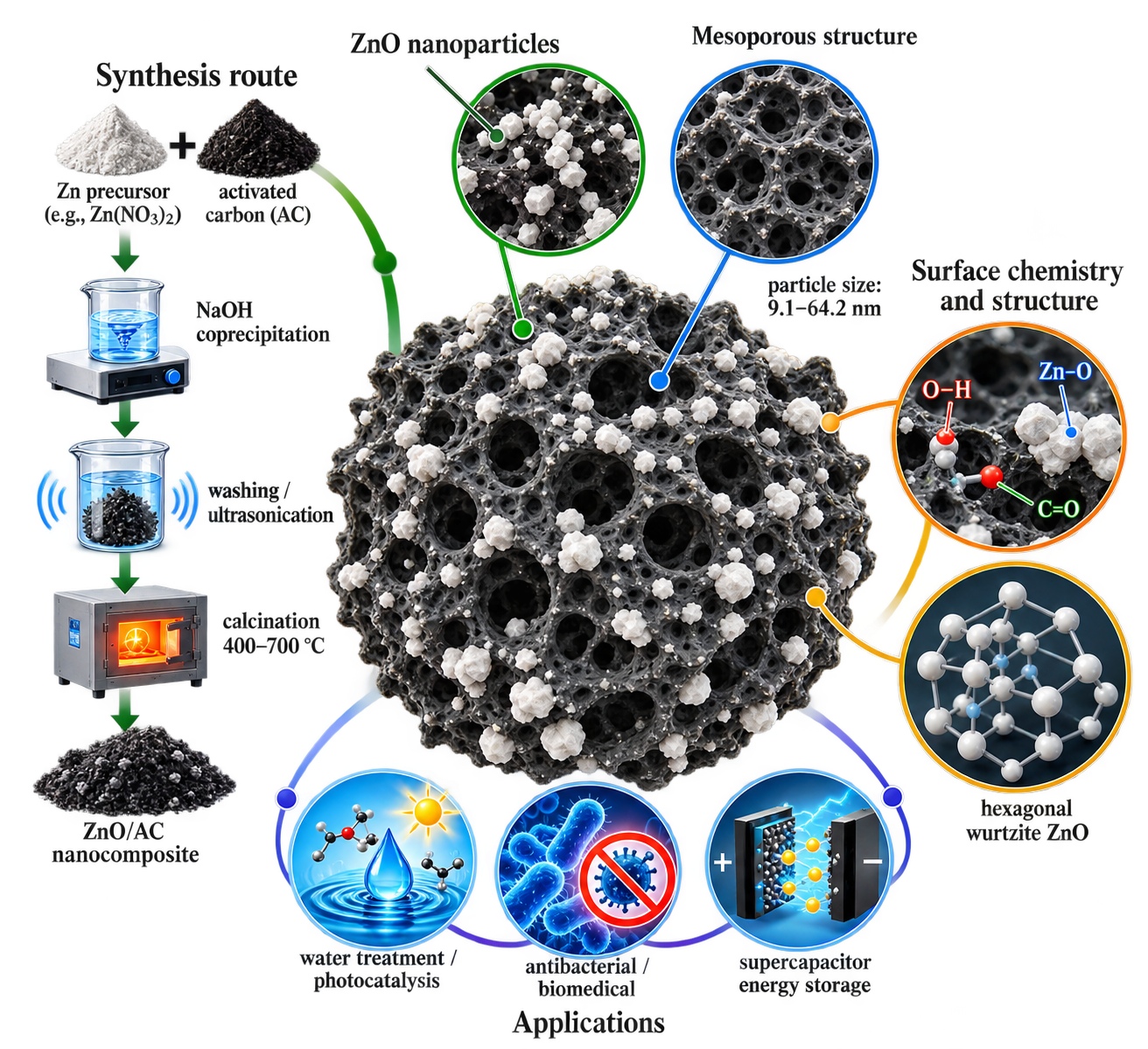
ZnO/activated carbon (ZnO/AC) nanocomposites are promising functional materials due to the combination of ZnO semiconducting properties and the high surface area and porosity of activated carbon. This study aims to systematically examine the effects of coprecipitation synthesis on the characteristics of ZnO/AC nanocomposites and their implications for various applications. A systematic review was conducted on research articles published between 2016 and 2026, following predefined inclusion and exclusion criteria. Six studies met the eligibility criteria and were included in the final qualitative synthesis, comprising three studies on supercapacitor electrodes, two on water treatment and photocatalytic applications, and one on biomedical applications. The findings indicate that synthesis parameters, including precursor type, ZnO ratio, precipitating agent, pH, calcination temperature, activation method, and post-synthesis treatment, influence morphology, particle size, porosity, functional groups, crystal structure, and optical properties. The reviewed materials predominantly exhibit hexagonal wurtzite ZnO structures, nanoscale dimensions, and porous morphologies, with characteristic functional groups including O–H, C=O, and Zn–O. Recent studies demonstrate increasing interest in multicomponent composites to enhance material functionality. ZnO/AC nanocomposites show promising potential for biomedical, environmental, and energy storage applications. However, the limited number of eligible studies and variations in reported synthesis parameters highlight the need for further systematic experimental validation.
References
Kausar, A., Ahmad, I., Zhao, T., Aldaghri, O., Ibnaouf, K. H., & Eisa, M. H. (2023). Graphene Nanocomposites as Innovative Materials for Energy Storage and Conversion—Design and Headways. International Journal of Molecular Sciences, 24(14), 11593. https://doi.org/10.3390/ijms241411593
Hanafi, M. F., & Sapawe, N. (2020). A review on the current techniques and technologies of organic pollutants removal from water/wastewater. Materials Today: Proceedings, 4th International Conference on Green Chemical Engineering and Technology: Materials Science, 31, A158–A165. https://doi.org/10.1016/j.matpr.2021.01.265
Periyasamy, A. P. (2024). Recent Advances in the Remediation of Textile-Dye-Containing Wastewater: Prioritizing Human Health and Sustainable Wastewater Treatment. Sustainability, 16(2), 495. https://doi.org/10.3390/su16020495
Ong, W. -J., Zheng, N., & Antonietti, M. (2021). Advanced nanomaterials for energy conversion and storage: Current status and future opportunities. Nanoscale, 13(22), 9904–9907. https://doi.org/10.1039/D1NR90103F
Seok, D., Jeong, Y., Han, K., Yoon, D. Y., & Sohn, H. (2019). Recent Progress of Electrochemical Energy Devices: Metal Oxide–Carbon Nanocomposites as Materials for Next-Generation Chemical Storage for Renewable Energy. Sustainability, 11(13), 3694. https://doi.org/10.3390/su11133694
Termoul, M., Attouti, S., Benallou, M. B., Zerhouni, A., Uğur, T., Tuna, M., Benderdouche, N., & Bestani, B. (2024). Synthesis and characterization of ZnO/activated carbon nanocomposite for the removal of cationic dye from aqueous solutions. Studies In Engineering And Exact Sciences, 5(1), 3462–3483. https://doi.org/10.54021/seesv5n1-172
Raha, S., & Ahmaruzzaman, M. (2022). ZnO nanostructured materials and their potential applications: Progress, challenges and perspectives. Nanoscale Advances, 4(8), 1868–1925. https://doi.org/10.1039/D1NA00880C
Güell, F., Galdámez-Martínez, A., R. Martínez-Alanis, P., C. Catto, A., Silva, L. F. da, R. Mastelaro, V., Santana, G., & Dutt, A. (2023). ZnO-based nanomaterials approach for photocatalytic and sensing applications: Recent progress and trends. Materials Advances, 4(17), 3685–3707. https://doi.org/10.1039/D3MA00227F
Alwash, A. (2025). Green fabrication of p-n CuO/ZnO heterojunctions for efficient photocatalytic degradation of dyes. South African Journal of Chemical Engineering, 54, 441–450. https://doi.org/10.1016/j.sajce.2025.09.007
Mahajan, M., Kumar, S., Gaur, J., Kaushal, S., Somvanshi, A., Kaur, H., Singh, G., Hatshan, M. R., Kumar, S., & Lotey, G. S. (2025). Role of cellulose, phenolic compounds, and water-soluble proteins in ZnO nanoparticle synthesis using Mangifera indica leaf extract for photocatalytic and antioxidant investigations. Colloids and Surfaces A: Physicochemical and Engineering Aspects, 720, 137066. https://doi.org/10.1016/j.colsurfa.2025.137066
Zhu, X., Wang, J., Yang, D., Liu, J., He, L., Tang, M., Feng, W., & Wu, X. (2021). Fabrication, characterization and high photocatalytic activity of Ag–ZnO heterojunctions under UV-visible light. RSC Advances, 11(44), 27257–27266. https://doi.org/10.1039/D1RA05060E
Ahmed, A. S., Alsultan, M., Sabah, A. A., & Swiegers, G. F. (2023). Carbon Dioxide Adsorption by a High-Surface-Area Activated Charcoal. Journal of Composites Science, 7(5), 179. https://doi.org/10.3390/jcs7050179
Hu, M., Wu, W., Lin, D., & Yang, K. (2022). Adsorption of fulvic acid on mesopore-rich activated carbon with high surface area. Science of The Total Environment, 838, 155918. https://doi.org/10.1016/j.scitotenv.2022.155918
Adeoye, J. B., Lau, S. Y., Tan, Y. H., Tan, Y. Y., Chiong, T., Mubarak, N. M., Khalid, M., & Ng, J. T. W. (2025). Efficient dye removal from aqueous solution using a hybrid GA@ZnO-AC nanocomposite. Scientific Reports, 15(1), 31754. https://doi.org/10.1038/s41598-025-17464-6
Ayadi, A., Jellouli Ennigrou, D., Proietto, F., Hamzaoui, A. H., & Jaouadi, M. (2023). Electrochemical Degradation of Phenol in Aqueous Solutions Using Activated Carbon-ZnO Composite. Environmental Engineering Science, 40(9), 349–361. https://doi.org/10.1089/ees.2023.0016
Luo, S., Liu, C., Zhou, S., Li, W., Ma, C., Liu, S., Yin, W., Heeres, H. J., Zheng, W., Seshan, K., & He, S. (2020). ZnO nanorod arrays assembled on activated carbon fibers for photocatalytic degradation: Characteristics and synergistic effects. Chemosphere, 261, 127731. https://doi.org/10.1016/j.chemosphere.2020.127731
Rajendran, R., Rojviroon, O., Arumugam, P., Ramasamy, G., Paramasivam, S., & Rojviroon, T. (2025). Synergistic effects of activated Carbon-Supported TiO2/ZnO nanocomposites for photocatalytic dye degradation and antibacterial activity. Journal of Molecular Liquids, 433, 127792. https://doi.org/10.1016/j.molliq.2025.127792
Li, N., Jiao, F., Pan, X., Ding, Y., Feng, J., & Bao, X. (2019). Size Effects of ZnO Nanoparticles in Bifunctional Catalysts for Selective Syngas Conversion. ACS Catalysis, 9(2), 960–966. https://doi.org/10.1021/acscatal.8b04105
Vijayalakhmi, K. A., & Deepa, R. (2025). Electrochemical Performance of Supercapacitors Based on ZnO/NiO@ Coconut Shell Activated Carbon Composite. Journal of The Electrochemical Society, 172(7), 073504. https://doi.org/10.1149/1945-7111/adeb35
Islam, M. U., Iqbal, M., & Kossar, S. (2025). Synthesis and characterization of ZnO-graphite binary nanocomposite for supercapacitor and photocatalyst application. The European Physical Journal Plus, 140(12), 1241. https://doi.org/10.1140/epjp/s13360-025-07082-6
Aslam, M., Raman, A. P. S., Sharma, U., Nand, B., Ebenso, E. E., Pandey, G., Singh, P., & Kumari, K. (2026). Carbon nanocomposites in electrochemical sensing of pesticides: Trends, materials, and applications. Chemistry & Biodiversity, 23(2), e02490. https://doi.org/10.1002/cbdv.202502490
Soualmi, S., Henni, M., Djahnit, L., & Hamdani, H. (2024). Sol-gel Synthesized ZnO–SrMn2O4 Nanocomposite and Its Antibacterial Properties. Eurasian Journal of Chemistry, 29(4 (116)), 71–81. https://doi.org/10.31489/2959-0663/4-24-12
Ramadhani, F. A. F., Taufiq, A., Mufti, N., Kurniawan, R., Hidayat, A., & Subadra, S. U. I. (2025). Synthesis and characterization of cobalt ferrite/zinc oxide nanocomposite combined with activated carbon for Cu removal application. AIP Conference Proceedings, 3197(1). https://doi.org/10.1063/5.0241030
Rahmadani, F. N. A., Fadlilah, I., & Rahayu, T. E. P. S. (2024). Sintesis Material Fotokatalis Seng Oksida –Silika Abu Tongkol Jagung (ZnO-SiO2) dengan Metode Kopresipitasi dan Karakterisasinya. JC-T (Journal Cis-Trans) : Jurnal Kimia Dan Terapannya, 8(1), 34–43. https://doi.org/10.17977/um0260v8i12024p033
Haraki, R. E., Arie, A. A., Susanti, R. F., Oktaviano, H. S., & Nugroho, A. (2023). Synthesis and Electrochemical Properties of ZnO/ Activated Carbon from Vetiver Distillation Waste. Engineering Chemistry, 2, 35–41. https://doi.org/10.4028/p-1z7h01
Ardiansyah, F. F., Ma’arif, M. S., Riska, A. M., Fadlilah, F., Alfan, M. W. N., & Rohmawati, L. (2025). Fabrication of ZnO/MgO nanocomposites from natural materials by coprecipitation method. AIP Conference Proceedings, 3166(1). https://doi.org/10.1063/5.0240562
Hareeshanaik, S., Prabhakara, M. C., Bhojya Naik, H. S., Vishnu, G., Viswanath, R., & Adarshgowda, N. (2024). Multifunctional Applications of Gd-Doped ZnO Nanoparticles Prepared Easily by the Coprecipitation Method. ChemistrySelect, 9(43), e202403303. https://doi.org/10.1002/slct.202403303
Tao, H., & Song, S. (2023). Study on the effect of high temperature heat treatment of H2 on the pore structure of activated carbon. Journal of Physics: Conference Series, 2539(1), 012003. https://doi.org/10.1088/1742-6596/2539/1/012003
Ejsmont, A., & Goscianska, J. (2023). Hydrothermal Synthesis of ZnO Superstructures with Controlled Morphology via Temperature and pH Optimization. Materials, 16(4), 1641. https://doi.org/10.3390/ma16041641
Peymanfar, R., Yektaei, M., Javanshir, S., & Selseleh-Zakerin, E. (2020). Regulating the energy band-gap, UV–Vis light absorption, electrical conductivity, microwave absorption, and electromagnetic shielding effectiveness by modulating doping agent. Polymer, 209, 122981. https://doi.org/10.1016/j.polymer.2020.122981
Zhang, K., Sun, J., E, L., Ma, C., Luo, S., Wu, Z., Li, W., & Liu, S. (2022). Effects of the Pore Structure of Commercial Activated Carbon on the Electrochemical Performance of Supercapacitors. Journal of Energy Storage, 45, 103457. https://doi.org/10.1016/j.est.2021.103457
Page, M. J., Moher, D., Bossuyt, P. M., Boutron, I., Hoffmann, T. C., Mulrow, C. D., Shamseer, L., Tetzlaff, J. M., Akl, E. A., Brennan, S. E., Chou, R., Glanville, J., Grimshaw, J. M., Hróbjartsson, A., Lalu, M. M., Li, T., Loder, E. W., Mayo-Wilson, E., McDonald, S., … McKenzie, J. E. (2021). PRISMA 2020 explanation and elaboration: Updated guidance and exemplars for reporting systematic reviews. BMJ, 372, n160. https://doi.org/10.1136/bmj.n160
Higgins, J. P. T., & Thompson, S. G. (2002). Quantifying heterogeneity in a meta-analysis. Statistics in Medicine, 21(11), 1539–1558. https://doi.org/10.1002/sim.1186
Cinnathambi Subramani, M., Kandasamy, B., Budiman, I., Subyakto, S., Chitraningrum, N., Widyaningrum, B. A., Saputra, N. A., Fauzi, A. A. B., Holilah, H., Hata, T., & Nafiqoh, N. (2025). Synthesis and characterization of bamboo stem porous activated carbon/chitosan/zinc oxide (BSPAC/CS/ZnO) ternary nanocomposite for enhancement of biological activities. International Journal of Biological Macromolecules, 305, 141041. https://doi.org/10.1016/j.ijbiomac.2025.141041
Rizvi, H. I., Mushtaq, A., Iqbal, T., Afsheen, S., Ashfaq, Z., Al-Zaqri, N., & Warad, I. (2025). Photocatalytic detoxification of lemon yellow food additive by Novel AC@ZnO/CuO/WO3 quaternary composites via Citrus sinensis and solid-state-reaction method. Journal of Alloys and Compounds, 1022, 179915. https://doi.org/10.1016/j.jallcom.2025.179915
Taha, A., Ben Aissa, M., & Da’na, E. (2020). Green Synthesis of an Activated Carbon-Supported Ag and ZnO Nanocomposite for Photocatalytic Degradation and Its Antibacterial Activities. Molecules, 25(7), 1586. https://doi.org/10.3390/molecules25071586
Yadav, M. S., Sinha, A. K., & Singh, M. N. (2018). Electrochemical behaviour of ZnO–AC based nanocomposite electrode for supercapacitor. Materials Research Express, 5(8), 085503. https://doi.org/10.1088/2053-1591/aad2c4
Yadav, M. S., Singh, N., & Kumar, A. (2018). Synthesis and characterization of zinc oxide nanoparticles and activated charcoal based nanocomposite for supercapacitor electrode application. Journal of Materials Science: Materials in Electronics, 29(8), 6853–6869. https://doi.org/10.1007/s10854-018-8672-5
Yadav, M. S., Singh, N., & Bobade, S. M. (2018). Zinc oxide nanoparticles and activated charcoal-based nanocomposite electrode for supercapacitor application. Ionics, 24(11), 3611–3630. https://doi.org/10.1007/s11581-018-2527-1
Zhu, C., & Wang, X. (2025). Nanomaterial ZnO synthesis and its photocatalytic applications: A review. Nanomaterials, 15(9), 682. https://doi.org/10.3390/nano15090682
Feng, P., Cui, K., Hai, Z., Wang, J., & Wang, L. (2023). Facile synthesis of activated carbon loaded g-C3N4 composite with enhanced photocatalytic performance under visible light. Diamond and Related Materials, 136, 109921. https://doi.org/10.1016/j.diamond.2023.109921
Yue, Y., Yue, X., Tang, X., Han, L., Wang, J., Wang, S., & Du, C. (2024). Synergistic adsorption and photocatalysis study of TiO2 and activated carbon composite. Heliyon, 10(10), e30817. https://doi.org/10.1016/j.heliyon.2024.e30817
Ahmadi, S., Quimbayo, J. M., Yaah, V. B. K., De Oliveira, S. B., & Ojala, S. (2025). A critical review on combining adsorption and photocatalysis in composite materials for pharmaceutical removal: Pros and cons, scalability, TRL, and sustainability. Energy Nexus, 17, 100396. https://doi.org/10.1016/j.nexus.2025.100396
Ngidi, N. P. D., Koekemoer, A. F., & Ndlela, S. S. (2024). Recent advancement in the electrochemical performance of electrochemical capacitors based on biomass-derived porous carbon: A review. Journal of Energy Storage, 89, 111638. https://doi.org/10.1016/j.est.2024.111638
Tundwal, A., Kumar, H., J. Binoj, B., Sharma, R., Kumar, G., Kumari, R., Dhayal, A., Yadav, A., Singh, D., & Kumar, P. (2024). Developments in conducting polymer-, metal oxide-, and carbon nanotube-based composite electrode materials for supercapacitors: A review. RSC Advances, 14(14), 9406–9439. https://doi.org/10.1039/D3RA08312H
Mawazi, S. M., Kumar, M., Ahmad, N., Ge, Y., & Mahmood, S. (2024). Recent Applications of Chitosan and Its Derivatives in Antibacterial, Anticancer, Wound Healing, and Tissue Engineering Fields. Polymers, 16(10), 1351. https://doi.org/10.3390/polym16101351
Rashki, S., Dawi, E. A., Zilaei, M. R., Safardoust-Hojaghan, H., Ghanbari, M., Ryadh, A., Lafta, H. A., Khaledi, A., & Salavati-Niasari, M. (2023). ZnO/chitosan nanocomposites as a new approach for delivery LL37 and evaluation of the inhibitory effects against biofilm-producing Methicillin-resistant Staphylococcus aureus isolated from clinical samples. International Journal of Biological Macromolecules, 253, 127583. https://doi.org/10.1016/j.ijbiomac.2023.127583
Downloads
Published
How to Cite
Issue
Section
License
Copyright (c) 2026 Kormil Saputra, Muhammad R. Ramdani, Dian W. Kurniawidi

This work is licensed under a Creative Commons Attribution-NonCommercial-NoDerivatives 4.0 International License.

This work is licensed under a Creative Commons Attribution-NonCommercial-NoDerivatives 4.0 International License.
Authors retain copyright and grant the journal right of first publication with the work simultaneously licensed under a Creative Commons Attribution License (CC BY-NC-ND 4.0) that allows others to share the work with an acknowledgement of the work's authorship and initial publication in this journal.
