

Influence of External Factors on the Behavior of Polymer Materials Based on Polyethylene Glycol Maleate
DOI:
https://doi.org/10.31489/2959-0663/1-26-6Keywords:
unsaturated polyester, terpolymer, hydrogel, “cold” curing, external factors, water absorption, swelling degree, polyethylene glycol maleate , acrylic acidAbstract
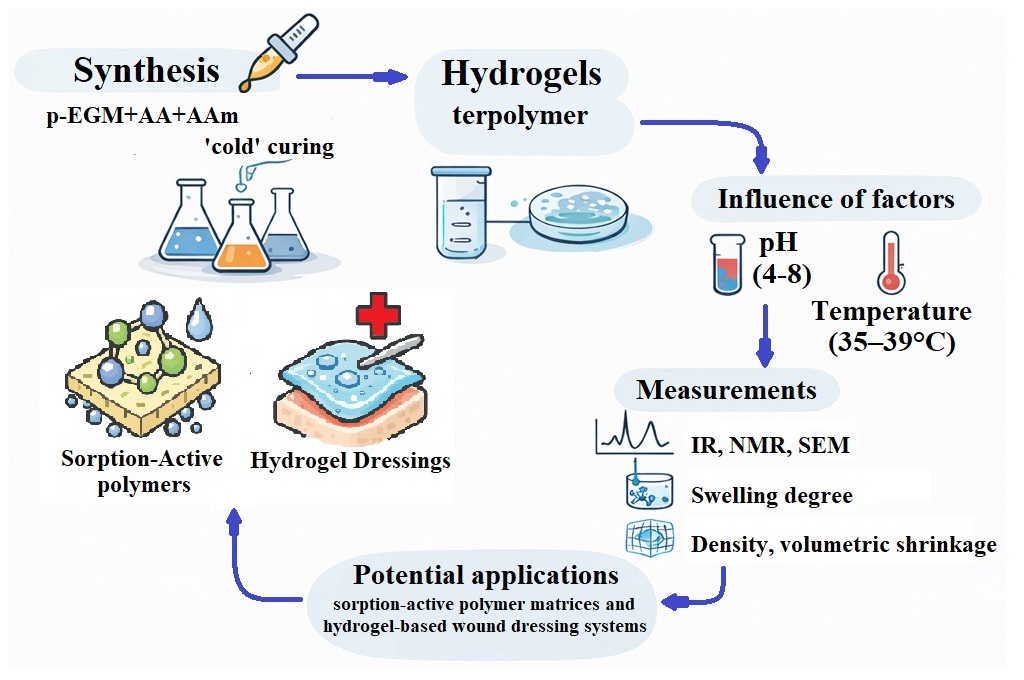
This study aims to evaluate the effect of external physicochemical factors on the behaviour of hydrogels based on polyethylene glycol maleate (p-EGM) and to assess their potential applicability in sorption-active polymer matrices and biomedical hydrogel systems. This paper presents the results of an investigation into the physicochemical properties of polyethylene glycol maleate and acrylamide solutions in acrylic acid and their cured products. The degree of unsaturation of the initial unsaturated polyester was determined using the bromide–bromate method. The dynamic viscosity of the initial polymer–monomer mixtures was found to be in the range of 0.251–0.697 Pa·s, while the density of the solutions varied from 1.0554 to 1.0996 g/cm3. The density of the cured terpolymers was calculated by the hydrostatic method, and the calculated total volumetric shrinkage did not exceed 15 %. The composition of the obtained terpolymers was confirmed by HPLC analysis. The synthesized hydrogels exhibited a high swelling degree (up to 2898 %) and pronounced sensitivity to environmental pH (4–8) and temperature (35–39 °C), as established by gravimetric measurements. Structural identification was performed using IR and NMR spectroscopy, and the surface morphology was analyzed by SEM. It was demonstrated that an increased acrylic acid content leads to the formation of a more porous polymer network with enhanced water absorption, controllable permeability and structural stability, indicating potential biomedical applicability of the developed materials. Overall, the obtained results suggest that the synthesized hydrogels may be considered promising candidates for potential use in sorption-active polymer matrices and hydrogel-based wound dressing systems.
References
Yu, P., Wei, L., Yang, Z., Liu, X., Ma, H., Zhao, J., Liu, L., Wang, L., Chen, R. & Cheng, Y. (2024). Hydrogel wound dressings accelerating healing process of wounds in movable parts. International Journal of Molecular Sciences, 25(12), 6610. https://doi.org/10.3390/ijms25126610 DOI: https://doi.org/10.3390/ijms25126610
Demeter, M., Scărișoreanu, A. & Călina, I. (2023). State of the art of hydrogel wound dressings developed by ionizing radiation. Gels, 9(1), 55. https://doi.org/10.3390/gels9010055 DOI: https://doi.org/10.3390/gels9010055
Sulastri, E., Zubair, M.S., Lesmana, R., Mohammed, A.F.A. & Wathoni, N. (2021). Development and characterization of ulvan polysaccharides-based hydrogel films for potential wound dressing applications. Drug Design, Development and Therapy, Volume 15, 4213–4226. https://doi.org/10.2147/DDDT.S331120 DOI: https://doi.org/10.2147/DDDT.S331120
Ahmed, E.M. (2015). Hydrogel: Preparation, characterization, and applications: A review. Journal of Advanced Research, 6(2), 105–121. https://doi.org/10.1016/j.jare.2013.07.006 DOI: https://doi.org/10.1016/j.jare.2013.07.006
Boateng, J.S., Matthews, K.H., Stevens, H.N.E. & Eccleston, G.M. (2008). Wound healing dressings and drug delivery systems: A review. Journal of Pharmaceutical Sciences, 97(8), 2892–2923. https://doi.org/10.1002/jps.21210 DOI: https://doi.org/10.1002/jps.21210
Liang, Y., He, J. & Guo, B. (2021). Functional hydrogels as wound dressing to enhance wound healing. ACS Nano, 15(8), 12687–12722. https://doi.org/10.1021/acsnano.1c04206 DOI: https://doi.org/10.1021/acsnano.1c04206
Caló, E. & Khutoryanskiy, V.V. (2015). Biomedical applications of hydrogels: A review of patents and commercial products. European Polymer Journal, 65, 252–267. https://doi.org/10.1016/j.eurpolymj.2014.11.024 DOI: https://doi.org/10.1016/j.eurpolymj.2014.11.024
Koetting, M.C., Peters, J.T., Steichen, S.D. & Peppas, N.A. (2015). Stimulus-responsive hydrogels: Theory, modern advances, and applications. Materials Science and Engineering: R: Reports, 93, 1–49. https://doi.org/10.1016/j.mser.2015.04.001 DOI: https://doi.org/10.1016/j.mser.2015.04.001
Li, J. & Mooney, D.J. (2016). Designing hydrogels for controlled drug delivery. Nature Reviews Materials, 1, 16071. https://doi.org/10.1038/natrevmats.2016.71 DOI: https://doi.org/10.1038/natrevmats.2016.71
Pan, Z., Ye, H. & Wu, D. (2021). Recent advances on polymeric hydrogels as wound dressings. APL Bioengineering, 5(1), 011504. https://doi.org/10.1063/5.0038364 DOI: https://doi.org/10.1063/5.0038364
Tavakoli, S. & Klar, A.S. (2020). Advanced hydrogels as wound dressings. Biomolecules, 10(8), 1169. https://doi.org/10.3390/biom10081169 DOI: https://doi.org/10.3390/biom10081169
Alberts, A., Bratu, A. G., Niculescu, A.-G., & Grumezescu, A. M. (2025). New Perspectives of Hydrogels in Chronic Wound Management. Molecules, 30(3), 686. https://doi.org/10.3390/molecules30030686 DOI: https://doi.org/10.3390/molecules30030686
Liang, Y., Chen, B., Li, M., He, J., Yin, Z., & Guo, B. (2020). Injectable Antimicrobial Conductive Hydrogels for Wound Disinfection and Infectious Wound Healing. Biomacromolecules, 21(5), 1841–1852. https://doi.org/10.1021/acs.biomac.9b01732 DOI: https://doi.org/10.1021/acs.biomac.9b01732
Xu, Z., Shou, D., Cai, W., Li, J., Wu, D., Jiang, T., & Kong, Y. (2025). Dynamically self-degradable, injectable and self-healing 6-deoxy-6-arginine grafted chitosan hydrogels for wounds healing. European Polymer Journal, 233, 113986. https://doi.org/10.1016/j.eurpolymj.2025.113986 DOI: https://doi.org/10.1016/j.eurpolymj.2025.113986
Kapusta, O., Jarosz, A., Stadnik, K., Giannakoudakis, D.A., Barczyński, B. & Barczak, M. (2023). Antimicrobial Natural Hydrogels in Biomedicine: Properties, Applications, and Challenges—A Concise Review. International Journal of Molecular Sciences, 24(3), Art. 2191. https://doi.org/10.3390/ijms24032191 DOI: https://doi.org/10.3390/ijms24032191
Jaiswal, R., & Sherje, A. P. (2024). Recent advances in biopolymer-based smart hydrogel for wound healing. Journal of Drug Delivery Science and Technology, 99, 105990. https://doi.org/10.1016/j.jddst.2024.105990 DOI: https://doi.org/10.1016/j.jddst.2024.105990
Burkeyev, M.Z., Kovaleva, A.K., Burkeyeva, G.K., Tazhbayev, Y.M. & Plocek, J. (2020). Polypropylene Glycol Maleate Phthalate Terpolymerization with Acrylamide and Acrylic Acid. Polymer Korea, 2(44), 123–131. https://doi.org/10.7317/pk.2020.44.2.123 DOI: https://doi.org/10.7317/pk.2020.44.2.123
Burkeyev, M., Kudaibergen, G., Tazhbayev, Y., Burkeyeva, G., Omasheva, A., Yesentayeva, N., Bolatbay, A. (2018). The number average and mass average molar masses of polyethylene (propylene) glycol fumarates. Bulletin of the Karaganda University. “Chemistry” Series, 90(2), 17–22. https://doi.org/10.31489/2018ch2/17-22 DOI: https://doi.org/10.31489/2018Ch2/17-22
Burkeev, M., Zhunissova, M., Tazhbayev, Y., Fomin, V., Sarsenbekova, A., Burkeyeva, G., Kazhmuratova, A., Zhumagalieva, T., Zhakupbekova, E., Khamitova, T. (2022). Influence of RAFT Agent on the Mechanism of Copolymerization of Polypropylene Glycol Maleinate with Acrylic Acid. Polymers, 14(9), 1884. https://doi.org/10.3390/polym14091884 DOI: https://doi.org/10.3390/polym14091884
Akhmetkarimova, Z.S., Kudaibergen, G.K., Kaukabaeva, G.K., Abeldenov, S.K. & Rysbek, A.B. (2023). Thiol-Ene Click Synthesis of Alginate Hydrogels Loaded with Silver Nanoparticles and Cefepime. Eurasian Journal of Chemistry, 28(2(110)), 14–23. https://doi.org/10.31489/2959-0663/2-23-14 DOI: https://doi.org/10.31489/2959-0663/2-23-14
Burkeyeva, G.K., Kovaleva, A.K., Muslimova, D.M., Havlicek, D., Zhumabek, N.M. & Nukin, N.A. (2025). Investigation of Physical and Chemical Properties of Thermosetting Copolymers of Polyethylene Glycol Maleate with Acrylic Acid During their “Cold” Curing. Eurasian Journal of Chemistry, 30, 2(118), 52-61. https://doi.org/10.31489/2959-0663/2-25-9 DOI: https://doi.org/10.31489/2959-0663/2-25-9
Singh, B. & Singh, J. (2021). Application of tragacanth gum and alginate in hydrogel wound dressings formed by radiation-induced copolymerization. Carbohydrate Polymer Technologies and Applications, 2, 100058. https://doi.org/10.1016/j.carpta.2021.100058 DOI: https://doi.org/10.1016/j.carpta.2021.100058
Downloads
Published
How to Cite
Issue
Section
License
Copyright (c) 2026 Gulsym K. Burkeyeva, Anna K. Kovaleva , Nurken M. Zhumabek, Nurlan A. Nukin

This work is licensed under a Creative Commons Attribution-NonCommercial-NoDerivatives 4.0 International License.

This work is licensed under a Creative Commons Attribution-NonCommercial-NoDerivatives 4.0 International License.
Authors retain copyright and grant the journal right of first publication with the work simultaneously licensed under a Creative Commons Attribution License (CC BY-NC-ND 4.0) that allows others to share the work with an acknowledgement of the work's authorship and initial publication in this journal.
